
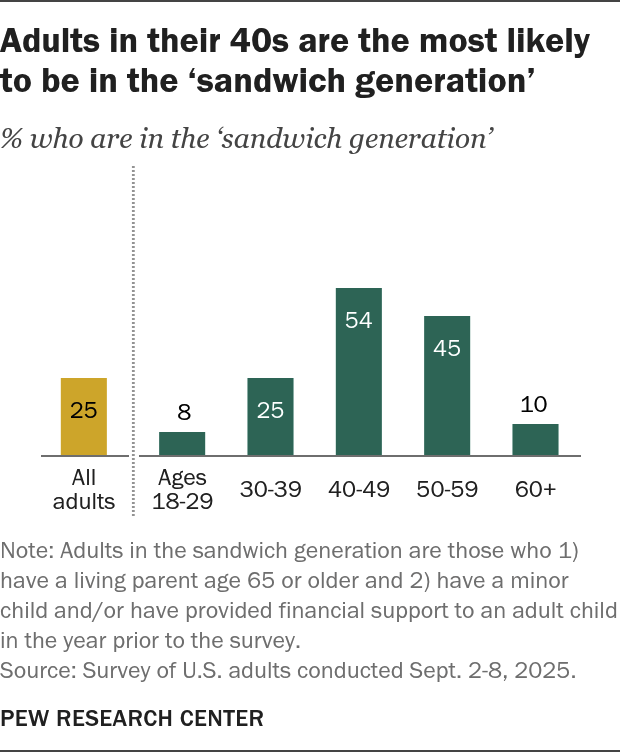
A quarter of U.S. adults are now part of the so-called “sandwich generation,” according to a Pew Research Center survey from September 2025. These adults have a parent age 65 or older and have a child under 18, an adult child receiving financial support or both.
| Category | Percent | Group |
|---|---|---|
| All adults | 25 | All |
| Ages 18-29 | 8 | Ages |
| 30-39 | 25 | Ages |
| 40-49 | 54 | Ages |
| 50-59 | 45 | Ages |
| 60+ | 10 | Ages |
Americans in their 40s are the most likely to be sandwiched between their children and an aging parent. More than half in this age group (54%) are in this situation. This compares with:
- 45% of those in their 50s
- 25% of those in their 30s
- 10% of those 60 and older
- 8% of adults younger than 30
Overall, the share of U.S. adults in the sandwich generation has grown only modestly in recent years, even as people are living longer and many young adults are struggling to gain financial independence. When we last measured this in 2021, 23% were in the sandwich generation.
Still, a larger share of people in their 50s are sandwiched now than in 2021 (45% vs. 36%). This is partly because more adults in their 50s now have a living parent 65 or older.
Some groups of Americans are more likely than others to be in the sandwich generation, such as:
- 31% of Asian adults and 30% of Hispanic adults vs. 23% of White adults and 21% of Black adults
- 30% of those with at least a bachelor’s degree vs. 22% with some college or less education
- 32% of those with upper incomes vs. 26% of those with middle incomes and 20% of those with lower incomes
The family situations for sandwiched adults
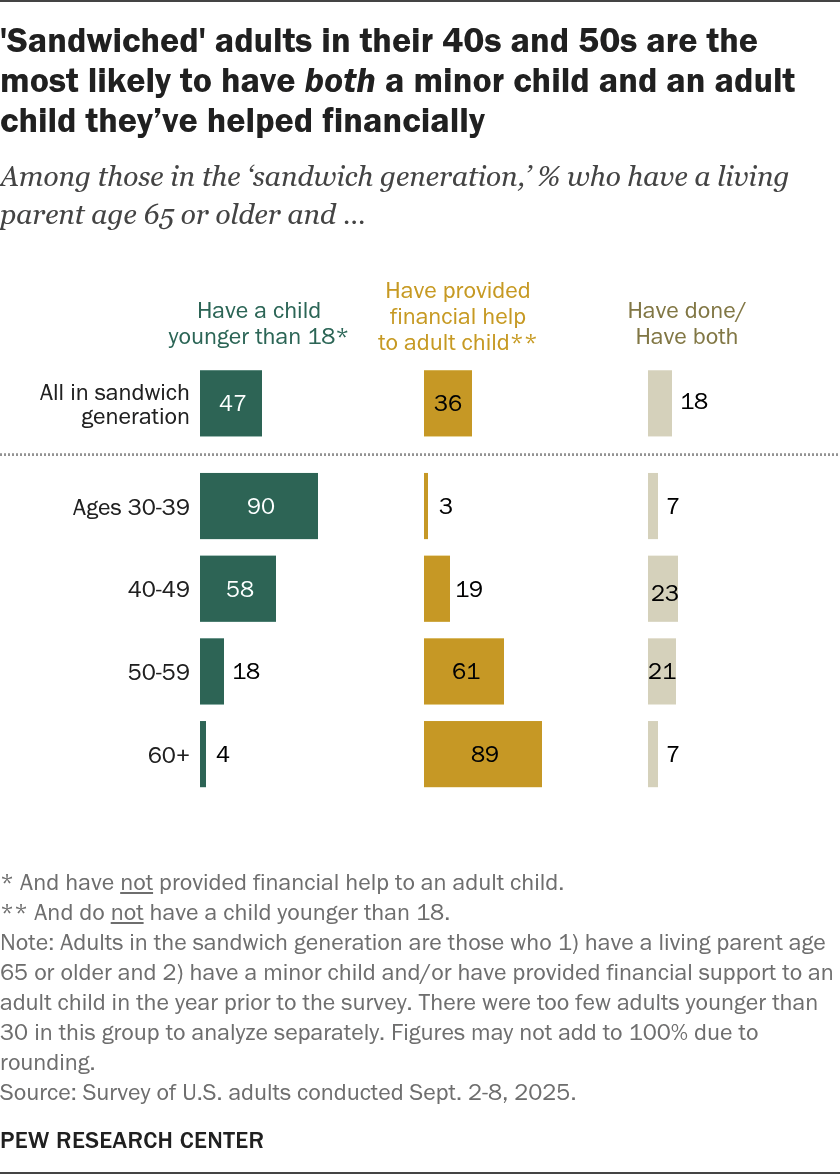
A majority of sandwiched adults in their 30s and 40s have an aging parent and at least one child younger than 18, but no adult children they’ve supported financially. This is the case for 90% of sandwiched adults in their 30s and 58% of those in their 40s.
** And do not have a child younger than 18.
Note: Adults in the sandwich generation are those who 1) have a living parent age 65 or older and 2) have a minor child and/or have provided financial support to an adult child in the year prior to the survey. There were too few adults younger than 30 in this group to analyze separately. Figures may not add to 100% due to rounding.
| Have a child younger than 18* | Have provided financial help to adult child** | Have done/Have done both | Grouping | |
|---|---|---|---|---|
| All in sandwich generation | 47 | 36 | 18 | All |
| Ages 30-39 | 90 | 3 | 7 | Age |
| 40-49 | 58 | 19 | 23 | Age |
| 50-59 | 18 | 61 | 21 | Age |
| 60+ | 4 | 89 | 7 | Age |
** And do not have a child younger than 18.
Note: Adults in the sandwich generation are those who 1) have a living parent age 65 or older and 2) have a minor child and/or have provided financial support to an adult child in the year prior to the survey. There were too few adults younger than 30 in this group to analyze separately. Figures may not add to 100% due to rounding.
By the time they’re in their 50s, though, far smaller shares of sandwiched adults are raising children who are minors. Instead, majorities of those in their 50s (61%) and those 60 and older (89%) are sandwiched between an aging parent and an adult child they’ve helped financially.
Among those in their 40s and 50s, 23% and 21%, respectively, have both a child younger than 18 and an adult child they’ve helped financially, in addition to having an aging parent.
There aren’t enough sandwiched adults younger than 30 to analyze their family situations separately.
Sandwiched adults’ life satisfaction
The 2021 survey also asked adults about their satisfaction with various aspects of their lives.

| Sandwich generation | Other adults | |
|---|---|---|
| Their family life | 48 | 43 |
| The quality of life in their community | 25 | 24 |
| Their social life | 24 | 24 |
| Their personal financial situation | 17 | 17 |
Adults in the sandwich generation were more likely than those who were not sandwiched to say they were very satisfied with their family life (48% vs. 43%). This difference was largest for people in their 40s (49% vs. 38%).
Adults who are and are not sandwiched answered similarly when we asked about some other aspects of their life, including their social life and their personal financial situation.
Note: Here are the survey questions used for this analysis, the detailed responses and the survey methodology. This is an update of a post originally published April 8, 2022.