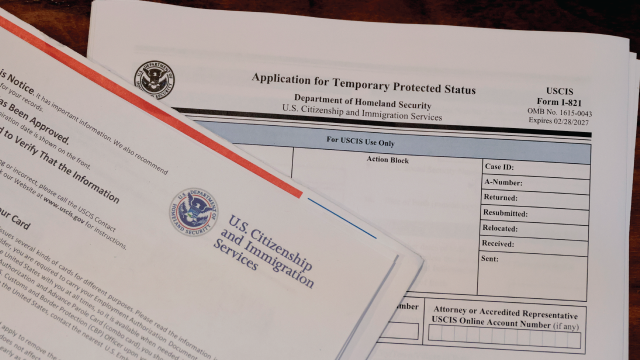
President Donald Trump’s administration has taken steps to end Temporary Protected Status for 13 countries, affecting an estimated 1 million out of 1.3 million recipients who had it as of March 2025.
Temporary Protected Status (TPS) is a federal humanitarian program created in the 1990 Immigration Act. It gives eligible immigrants permission to remain and work in the United States without threat of deportation for periods of six to 18 months. To be eligible, immigrants must already be in the U.S. and come from TPS-designated countries that are deemed unsafe to return to because of war, natural disasters or other crises.
TPS designations can be, and usually have been, extended. Since the program’s inception, nearly 30 countries have received TPS designations, some more than once. When Trump returned to office in January 2025, 17 countries had this designation. The administration has since ended or moved to end it for 13 of them, with Venezuelans, Haitians and Hondurans some of the largest groups impacted.
In June 2026, the U.S. Supreme Court allowed the administration to terminate TPS designations for Haiti and Syria. This decision has already cleared the way for other terminations and will likely continue to do so.
The Trump administration says it terminated TPS designations because the affected countries are now safe for immigrants to return to. It has been particularly critical of TPS-designated countries that had protection for years or decades, emphasizing that the program is meant to be temporary. Advocates have criticized the administration’s actions, saying dangerous conditions persist in many of these countries and arguing that the terminations are motivated by racial discrimination.
Here’s a closer look at how the TPS program has changed during the second Trump administration, based on data from the Department of Homeland Security.
From 2024: How Temporary Protected Status has expanded under the Biden administration
Where TPS terminations stand for various countries
The Trump administration has terminated TPS for 11 countries, with no legal challenges currently pending. Terminations for two others are currently suspended as lower courts respond to the Supreme Court’s recent ruling.
| Country | No. of TPS recipients | Required year of U.S. residence |
|---|---|---|
| Terminated | ||
| Afghanistan | 8,100 | 2023 |
| Cameroon | 5,000 | 2023 |
| Haiti | 334,900 | 2024 |
| Honduras | 51,000 | 1998 |
| Myanmar | 4,000 | 2024 |
| Nepal | 7,200 | 2015 |
| Nicaragua | 2,900 | 1998 |
| South Sudan | 230 | 2023 |
| Syria | 6,100 | 2024 |
| Venezuela | 268,200 | 2021 |
| 348,200 | 2023 | |
| Yemen | 2,800 | 2024 |
| Subtotal | 1,038,600 | |
| Terminated (temporarily halted due to ongoing litigation) | ||
| Ethiopia | 5,000 | 2024 |
| Somalia | 1,100 | 2024 |
| Subtotal | 6,100 | |
| Total | 1,044,700 |
11 countries’ TPS designations have been terminated
The Trump administration has ended TPS designations for Afghanistan, Cameroon, Haiti, Honduras, Myanmar, Nepal, Nicaragua, South Sudan, Syria, Venezuela and Yemen. This has affected more than 1 million recipients.
Venezuelans account for a majority of those who have lost protection (59%), numbering more than 615,000 immigrants. The country received two separate TPS designations – first in 2021 and then in 2023, based on different eligibility criteria. While some Venezuelan recipients (those who arrived before August 2023) still have TPS, their protection is scheduled to expire in October.
TPS recipients from Haiti make up about a third (32%) of those who have lost protection during Trump’s second term. The Supreme Court’s ruling allowed the administration to revoke Haiti’s and Syria’s designations; the terminations went into effect July 27. Since then, the administration has been under pressure to arrest affected Haitians, and Immigration and Customs Enforcement (ICE) has increased monitoring of some communities with large Haitian populations.
Some of the immigrants who have lost TPS lived in the U.S. for decades. For instance, TPS recipients from Honduras and Nicaragua had lived in the U.S. since 1998, following Hurricane Mitch and its aftermath, as well as political and social crises in those countries.
2 countries’ TPS terminations are pending
The Trump administration also has moved to terminate TPS for about 6,000 immigrants from two other countries: Ethiopia and Somalia. These terminations have been mired in legal disputes, leaving these immigrants’ futures uncertain. The Supreme Court didn’t rule on TPS for these countries, but the decision on Haiti and Syria still could affect them.
Meanwhile, the Trump administration is incentivizing TPS recipients who may lose their protections to “self-deport.” The administration is also limiting their ability to work legally in the U.S., by revoking employment authorization even as their protected status remains active. Some immigrants are seeking ways to stay in the country under other legal avenues, such as applying for asylum or permanent residency.
4 countries have extended TPS designations
| Country | No. of TPS recipients | Required year of U.S. residence |
|---|---|---|
| El Salvador* | 170,100 | 2001 |
| Lebanon | 140 | 2024 |
| Sudan* | 1,800 | 2023 |
| Ukraine* | 101,200 | 2023 |
| Total | 273,200 |
Note: Counts exclude recipients who are lawful permanent residents or U.S. citizens. Numbers may not sum to total due to rounding. Specific dates of U.S. residence required to qualify can be found in Federal Register notices. Designations reflect policy announcements as of Aug. 12, 2026.
While the Trump administration has moved to end TPS designation for most countries that had it, it remains in effect for about 273,000 immigrants from four countries. Almost all are from El Salvador and Ukraine, with much smaller numbers from Lebanon and Sudan.
Most of these extensions were enacted under the Biden administration. Lebanon’s designation, with only 140 TPS recipients, was extended under Trump.
These four TPS designations are set to expire before the end of 2026, some as early as September. It remains to be seen if the Trump administration will re-extend them.
What do Americans think of TPS terminations?
In a June 2025 survey, Pew Research Center asked U.S. adults whether they approve of the Trump administration ending TPS for at least 500,000 immigrants. A majority (59%) said they disapproved of the policy, while 39% approved.
Public opinion on ending TPS differed sharply by party. Democrats and Democratic-leaning independents were far more likely to disapprove than approve of ending TPS for many immigrants (86% vs. 13%), while Republicans and Republican leaners were far more likely to approve than disapprove (68% vs. 31%).