
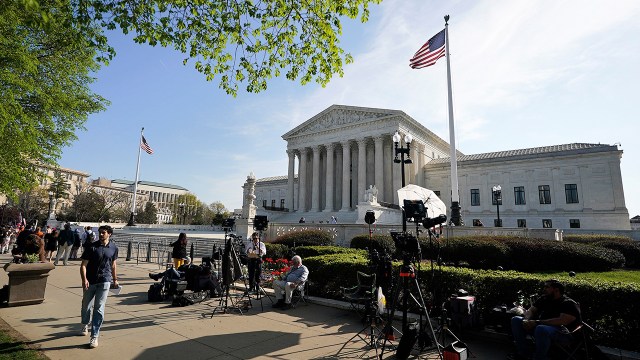
The U.S. Supreme Court is weighing whether to overrule two of its own long-standing legal precedents – one about presidential power over federal agencies, which has been in place for over 90 years, and another about campaign financing by political parties.

| Terms | All cases | Cases that overturned an older ruling | % of cases that overturned an older ruling |
|---|---|---|---|
| 2005-2024 | 1471 | 21 | 1.4% |
| 1985-2004 | 2209 | 44 | 2.0% |
| 1965-1984 | 3269 | 69 | 2.1% |
| 1945-1964 | 2531 | 30 | 1.2% |
| 1925-1944 | 3295 | 36 | 1.1% |
| 1905-1924 | 4370 | 10 | 0.2% |
| 1885-1904 | 4901 | 6 | 0.1% |
| 1865-1884 | 4084 | 13 | 0.3% |
| 1845-1864 | 1426 | 3 | 0.2% |
| 1825-1844 | 858 | 3 | 0.3% |
| 1805-1824 | 685 | 1 | 0.1% |
| 1791-1804 | 103 | 0 | 0.0% |
These cases follow the court’s high-profile decision in June 2022 to overturn Roe v. Wade, a ruling that had guaranteed the right to an abortion nationwide for nearly five decades.
Since the Supreme Court’s founding in 1789 through its most recent full term in 2024, fewer than 1% of all rulings (236 of 29,202) have overturned an earlier high court decision, according to a Pew Research Center analysis of data from the Library of Congress and the Supreme Court Database at Pennsylvania State University.
Overturning precedent hasn’t been very common in recent decades, either. Between the 2005 and 2024 terms, only 21 of 1,471 rulings (1.4%) overturned one or more earlier decisions.
For the Library of Congress to consider a case overturned, a majority of the Supreme Court must have explicitly said so or used language that is “functionally equivalent.” Also, these figures only account for cases the Supreme Court agreed to hear in the first place; the modern court takes up fewer than 100 cases out of thousands of petitions it receives each term.
How long did precedents stand before being overturned?

| Years | Cases | % |
|---|---|---|
| Fewer than 25 years | 167 | 57% |
| 25-49 | 78 | 27% |
| 50-74 | 19 | 7% |
| 75-99 | 18 | 6% |
| 100+ | 10 | 3% |
The first time the Supreme Court overturned its own ruling was in 1810, with Hudson and Smith v. Guestier. This case broadly concerned courts’ international jurisdiction and overruled a decision handed down two years earlier. On average, decisions that have been overturned by the court stood for around 29 years before being reversed.
Many rulings lasted much longer, including 10 that were in place for at least a century before being overturned. On the other end of the spectrum, 71 rulings were in place for a decade or less.
Across the most recent 20 terms, the average overturned decision had a shelf life of around 38 years.
What kinds of cases have been overturned most frequently?

| Issue area | All cases | Cases that overturned an older ruling |
|---|---|---|
| Economic activity | 28.9% | 27.1% |
| Criminal procedure | 11.0% | 26.7% |
| Civil rights | 9.9% | 13.6% |
| Federalism | 3.1% | 8.1% |
| Judicial power | 19.1% | 7.6% |
| First Amendment | 2.8% | 6.4% |
| Due process | 3.9% | 3.8% |
| Federal taxation | 5.1% | 2.5% |
| Unions | 1.8% | 2.5% |
| Attorneys | 1.1% | 0.0% |
| Interstate relations | 0.9% | 0.0% |
| Other | 12.2% | 1.7% |
The Supreme Court has overturned precedents in a variety of legal areas. For example, the decision that overturned Roe v. Wade in 2022 broadly concerned civil rights. That’s according to the Supreme Court Database, which categorizes cases by issue area.
Overall, 14% of Supreme Court rulings that overturned precedents concerned civil rights. That’s slightly higher than the share of all high court cases that concern civil rights (10%).
More than a quarter of all decisions that overturned earlier rulings are related to economic activity (27%), similar to the share of all cases related to the same topic (29%).
One prominent case in this category is Loper Bright Enterprises v. Raimondo, a June 2024 ruling that overturned a 40-year precedent. It ended the practice of “Chevron deference,” which gave federal agencies the power to interpret laws they administer.
Criminal procedure cases are disproportionately likely to have been overturned: 27% of all decisions that overturned earlier ones relate to criminal procedure, compared with only 11% of all Supreme Court decisions.
Ramos v. Louisiana, a 2020 criminal procedure case, overturned two separate precedents that had been on the books for almost five decades. The justices ruled that a jury must find a criminal defendant guilty by a unanimous verdict rather than a majority verdict, as was allowed in some states at the time.
Between the 2005 and 2024 terms, several cases that reversed others have been related to civil rights or criminal procedure (five each) or economic activity (four).
Related: Favorable views of Supreme Court remain near historic low
