Black Americans are among the most religious groups in the United States. But religion differs substantially among Black Americans. Similar to patterns seen among the U.S. population overall, older Black adults are more religious than younger Black adults, and women are more religious than men.
Here are key facts about Black Americans and religion, based on Pew Research Center’s 2023-24 Religious Landscape Study (RLS) and other Center surveys.
Most Black Americans are Christian, though the share who identify as such has fallen since 2007. About three-quarters of Black adults (73%) are Christian, including 65% who are Protestant, 4% who are Catholic, and 4% who identify with other Christian groups such as the Church of Jesus Christ of Latter-day Saints and Jehovah’s Witnesses.
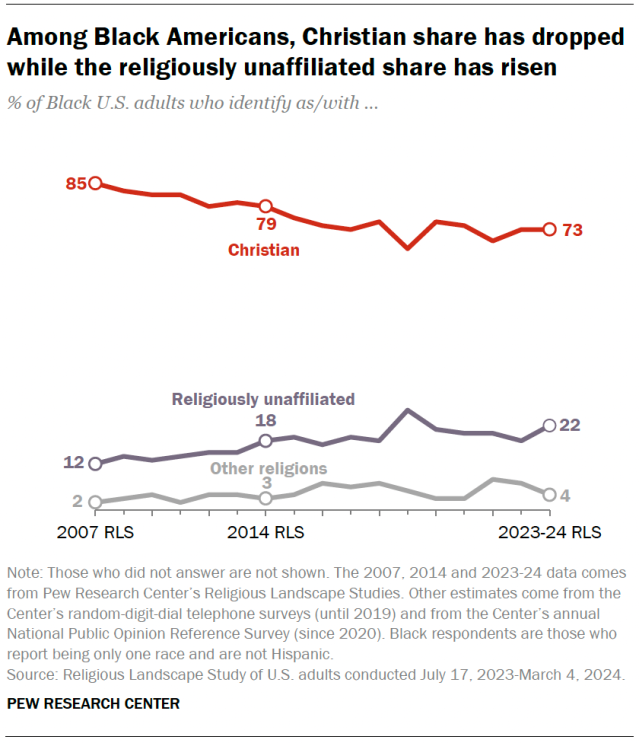
The Christian share of Black adults is down from 79% in 2014 and 85% in 2007. Christian affiliation has similarly declined among the overall U.S. population during this time. Nonetheless, Black adults are more likely than U.S. adults overall to be Christian (73% vs. 62%).
Only 4% of Black adults identify with non-Christian religions, including Islam. And 22% of Black adults are religious “nones,” or adults who are not affiliated with a religion, including 3% who identify as atheist or agnostic and 19% who say their religion is “nothing in particular.”
By several measures, Black Americans are more religious than Americans of other races and ethnicities. Compared with White, Hispanic and Asian adults, Black adults are more likely to believe in God or a universal spirit (95%) and to do so with absolute certainty (74%).
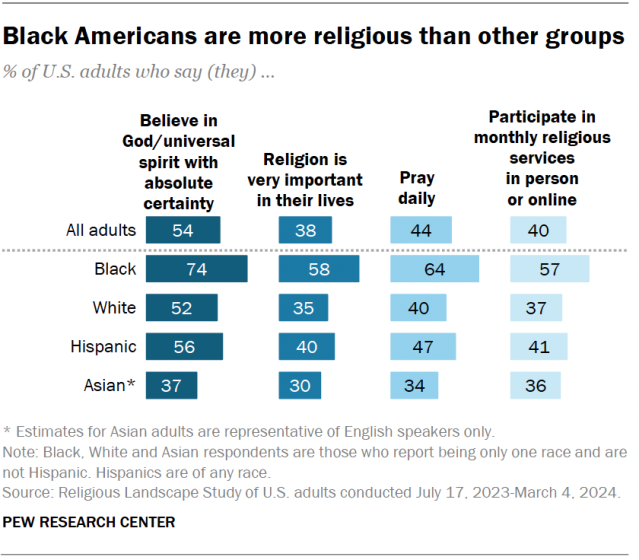
Black adults also are more likely than other racial or ethnic groups to say religion is very important in their lives (58%), to pray daily (64%) and to participate monthly in religious services, whether in person or online (57%).
Around half or fewer of Americans in other racial or ethnic groups say religion is very important to them or pray daily. Even fewer attend religious services monthly.
Most Black adults who are religiously unaffiliated say they believe in God. Among Americans who do not identify with a religion, 83% of Black “nones” believe in God. “Nones” who are Hispanic (69%), White (46%) or Asian (42%) are less likely to do so.
Black “nones” also are more likely than their counterparts in other racial or ethnic groups to say that people have a soul or spirit in addition to their physical body (82%). And they’re more likely to pray monthly or more often (61%).
Most Black adults who attend religious services at least a few times a year (61%) attend Black congregations – that is, ones where the senior religious leaders and the majority of the congregants are Black.
A Pew Research Center study in 2021 found that Black congregations are more likely than non-Black congregations to offer Black Americans distinctive experiences. These experiences include sermons on race relations or racial inequality, expressive worship services, and a sense of racial affirmation or pride.
In addition to distinctive worship experiences, historically Black houses of worship have long served as the civic center of Black communities, especially during key eras of Black history such as the abolitionist and civil rights movements. Today, Black houses of worship continue to offer Black communities support on issues of voting, health and food security.
Black men are more likely than Black women to move away from Christianity as they age. Among Black Americans, men are about as likely as women to say they were raised as Christians (81% vs. 85%). But they are less likely to identify as Christians in adulthood (67% vs. 78%).
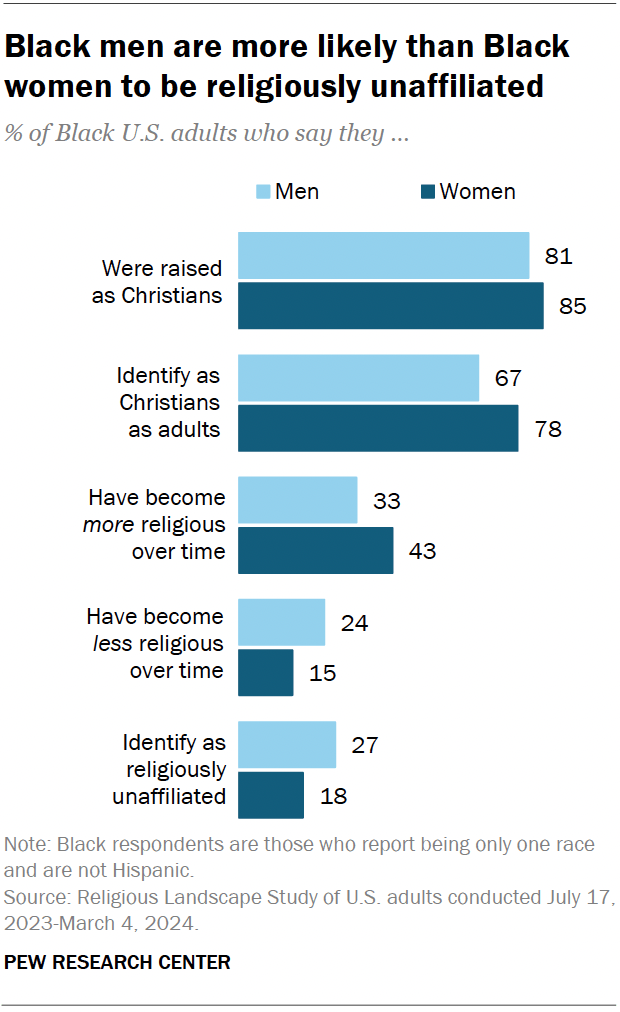
Conversely, Black men are more likely than Black women to be religiously unaffiliated as adults (27% vs. 18%) and to say they have become less religious over the course of their lives (24% vs. 15%).
The pattern is similar – but less pronounced – among White adults. White men are less likely than White women to identify as Christians as adults (60% vs. 66%). They are slightly more likely to be unaffiliated (33% vs. 28%) and to say they have become less religious over time (33% vs. 30%).
Hispanic and Asian adults do not differ by gender on these questions.
More Black women than men consider themselves very spiritual. Americans define spirituality in many ways, including through the connections they feel to the universe, nature or humanity. Because there is no single way to measure spirituality, our Religious Landscape Study asked multiple questions about spiritual beliefs, practices, experiences and identities.
Black women are slightly more likely than Black men to consider themselves very spiritual (50% vs. 42%). They also are more likely than Black men to listen to music (80% vs. 68%) or to look inward for spiritual reasons a few times a month or more often (68% vs. 57%).
However, roughly equal shares of Black women and men say they do each of the following monthly for spiritual reasons: meditate (46% vs. 45%), exercise (45% vs. 47%), visit a nature spot such as a waterfall, mountaintop or river (26% vs. 26%), or practice yoga (15% vs. 13%).
Older Black adults are more likely than younger Black adults to describe themselves as very religious. For example, 39% of Black adults ages 65 and older describe themselves this way, compared with 21% of Black adults under 30.
This age pattern is not unique to Black Americans. White and Hispanic adults who are 65 and older also are more likely than their peers under 30 to describe themselves as very religious.
Even so, Black adults, regardless of age, are more likely than adults in other racial and ethnic groups to say they’re very religious.
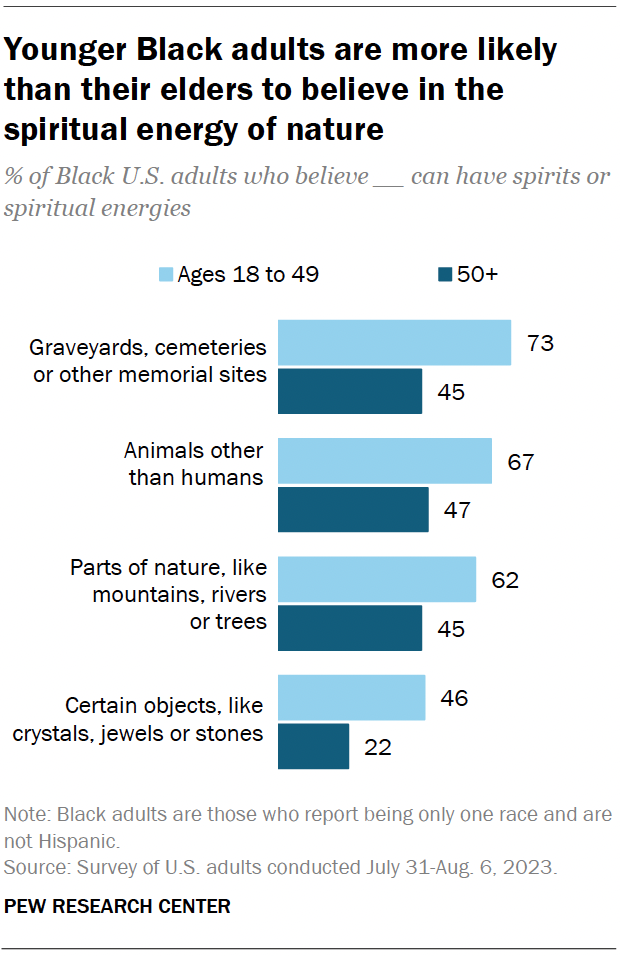
Younger Black adults are more likely than their elders to believe in the spiritual energy of nature, according to another Center survey from 2023. For example, Black adults under 5o are more likely than their older peers to say spiritual energy can be found in memorial sites like graveyards and cemeteries (73% vs. 45%) and in animals (67% vs. 47%).