
The Briefing
☀️ Happy Thursday! The Briefing is your guide to the world of news and information. Sign up here!
In today’s email:
- Featured story: Judge temporarily pauses Paramount-Warner Bros. merger
- New from Pew Research Center: How we measured Americans’ engagement in public life
- In other news: EU fines Google $1 billion for anticompetitive practices
- Looking ahead: Another ‘pivot to video’ for news organizations?
- Chart of the week: Younger and older Americans engage in public life in different ways
🔥 Featured story
A federal judge this week placed a temporary restraining order on Paramount’s purchase of Warner Bros. Discovery after 12 states filed a lawsuit alleging that the deal violates antitrust law. If the merger goes through, Paramount would control dozens of cable channels as well as theatrical distribution of movies from two studios.
The deal could also bring two of the largest news brands in the U.S. under the same ownership. One-third of U.S. adults say they regularly get news from CNN (currently owned by Warner Bros.), while three-in-ten regularly get news from CBS News (owned by Paramount), according to a 2025 Pew Research Center survey.
🚨 New from Pew Research Center
Last week, we released a report from the Pew-Knight Initiative exploring how Americans engage with news, politics, religion and civic life, including an analysis of four distinct “engagement groups” that make up the U.S. public. A Decoded blog post explains how we created and analyzed these groups.
📌 In other news
- EU fines Google $1 billion for anticompetitive practices
- Federal judge says Trump must disclose financial information amid his lawsuit against BBC
- After networks chose not to air Trump’s speech last week, Trump calls for broadcast licenses to be revoked
- Trump administration shortens length of foreign journalist visas
- Justice Department sought phone records of New York Times journalists in subpoenas
- OpenAI announces new investment in American Journalism Project, which supports local news
- France joins growing list of countries restricting social media for children
- Baltimore Sun owner threatens to sue Maryland governor for defamation over Jeffrey Epstein comments
📅 Looking ahead
Media observers have recently noted a trend of news organizations – including The New York Times and The Wall Street Journal – shifting more resources toward creating video content. For some, this has brought to mind the largely unsuccessful “pivot to video” of a decade ago, although the dynamics and platforms involved have shifted markedly since then.
Indeed, a growing share of Americans get news on video-focused social media sites like YouTube, TikTok and Instagram. For instance, 35% of U.S. adults said in 2025 that they regularly get news on YouTube, up from 23% in 2020.
The most common way Americans prefer to get their news continues to be by watching it: 44% of Americans say this is the case, compared with 37% who prefer reading the news and 19% who like listening to it, according to an August 2025 survey. These numbers have been fairly steady since 2016.
📊 Chart of the week
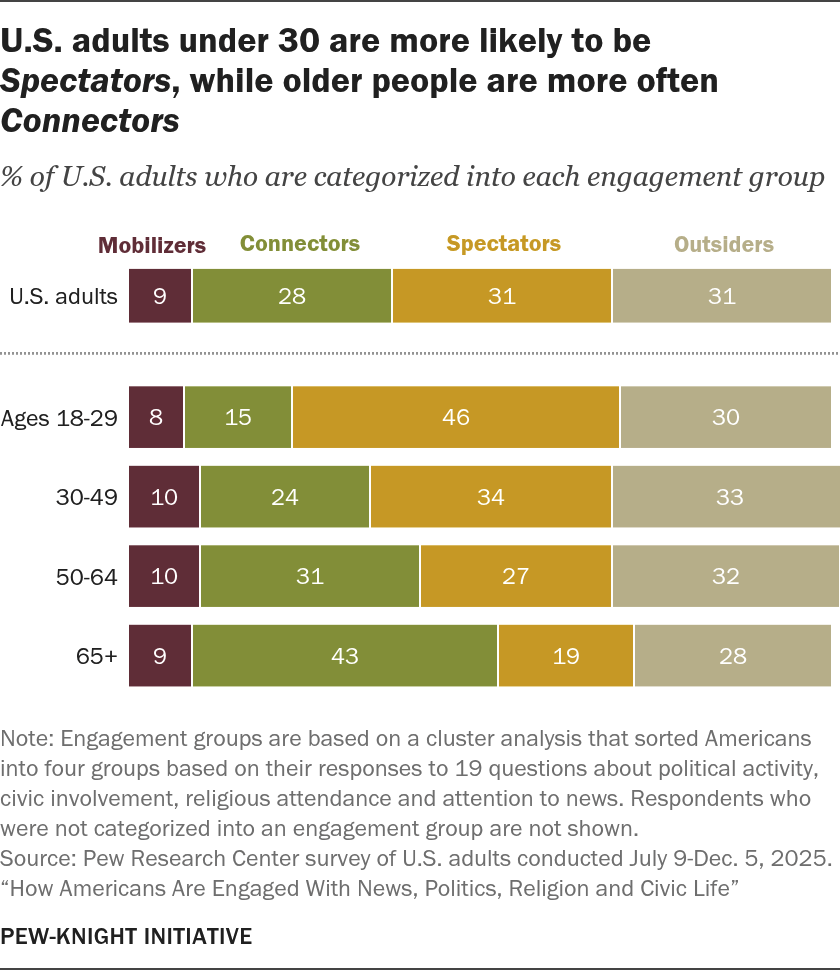
This week’s chart comes from our new report from the Pew-Knight Initiative on how Americans engage in public life, and how that differs by age.
Our analysis split the U.S. public into four “engagement groups” – Mobilizers, Connectors, Spectators and Outsiders – based on their patterns of participation in activities like voting, donating to charity, attending religious services, joining groups and following the news. We found that older Americans are more likely than younger adults to be Connectors, who tend to participate in civic and community life, while younger Americans are more likely to be Spectators – those who follow the news and interact with it online but are less engaged in other ways.
| Group | Mobilizers | Connectors | Spectators | Outsiders | |
|---|---|---|---|---|---|
| U.S. adults | U.S. adults | 9 | 28 | 31 | 31 |
| Ages 18-29 | Age | 8 | 15 | 46 | 30 |
| 30-49 | Age | 10 | 24 | 34 | 33 |
| 50-64 | Age | 10 | 31 | 27 | 32 |
| 65+ | Age | 9 | 43 | 19 | 28 |
👋 That’s all for this week.
The Briefing is compiled by Pew Research Center staff, including Naomi Forman-Katz, Christopher St. Aubin, Emily Tomasik, Joanne Haner, and Sawyer Reed. It is edited by Michael Lipka and copy edited by David Kent.
Do you like this newsletter? Email us at journalism@pewresearch.org or fill out this two-question survey to tell us what you think.
