Discussing news is a key way Americans make sense of what is happening around them. Many say these conversations help them learn, share perspectives and feel connected. At the same time, a growing share of Americans have stopped talking to certain people about political news because of something they said.
Our data explores both sides of this dynamic: why discussing the news remains valuable, and why many people are pulling back.
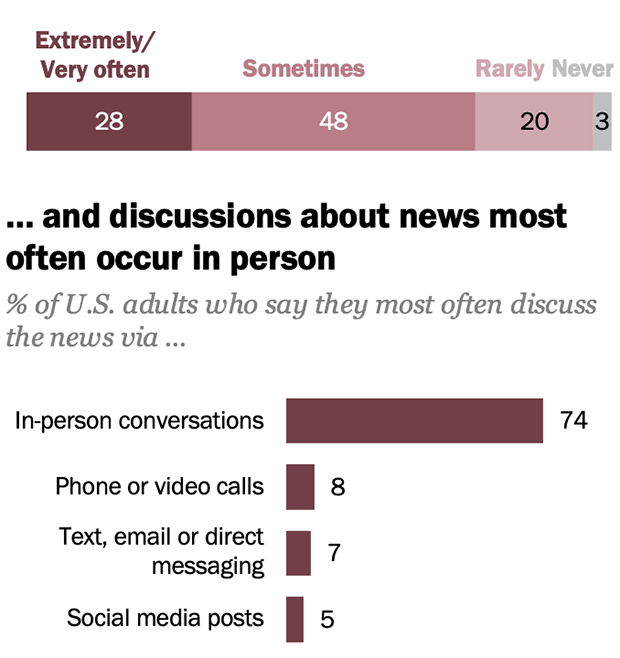
“Americans’ Complicated Relationship With News”
| Discuss news with others | |
| Extremely/Very often | 23% |
| Sometimes | 48% |
| Rarely | 20% |
| Never | 3% |
| Most often discuss news in … | |
| In-person conversations | 74% |
| Phone or video calls | 8% |
| Text, email or direct messaging | 7% |
| Social media | 5% |
“Americans’ Complicated Relationship With News”
These findings are based on a Pew Research Center survey of U.S. adults aimed at understanding how Americans are thinking about and experiencing news today. Read key findings from the full study.
About three-quarters of U.S. adults (76%) say they discuss the news with others at least sometimes, including 28% who do so extremely or very often. One-in-five say they do this rarely, while only 3% say they never discuss news with others.
Even in a digital era when most Americans encounter and engage with news online, the majority of U.S. adults say they most often discuss the news in person (74%).
Far smaller shares say they do so primarily by phone or video calls (8%); text, email or direct messaging (7%); or social media posts (5%).
Although younger Americans are slightly more likely to say they discuss news digitally – via social media or text, email or direct messaging – large majorities of all age groups most often have these conversations in person.
How, and with whom, people talk about the news may vary. In focus group discussions held as part of this study, one woman in her 50s said: “There’s certain audiences my mouth stays shut, and other ones where it just won’t stop. So it’s who I feel comfortable around. And a lot of times, I’ll listen to other people. If I’m not going to say anything, I’m going to listen because I do want to know what people are thinking.”
What do people get out of news discussions?
There are several common experiences people have when discussing news with others. For example, most Americans say they at least sometimes learn something new about an issue or event (88%), share their own opinion about an issue (86%), feel connected with others (80%) and correct information they believe is inaccurate (79%).
A smaller share – but still more than half (59%) – say they at least sometimes change their own opinion about an issue when discussing the news with others. Just 4% say this happens all or most of the time.
“Americans’ Complicated Relationship With News”
| All of the time | Most of the time | Sometimes | Rarely | Never | |
|---|---|---|---|---|---|
| Learn something new about an issue or event | 5% | 20% | 64% | 7% | 1% |
| Share their own opinion about an issue | 10% | 31% | 46% | 8% | 2% |
| Feel connected with others | 5% | 25% | 50% | 12% | 3% |
| Correct information they believe is inaccurate | 6% | 19% | 54% | 14% | 3% |
| Change their opinion about an issue | 2% | 3% | 55% | 33% | 4% |
| Argue with others | 1% | 4% | 32% | 42% | 17% |
“Americans’ Complicated Relationship With News”
Meanwhile, 37% of Americans say they at least sometimes argue with others when discussing the news.
More people are stepping away from political news conversations
A rising share of Americans (56%) say they have stopped talking to someone about political or election news, whether in person or online, because of something they said. This is up from 45% who said the same in 2024.
“Americans’ Complicated Relationship With News”
| Date | Percent |
|---|---|
| 2019 | 45% |
| 2020 | 42% |
| 2024 | 45% |
| 2025 | 56% |
“Americans’ Complicated Relationship With News”
Some groups are more likely to have stopped talking to someone about political news:
- Liberal Democrats. About three-quarters of liberal Democrats (77%) say they’ve ever done this – 22 percentage points higher than among conservative or moderate Democrats (55%). Conservative Republicans (53%) and moderate or liberal Republicans (46%) are also considerably less likely than liberal Democrats to say they have stopped talking to someone about political news because of something they said.
- More-educated Americans. About two-thirds of college graduates (65%) have stopped talking to someone about political news, versus 58% of those with some college education and 46% of adults with a high school education or less.
- Older adults. At least half of Americans across all age groups have done this – but those ages 65 and older are more likely than adults under 3o to say this has happened (62% vs. 51%).
Some focus group participants discussed tempering what news they discuss based on who they’re talking to. “I can talk about the economy with just about anybody if they’re willing to listen to the boring stuff,” a Democratic man in his 40s said. “But if we go into politics and stuff like that – I’ve lost a lot of friends.”
A Republican woman in her 40s said, “I tend to only really talk about political things when I know I’m with people that are like-minded, just because there’s – it’s just easier that way.”
Why people avoid conversations about the news
Nearly equal shares of U.S. adults say concern about making things uncomfortable (58%), a lack of knowledge about the news (57%) or a lack of interest in talking about the news (57%) has kept them from discussing it with others.
“Americans’ Complicated Relationship With News”
| Ages 18-29 | 30-49 | 50-64 | 65+ | |
|---|---|---|---|---|
| Concern about making things uncomfortable | 58% | 57% | 59% | 59% |
| Lack of knowledge about the news | 65% | 60% | 55% | 50% |
| Lack of interest in talking about the news | 64% | 64% | 55% | 41% |
“Americans’ Complicated Relationship With News”
Different groups sometimes have different reasons for not talking about news with others. For instance, young adults are more likely than older Americans to say a lack of knowledge or interest has kept them from discussing news. And passive news consumers – those who say they mostly come across news rather than seek it out – are also more likely to say this is the case.
One woman in her 30s said, “If you’re going to have a conversation [about news], you should be well educated on it, and the pros and the cons, and both sides of the spectrum, so that you can have an intelligent conversation with whom you’re sharing it with.”
Democrats and independents who lean toward the Democratic Party, along with more-educated and higher-income Americans, are most likely to say they have avoided discussing the news with others out of concern about making things uncomfortable.
“We’re in that space right now where you don’t want to offend anybody, especially if you’re close with them right now,” a Democratic woman in her 30s said. “So you’re kind of just like, hey, I’m going to keep this article to myself, and if I do share it, it will probably be with somebody, like maybe one or two people that I absolutely trust, and that’s it.”