For years, parents have been raising teenagers in an era of smartphones and social media. Now, artificial intelligence (AI) chatbots introduce a new layer to modern parenting.
With a majority of teens now using these tools, Pew Research Center asked 1,458 U.S. parents of 13- to 17-year-olds the following questions:
- As far as you know, does your teen ever use AI chatbots?
- Do you ever talk with your teen about using them?
- Would you be OK with your teen using chatbots for certain things?
These questions are part of a larger study on teens and AI. For teens’ own experiences and views, check out the main report.
Parents’ perceptions of their teens’ chatbot use
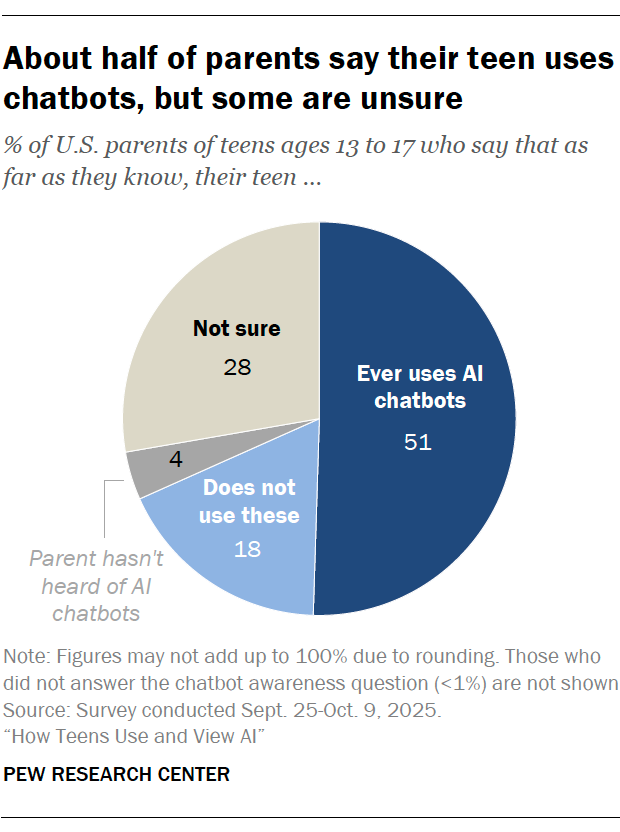
While it can be hard for parents to keep up with the latest tech trends, they’re already quite familiar with chatbots. In fact, more than nine-in-ten say they’ve heard of these tools, according to the fall 2025 survey.
When asked about their own teen, 51% of parents say their teen uses chatbots, while 18% say they do not. Still, about three-in-ten parents are not sure if their teen uses these tools.
There is also a gap between parents’ perceptions and what teens are actually doing. When we asked teens themselves, 64% of U.S. teens reported using chatbots. This is 13 percentage points higher than what their parents say.
Talking about chatbots with teens
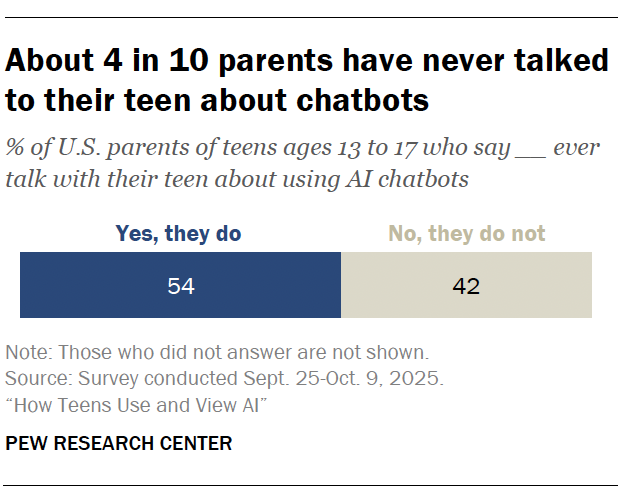
As new technology emerges, parents may have to consider how to discuss these tools with their teens.
In our survey, just over half of parents say they ever talk to their teen about chatbots. But some parents – roughly four-in-ten – say they have not had these discussions.
Parents weigh in on acceptable uses of chatbots
Teens turn to chatbots for everything from entertainment to schoolwork. But what uses do parents find appropriate? And where do they draw the line?
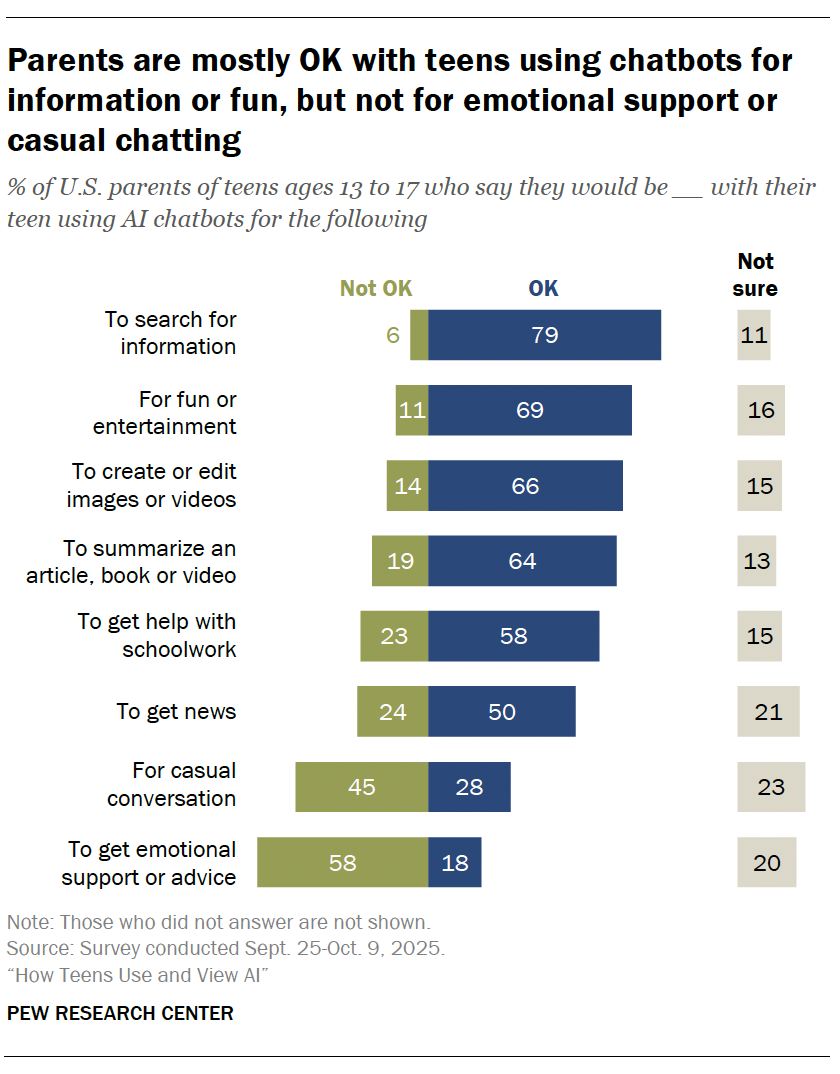
Searching for information tops the list of acceptable uses we asked about. About eight-in-ten parents say they would be OK with their teen using chatbots for this purpose.
Smaller shares – though still roughly two-thirds – are comfortable with their teen using chatbots for fun or entertainment, to create or edit images or videos, or to summarize articles, books or videos.
Roughly six-in-ten parents would be OK with their teen using these tools to help with schoolwork. And half say the same about getting news.
But parents are less accepting of their child using chatbots for more personal uses. Fewer than a third are OK with their teen having casual conversations with a chatbot.
Even fewer (18%) say they’d be comfortable with their teen getting emotional support or advice from a chatbot. In fact, this is the only use we asked about that a majority of parents are not OK with.
Still, some don’t know where they stand. The shares saying “not sure” range from 11% to 23% across these uses.
How parents’ views differ by household income, race and ethnicity
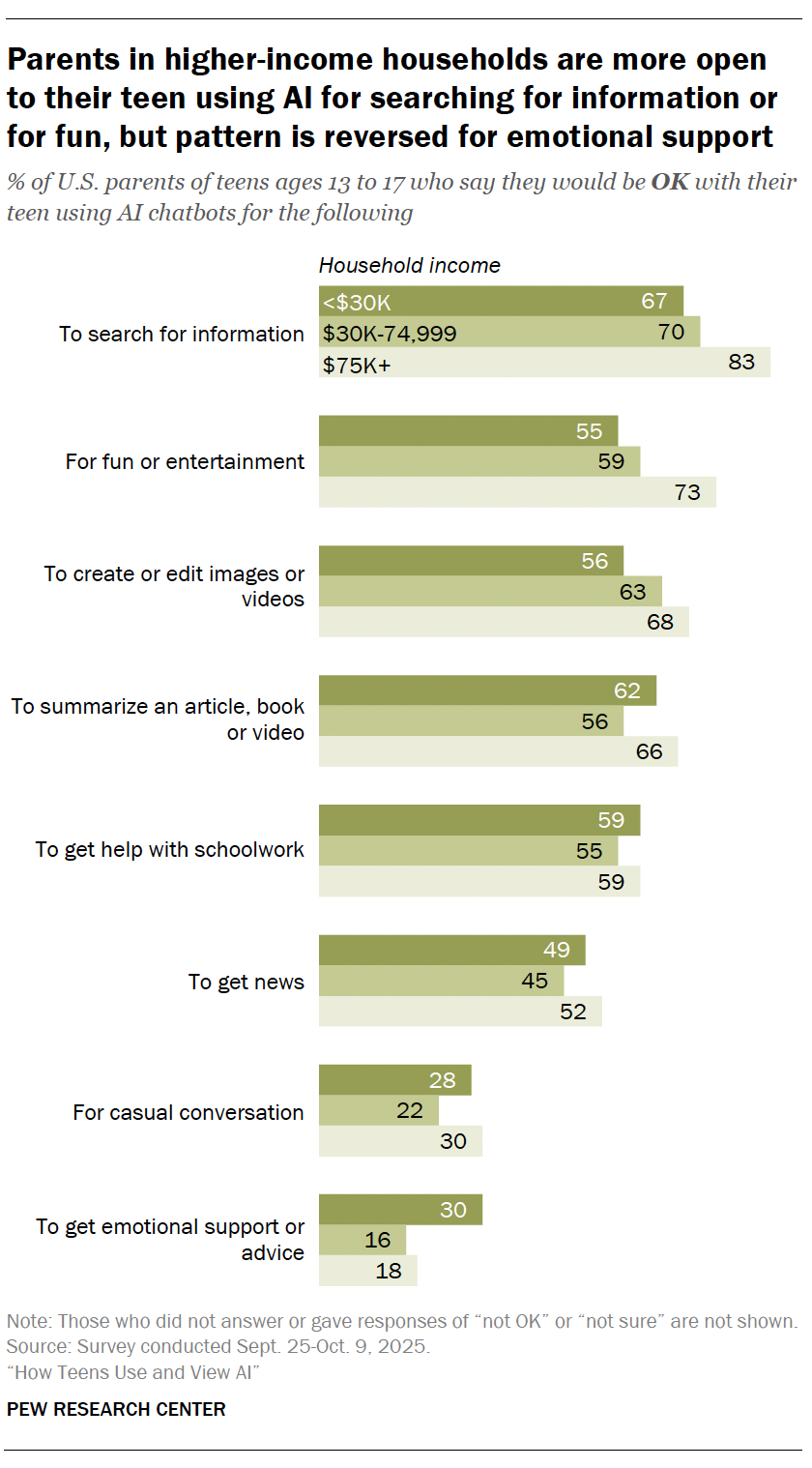
In some cases, parents’ comfort levels with their teen using chatbots differ by household income. For example:
Searching for information: 83% of parents in households earning $75,000 or more a year say they would be comfortable with their teen using chatbots to do this. This drops to about seven-in-ten among parents with annual incomes less than $75,000.
For fun, entertainment: Parents in upper-income households are also more open to their teen using chatbots for fun or entertainment than those with lower or middle incomes.
But the pattern is reversed for getting emotional support or advice. Three-in-ten parents in lower-income households say they’d be comfortable with their teen doing this. Fewer parents in middle- and upper-income households say the same.
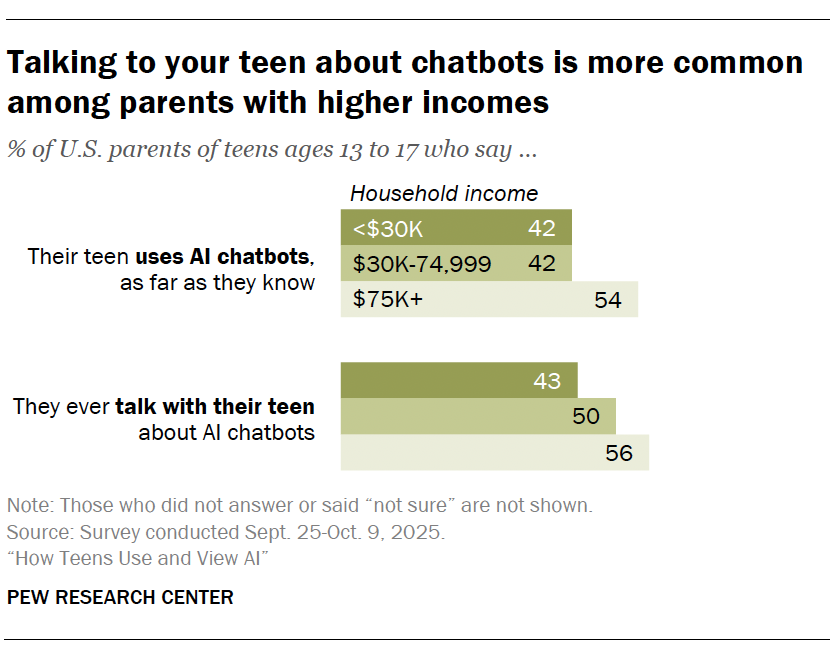
At the same time, a larger share of parents in higher-income households report that their teen uses chatbots. They’re also more likely than those in households earning less than $30,000 to say they have talked to their teen about chatbots (56% vs. 43%).
Beyond income, there are some differences by race and ethnicity. For example, 65% of Black parents would be OK with their teen getting news through chatbots, compared with about half of Hispanic or White parents.2
Black parents are also more comfortable with their teen using chatbots for emotional support or advice or for summarizing materials than Hispanic or White parents. To read more about how parents’ experiences and views differ across demographic groups, refer to the appendix.