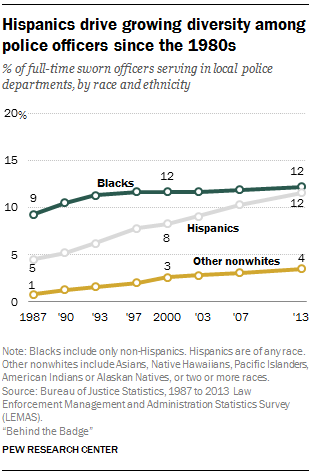
Hispanics are the fastest-growing major racial or ethnic group in local police departments in the United States. In 2013, Hispanics made up 12% of full-time sworn officers, up 7 percentage points since the late 1980s, according to the Bureau of Justice Statistics. And they are still underrepresented relative to their share of the U.S. population, while black officers have gained parity on this measure.
A recent Pew Research Center survey highlights how Hispanic officers see their jobs, their communities and other key issues affecting police today. (The survey was conducted by the National Police Research Platform May 19-Aug. 14, 2016 and collected the views of a nationally representative sample of 7,917 sworn officers working in 54 police and sheriff’s departments with 100 or more officers.)
Overall, Hispanic officers hold views similar to those of white officers on a variety of issues related to recent high-profile incidents between blacks and police. But when it comes to working with federal authorities on enforcing immigration laws, the views of Hispanic officers align more closely with those of black officers. Here are four key findings about how Hispanic police officers see their jobs:
Like most police officers, Hispanic officers have mixed feelings about their work. A majority of Hispanic police officers (63%) say their work often or nearly always makes them feel proud, a share similar to that of black (60%) but slightly higher than among white officers (58%). And 47% of Hispanic officers say their work often or nearly always makes them feel fulfilled. At the same time, though, many Hispanic officers express frustration about their jobs. Roughly half (47%) say their work often or nearly always makes them feel frustrated. In addition, about one-in-five Hispanic officers (21%) say their work often or nearly always makes them feel angry.
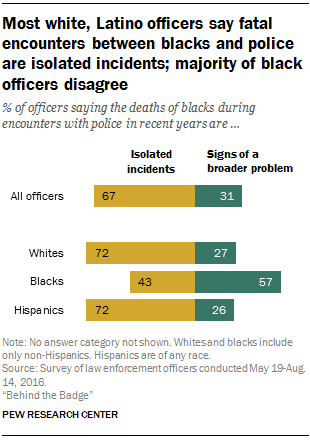
Views of Latino officers on fatal incidents and the ensuing protests mirror those of white officers. Roughly seven-in-ten Latino and white officers (72% of each group) say recent fatal encounters between blacks and the police are isolated incidents, rather than signs of a broader problem between blacks and the police.
By contrast, a majority of black officers (57%) see these incidents as signs of a larger problem. When it comes to protests related to those incidents, less than half of Latino officers (42%) and an even smaller share of white officers (27%) say that a genuine desire to hold police accountable is at least some of the motivation for these protests. By contrast, a majority of black officers (69%) say this.
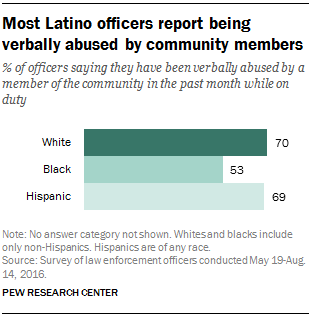
Similar shares of Hispanic officers and white officers say high-profile incidents between blacks and police have made policing harder. Seven-in-ten Hispanic officers (72%) say that officers in their departments are now less willing to stop and question people who seem suspicious, a share similar to the 73% of white officers who say this. Roughly two-thirds (64%) of black officers say this. In addition, Hispanic and white officers are more likely than black officers to report having been verbally abused by a member of the community while on duty in the past month.
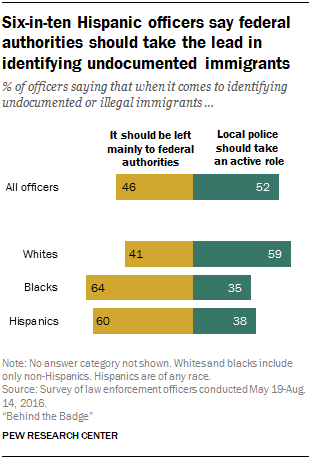
A majority of Latino (60%) and black (64%) officers say it should be up to federal authorities to identify undocumented immigrants. On the other hand, a majority of white officers (59%) say that when it comes to identifying undocumented immigrants, local police should take an active role.
The issue of immigration enforcement has gained prominence after President Donald Trump signed an executive order to boost deportations and penalize “sanctuary cities” where local police don’t cooperate with federal immigration authorities.