Transgender athletes’ participation in women’s and girls’ sports has been in the public spotlight this summer. The U.S. Supreme Court ruled in June that states can restrict transgender women and girls from participating in women’s and girls’ sports. And recent comments on the topic by prominent figures in the WNBA and in women’s tennis have prompted discussion among the public.
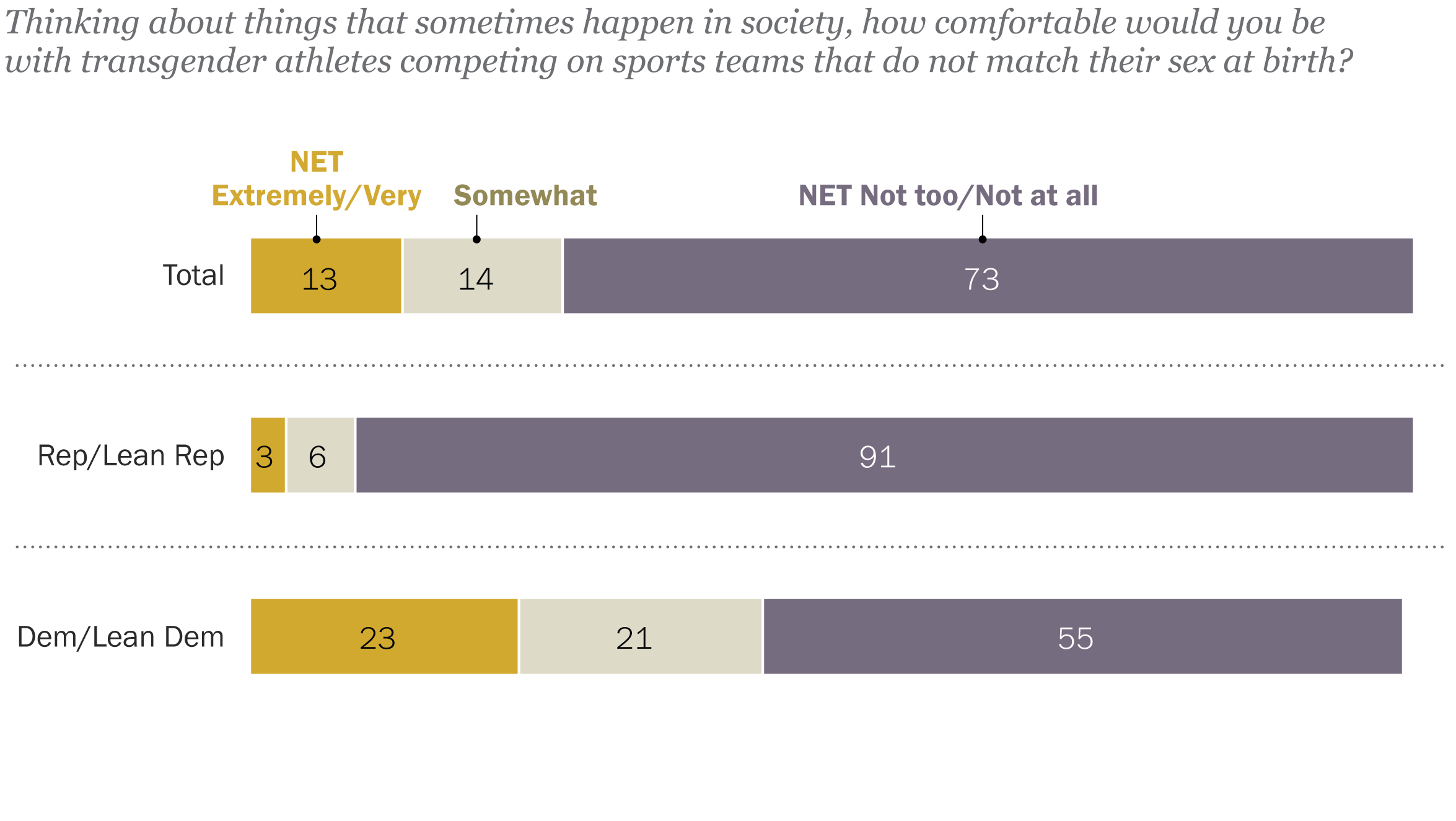
% who said in February 2025 that they would ___ laws or policies that …
| Extremely | Very | Somewhat | Not too | Not at all | |
|---|---|---|---|---|---|
| How comfortable would you be with transgender athletes competing on sports teams that do not match their sex at birth? (Nov. 2025) | 6 | 7 | 14 | 17 | 56 |
| Favor | Neither | Oppose | |||
| Would you favor or oppose laws or policies that require that transgender athletes compete on teams that match the sex they were assigned at birth? (Feb. 2025) | 66 | 19 | 15 |
Last year, two Pew Research Center surveys found that:
- 73% of Americans were uncomfortable with transgender athletes competing on sports teams that do not match their sex at birth.
- 66% of adults favored a law or policy that would require trans athletes to compete on teams that match their sex at birth.
The share of adults who said they favored such a proposal had grown in recent years among Republicans and Democrats alike.
While Americans were broadly uncomfortable with transgender athletes on sports teams that don’t match their sex at birth, a majority of Americans supported policies aimed at protecting trans people from discrimination in jobs, housing and public spaces. In February 2025, 56% of adults favored this, while 16% opposed it.
To learn more about the experiences of transgender adults living in the United States, read our report, “The Experiences of LGBTQ Americans Today.”
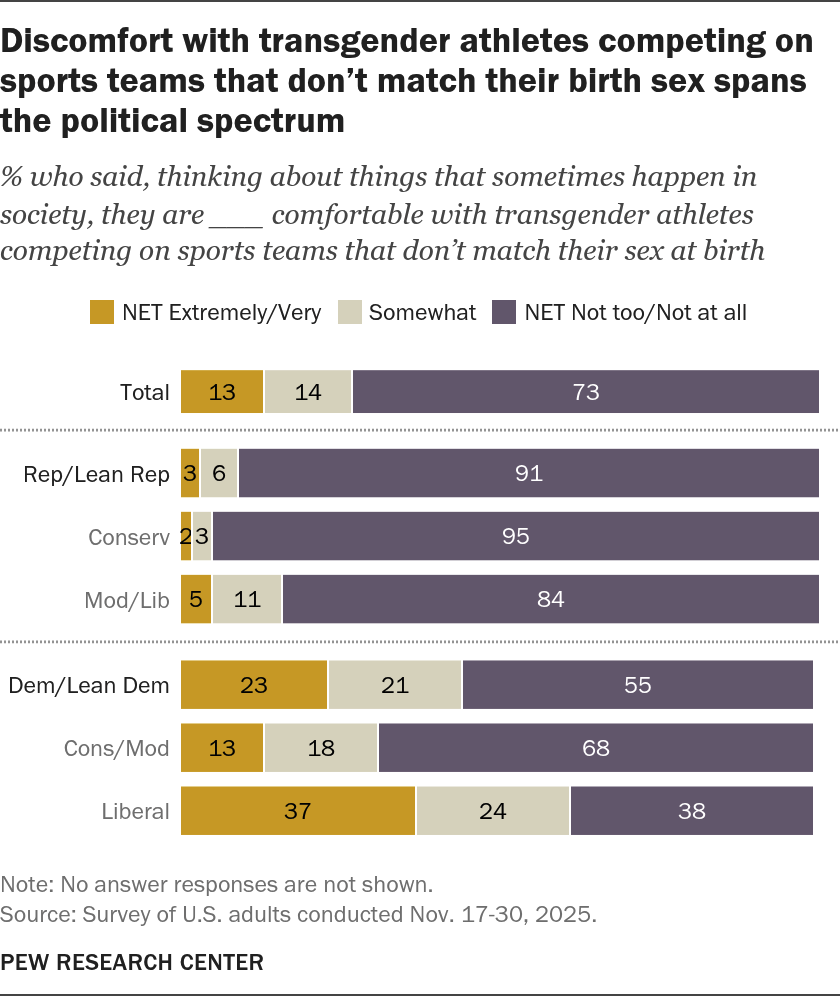
Political differences in views of transgender athletes
| Grouping | NET Extremely/Very | Somewhat | NET Not too/Not at all | |
|---|---|---|---|---|
| Total | Total | 13 | 14 | 73 |
| Rep/Lean Rep | Rep/Lean Rep | 3 | 6 | 91 |
| Conserv | Rep/Lean Rep | 2 | 3 | 95 |
| Mod/Lib | Rep/Lean Rep | 5 | 11 | 84 |
| Dem/Lean Dem | Dem/Lean Dem | 23 | 21 | 55 |
| Cons/Mod | Dem/Lean Dem | 13 | 18 | 68 |
| Liberal | Dem/Lean Dem | 37 | 24 | 38 |
An overwhelming majority of Republicans (91%) said they would not be comfortable with transgender athletes playing on teams that do not match their birth sex. That includes 95% of conservative Republicans and 84% of moderate and liberal Republicans.
In February 2025, 88% of Republicans said they favored a law or policy that would require transgender athletes to compete on teams that match their sex at birth. That’s modestly higher than in 2022 (85%).
Democrats are more divided on the issue. A slim majority (55%) said they would be not too or not at all comfortable with athletes playing on teams that do not match their birth sex, while smaller shares said they would be somewhat comfortable (21%) or extremely or very comfortable (23%).
There are also wide differences among Democrats by ideology. Among liberals, 37% said they would be extremely or very comfortable with this, and 24% said they would be somewhat comfortable. But a 68% majority of conservative and moderate Democrats said they would be uncomfortable.
Compared with Republicans, there is less appetite among Democrats for a law or policy that would require trans athletes to play on teams that match their sex at birth. In February, 45% favored this, up from 37% in 2022.
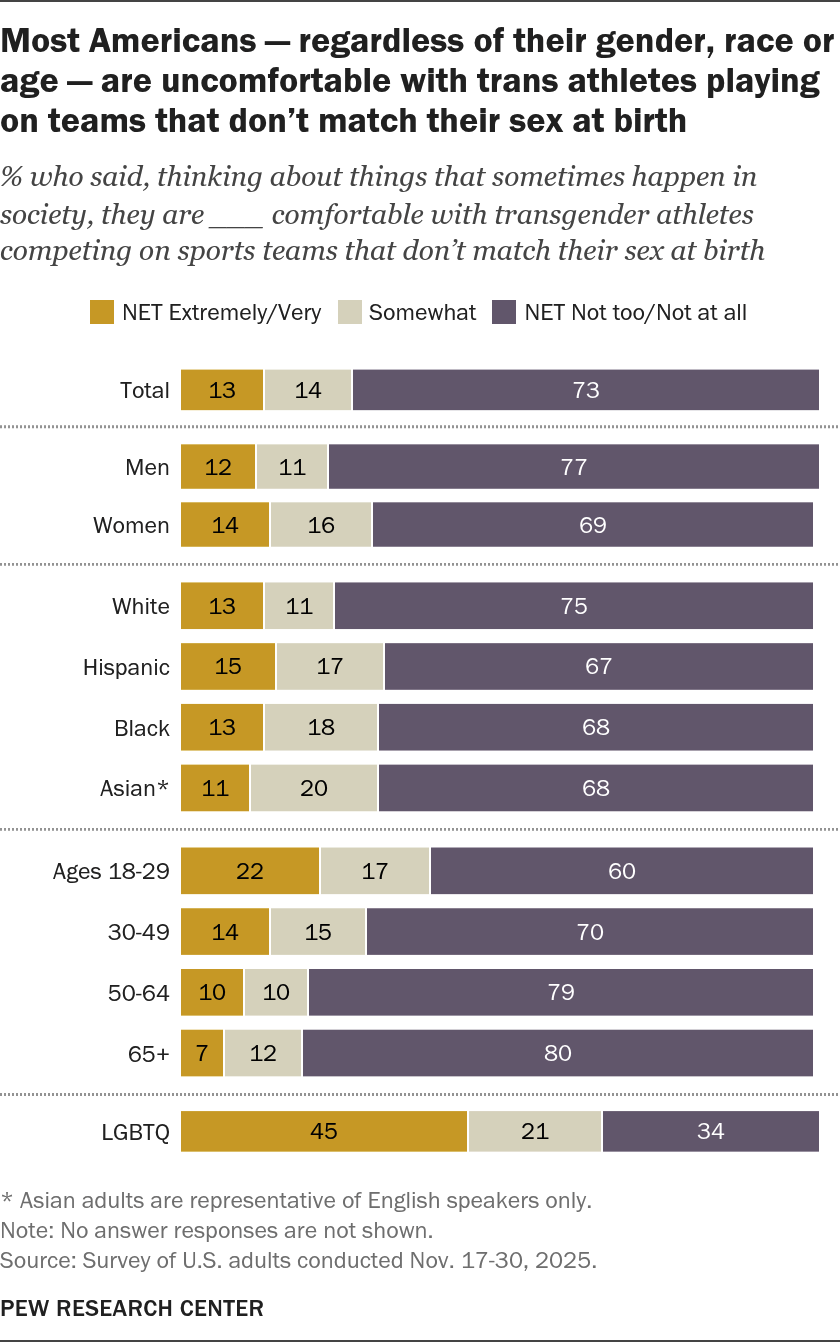
Views of transgender athletes by gender, race, age and LGBTQ identity
Note: No answer responses are not shown.
| Grouping | NET Extremely/Very | Somewhat | NET Not too/Not at all | |
|---|---|---|---|---|
| Total | Total | 13 | 14 | 73 |
| Men | Gender | 12 | 11 | 77 |
| Women | Gender | 14 | 16 | 69 |
| White | Race/Ethnicity | 13 | 11 | 75 |
| Hispanic | Race/Ethnicity | 15 | 17 | 67 |
| Black | Race/Ethnicity | 13 | 18 | 68 |
| Asian* | Race/Ethnicity | 11 | 20 | 68 |
| Ages 18-29 | Age | 22 | 17 | 60 |
| 30-49 | Age | 14 | 15 | 70 |
| 50-64 | Age | 10 | 10 | 79 |
| 65+ | Age | 7 | 12 | 80 |
| LGBTQ | LGBTQ | 45 | 21 | 34 |
Note: No answer responses are not shown.
Across most demographic groups, majorities of Americans said they would be uncomfortable with transgender athletes competing on sports teams that do not match their sex at birth.
However, some groups of Americans were more likely than others to express discomfort with this:
- Older adults were more likely than younger adults to express discomfort.
- Men were more uncomfortable with this than women were.
- White adults were more uncomfortable with this than Hispanic, Black and Asian adults were.
LGBTQ adults are more divided on this issue than most other groups: 45% of LGBTQ adults said they would be extremely or very comfortable with trans athletes playing on teams that don’t match their sex at birth. An additional 21% said they would be somewhat comfortable with this.
How views about transgender adults map onto attitudes about athletes
| Extremely/Very | Somewhat | Not too/Not at all | Grouping | |
|---|---|---|---|---|
| U.S. adults | 13 | 14 | 73 | All |
| Among those who said whether someone is a man or a woman … | ||||
| Is determined by their sex at birth (67%) | 4 | 6 | 89 | Sex at birth |
| Can be different from their sex at birth (31%) | 33 | 29 | 37 | Sex at birth |
In November, we also asked Americans which of two statements comes closer to their views. Consistent with prior years, two-thirds said they agreed more with the statement “Whether someone is a man or a woman is determined from their sex at birth.” A smaller share (31%) said they agreed more with “Someone can be a man or a woman even if that is different from their sex at birth.”
Adults who said gender is determined by sex at birth were overwhelmingly uncomfortable with transgender athletes competing on sports teams that don’t match their sex at birth (89%).
But among those who said a person’s gender can be different from their sex at birth, comfort with transgender athletes competing on these teams was mixed:
- 33% said they would be extremely or very comfortable with transgender athletes playing on teams that don’t match their birth sex.
- 29% were somewhat comfortable with this.
- 37% said they were not too or not at all comfortable with it.
Note: Here are the questions for the November survey, the detailed responses and the survey methodology. Here are the February survey questions, the detailed responses and the survey methodology.