
In recent months, the Trump administration struck a deal with pharmaceutical companies to lower the price many Americans pay for popular drugs used for weight loss, such as Ozempic and Wegovy.
As a result, these types of medications – formally known as glucagon-like peptide-1 receptor agonists, or GLP-1s – could become more broadly available in the United States, where obesity affects around four-in-ten adults ages 20 and older.
Here are six facts about obesity and weight loss in the U.S. and Americans’ views of drugs used for weight loss, drawn from Pew Research Center surveys and other sources.

Source: National Center for Health Statistics.
| Year label | Years | Obesity rate | Category |
|---|---|---|---|
| ’88- ’94 | 1988-1994 | 22.9% | 1988-1994 |
| ’99- ’00 | 1999-2000 | 30.5 | 1999-2018 |
| ’01- ’02 | 2001-2002 | 30.5 | 1999-2018 |
| ’03- ’04 | 2003-2004 | 32.2 | 1999-2018 |
| ’05- ’06 | 2005-2006 | 34.3 | 1999-2018 |
| ’07- ’08 | 2007-2008 | 33.7 | 1999-2018 |
| ’09- ’10 | 2009-2010 | 35.7 | 1999-2018 |
| ’11- ’12 | 2011-2012 | 34.9 | 1999-2018 |
| ’13- ’14 | 2013-2014 | 37.7 | 1999-2018 |
| ’15- ’16 | 2015-2016 | 39.6 | 1999-2018 |
| ’17- ’18 | 2017-2018 | 42.4 | 1999-2018 |
| ’21- ’23 | 2021-2023 | 40.3 | 2021-2023 |
Source: National Center for Health Statistics.
Around 40% of Americans ages 20 and older are considered obese, and nearly 10% are severely obese. These rates are based on body mass index data from 2021-23, the most recent age-adjusted estimates from the Centers for Disease and Control and Prevention (CDC).
The nation’s obesity rate has climbed in recent decades. In the 1988-94 survey period, 22.9% of adults ages 20 and older were classified as obese, and 2.8% were severely obese.
From 2017-18 to 2021-23, the share of adults considered obese declined by around 2 percentage points. This is the first time the rate has declined by more than 1 point between survey periods.
About two-thirds of U.S. adults (65%) said in a February 2024 Pew Research Center survey that willpower alone is usually not enough for most people to lose weight and keep it off. Another 34% said willpower alone is usually enough.

Note: Respondents who did not give an answer are not shown. White, Black and Asian adults include those who report being only one race and are not Hispanic. Hispanic adults are of any race.
Source: Survey of U.S. adults conducted Feb. 7-11, 2024.
| Willpower alone is usually NOT enough | Willpower alone is usually enough | Category | |
|---|---|---|---|
| U.S. adults | 65 | 34 | U.S. adults |
| Men | 59 | 41 | Gender |
| Women | 71 | 28 | Gender |
| White | 68 | 31 | Race/ethnicity |
| Black | 70 | 29 | Race/ethnicity |
| Hispanic | 55 | 43 | Race/ethnicity |
| Asian* | 54 | 46 | Race/ethnicity |
| Ages 18-29 | 55 | 44 | Age |
| 30-49 | 61 | 39 | Age |
| 50-64 | 71 | 29 | Age |
| 65+ | 73 | 26 | Age |
| Rep/Lean Rep | 59 | 40 | Party |
| Dem/Lean Dem | 71 | 28 | Party |
Note: Respondents who did not give an answer are not shown. White, Black and Asian adults include those who report being only one race and are not Hispanic. Hispanic adults are of any race.
Source: Survey of U.S. adults conducted Feb. 7-11, 2024.
Women were significantly more likely than men to say willpower is not enough (71% vs. 59%). And older adults were more likely than younger adults to say this is the case, though the prevailing view across all age groups is that willpower is not enough.
The same survey asked Americans about environmental and lifestyle factors that might impact a person’s weight. The largest shares said diet (57%) and exercise habits (43%) impact weight a great deal, though one-fifth or more said the same about stress, genetics and access to grocery stores.
Related: Americans on Healthy Food and Eating
About half (53%) of Americans say they hear or read about Ozempic, Wegovy and similar drugs extremely or very often, as of early 2025. Another 27% say they hear or read about them sometimes, while 19% say they rarely or never do.

Source: Survey of U.S. adults conducted Feb. 24-March 2, 2025.
| U.S. adults | |
|---|---|
| Extremely/Very often | 53 |
| Sometimes | 27 |
| Rarely/Never | 19 |
Source: Survey of U.S. adults conducted Feb. 24-March 2, 2025.
Women are more likely than men to say they hear or read about weight loss drugs extremely or very often (59% vs. 47%), with women ages 50 and older particularly likely to say this.

Source: Survey of U.S. adults conducted Feb. 24-March 2, 2025.
| Women | Category | |
|---|---|---|
| Women | 59 | U.S. adults |
| Ages 18-29 | 52 | Ages |
| 30-49 | 53 | Ages |
| 50-64 | 68 | Ages |
| 65+ | 63 | Ages |
Source: Survey of U.S. adults conducted Feb. 24-March 2, 2025.
Americans tend to see these drugs as good weight loss options for people with certain health conditions, but not for other people who just want to lose weight. Among those who had heard of Ozempic, Wegovy and similar drugs in February 2024, 53% said they are good weight loss options for people with obesity or a weight-related health condition.
A much smaller share (12%) saw these drugs as good options for people who want to lose weight but don’t have a weight-related health condition. Another 62% said they are not good options, and 26% were unsure.
Sales of GLP-1s have exploded in recent years. Novo Nordisk – the Danish maker of Ozempic, Wegovy and Rybelsus – reported $31.1 billion in revenue from these three drugs in 2024, up from $11.9 billion in 2022. They accounted for 70% of Novo Nordisk’s entire 2024 revenue.

Source: Novo Nordisk annual reports, accessed through U.S. Securities and Exchange Commission’s EDGAR database.
| Year | Total | U.S. | North America, excluding U.S. | Europe, Middle East and Africa | China | Rest of world |
|---|---|---|---|---|---|---|
| 2018 | $276,584,000 | $251,636,000 | $18,942,000 | $6,006,000 | $0 | $0 |
| 2019 | $1,738,198,000 | $1,485,946,000 | $76,230,000 | $149,226,000 | $0 | $0 |
| 2020 | $3,554,936,000 | $2,845,304,000 | $144,452,000 | $484,792,000 | $1,540,000 | $78,848,000 |
| 2021 | $6,149,066,000 | $4,434,738,000 | $269,808,000 | $1,029,028,000 | $46,662,000 | $368,830,000 |
| 2022 | $11,894,498,000 | $8,145,830,000 | $579,656,000 | $1,876,490,000 | $347,886,000 | $944,636,000 |
| 2023 | $22,454,894,000 | $15,939,000,000 | $1,021,174,000 | $3,152,688,000 | $762,608,000 | $1,579,424,000 |
| 2024 | $31,084,746,000 | $21,677,964,000 | $1,289,288,000 | $4,720,100,000 | $996,226,000 | $2,401,168,000 |
Source: Novo Nordisk annual reports, accessed through U.S. Securities and Exchange Commission’s EDGAR database.
Similar medications – such as Mounjaro and Zepbound, produced by the U.S. pharmaceutical company Eli Lilly – have also seen a steep rise in sales over the past few years.
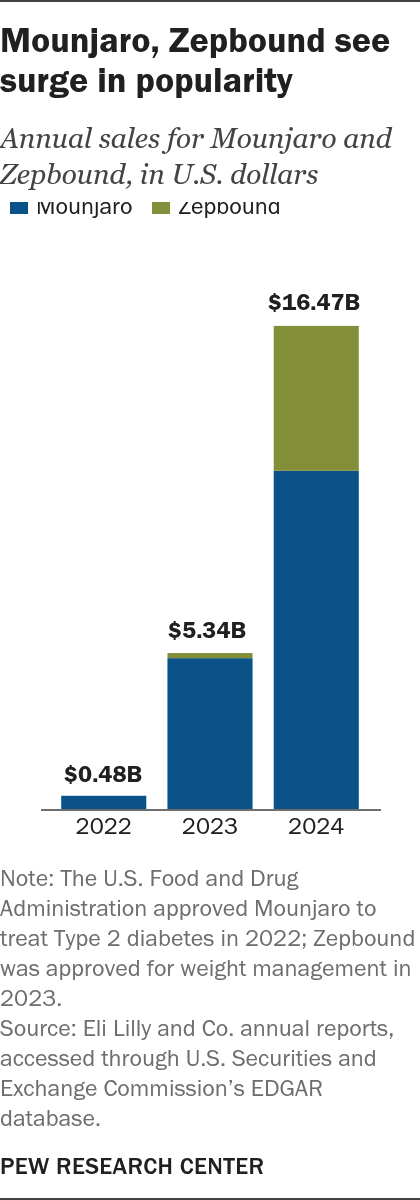
Source: Eli Lilly and Co. annual reports, accessed through U.S. Securities and Exchange Commission’s EDGAR database.
| Year | Mounjaro | Zepbound | Total company revenue |
|---|---|---|---|
| 2022 | $482,500,000 | $0 | $28,541,400,000 |
| 2023 | $5,163,100,000 | $175,800,000 | $34,124,100,000 |
| 2024 | $11,540,100,000 | $4,925,700,000 | $45,042,700,000 |
Source: Eli Lilly and Co. annual reports, accessed through U.S. Securities and Exchange Commission’s EDGAR database.
After receiving approval from the U.S. Food and Drug Administration in mid-2022, Mounjaro generated $5.2 billion in sales worldwide in 2023, and that jumped to $11.5 billion in 2024. Zepbound, approved in late 2023, made $4.9 billion in 2024. Together, Mounjaro and Zepbound accounted for around 37% of Eli Lilly’s 2024 revenue.
The largest market for weight loss drugs by far is North America. In 2024, nearly 70% of combined Ozempic, Wegovy and Rybelsus sales were in the U.S. alone, as were 84% of Mounjaro and Zepbound sales.
Thirteen states cover GLP-1s for obesity treatment under Medicaid, according to a January 2026 report from KFF, a nonpartisan research organization focused on health policy. Another seven states cover one or more weight loss drugs but not any GLP-1s.
The rising costs of weight loss drugs have caused some states to restrict who qualifies for them or end coverage altogether. For instance, California, New Hampshire, Pennsylvania and South Carolina stopped covering GLP-1s for weight loss as of Jan. 1. And North Carolina briefly suspended coverage last fall, citing shortfalls in funding.

Source: KFF.
| Name | FIPS | Insurance coverage |
|---|---|---|
| Alabama | 01 | Not covered |
| Alaska | 02 | Not covered |
| Arizona | 04 | Not covered |
| Arkansas | 05 | Not covered |
| California | 06 | Not covered |
| Colorado | 08 | Not covered |
| Connecticut | 09 | Coverage for one or more weight loss drugs but not GLP-1s |
| Delaware | 10 | Coverage in place and covers GLP-1s for obesity treatment |
| District of Columbia | 11 | Not covered |
| Florida | 12 | Not covered |
| Georgia | 13 | Not covered |
| Hawaii | 15 | Not covered |
| Idaho | 16 | Not covered |
| Illinois | 17 | Not covered |
| Indiana | 18 | Not covered |
| Iowa | 19 | Not covered |
| Kansas | 20 | Coverage in place and covers GLP-1s for obesity treatment |
| Kentucky | 21 | Not covered |
| Louisiana | 22 | Coverage for one or more weight loss drugs but not GLP-1s |
| Maine | 23 | Not covered |
| Maryland | 24 | Not covered |
| Massachusetts | 25 | Coverage in place and covers GLP-1s for obesity treatment |
| Michigan | 26 | Coverage in place and covers GLP-1s for obesity treatment |
| Minnesota | 27 | Coverage in place and covers GLP-1s for obesity treatment |
| Mississippi | 28 | Coverage in place and covers GLP-1s for obesity treatment |
| Missouri | 29 | Coverage in place and covers GLP-1s for obesity treatment |
| Montana | 30 | Not covered |
| Nebraska | 31 | Not covered |
| Nevada | 32 | Not covered |
| New Hampshire | 33 | Coverage for one or more weight loss drugs but not GLP-1s |
| New Jersey | 34 | Not covered |
| New Mexico | 35 | Coverage for one or more weight loss drugs but not GLP-1s |
| New York | 36 | Not covered |
| North Carolina | 37 | Coverage in place and covers GLP-1s for obesity treatment |
| North Dakota | 38 | Coverage for one or more weight loss drugs but not GLP-1s |
| Ohio | 39 | Not covered |
| Oklahoma | 40 | Not covered |
| Oregon | 41 | Not covered |
| Pennsylvania | 42 | Coverage for one or more weight loss drugs but not GLP-1s |
| Rhode Island | 44 | Coverage in place and covers GLP-1s for obesity treatment |
| South Carolina | 45 | Not covered |
| South Dakota | 46 | Not covered |
| Tennessee | 47 | Coverage in place and covers GLP-1s for obesity treatment |
| Texas | 48 | Coverage for one or more weight loss drugs but not GLP-1s |
| Utah | 49 | Coverage in place and covers GLP-1s for obesity treatment |
| Vermont | 50 | Not covered |
| Virginia | 51 | Coverage in place and covers GLP-1s for obesity treatment |
| Washington | 53 | Not covered |
| West Virginia | 54 | Not covered |
| Wisconsin | 55 | Coverage in place and covers GLP-1s for obesity treatment |
| Wyoming | 56 | Not covered |
Source: KFF.
KFF found that the number of Medicaid prescriptions for GLP-1s increased from 1.3 million in 2019 to 8.4 million in 2024. Likewise, Medicaid gross spending on GLP-1s increased from nearly $1 billion in 2019 to $8.6 billion 2024.
