Religious Groups Differ Widely in Their 2026 Midterm Preferences
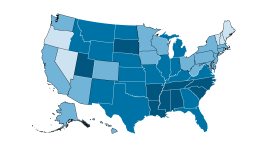
White evangelical Protestants and White Catholics favor Republicans in the midterms, while other religious groups split or lean Democratic.
Numbers, Facts and Trends Shaping Your World
Read our research on:

White evangelical Protestants and White Catholics favor Republicans in the midterms, while other religious groups split or lean Democratic.

Sent weekly on Wednesday
All
Publications
Event Audio http://features.pewresearch.org/pewresearch-org/religion/Rel_Trends_Aug%208_event.mp3 Download mp3 Americans’ Weakening Ties to Organized Religion, 1973-2012: Generations & Politics Michael Hout New York University Claude S. Fischer University of California, Berkeley http://www.slideshare.net/slideshow/embed_code/25382576 The Significance of the Rise of the Nones: Fundamental Change in Religiosity or Change in Labeling? Frank Newport Gallup http://www.slideshare.net/slideshow/embed_code/25382591 Religion Trends in the U.S. Greg Smith […]
On Aug. 8, 2013, the Pew Research Center brought together some of the leading experts in survey research on religion in the U.S. for a round-table discussion with journalists, scholars and other stakeholders on the rise of the religious “nones” and other important trends in American religion.
No religious group in the United States has released an official statement on radical life extension. However, here are brief summaries of how some clergy, bioethicists and other scholars from 18 major American religious groups say their traditions might approach this evolving issue.
Across 25 countries, Americans are the most likely to see the morality and ethics of people in their country as somewhat or very bad.
Singapore is the world’s most religiously diverse country overall as of 2020, while Yemen is the least diverse. But the U.S. ranks first among nations with very large populations, followed by Nigeria and Russia.
The Christian share of the population, after years of decline, has been relatively stable since 2019. And the religiously unaffiliated population, after rising rapidly for decades, has leveled off – at least temporarily.
The Global Religious Futures (GRF) project is jointly funded by The Pew Charitable Trusts and The John Templeton Foundation. Here are some big-picture findings from the GRF, together with context from other Pew Research Center studies.