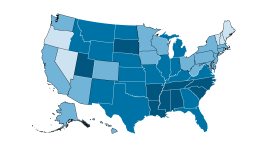
In our survey about 15 different behaviors debated in society, nine-in-ten U.S. adults say that married people having an affair is morally wrong. Republicans and Democrats differ sharply over the morality of abortion, homosexuality and the death penalty.
Professor Wilfred McClay argues that America’s particular brand of secularism, together with some features of Christianity, have produced a unique if imperfect mingling of religion and government in the country’s public life.
Pew Forum Faith Angle Conference Key West, Florida http://blip.tv/scripts/flash/showplayer.swf?autostart=false&brandname=Pew%20Forum&brandlink=https://www.pewresearch.org/religion&showplayerpath=http://blip.tv/scripts/flash/showplayer.swf&file=http://religionsecularism.blip.tv/rss/flash?sort=date&nsfw=dc&user=McClayForum&showguidebutton=false&showsharebutton=true&showfsbutton=true&showplaylist=trueWatch more event video on the multimedia page. More from the December 2007 Faith Angle Conference Religious Literacy: What Every American Should Know The Religion Factor in the 2008 Election More: Research, news, blogs Some of the nation’s leading journalists gathered in Key West, Fla., in December, […]
Pew Forum Faith Angle Conference Key West, Florida Some of the nation’s leading journalists gathered in Key West, Fla., in December 2007 for the Pew Forum’s biannual Faith Angle Conference on religion, politics and public life. Stephen Prothero, chair of the Department of Religion at Boston University, discussed the issue of religious illiteracy in the […]
The Pew Forum on Religion & Public Life has collected a variety of resources on Pope Benedict XVI’s views on public policy issues. The resources include links to his homilies and other writings on such issues as social justice, the participation of Catholics in political life, proposals to give legal recognition to same-sex unions, and […]
African Americans see a widening gulf between the values of middle class and poor blacks, and nearly four-in-ten say that because of the diversity within their community, blacks can no longer be thought of as a single race.
Washington, D.C. http://blip.tv/scripts/flash/showplayer.swf?autostart=false&brandname=Pew%20Forum&brandlink=https://www.pewresearch.org/religion&showplayerpath=http://blip.tv/scripts/flash/showplayer.swf&file=http://pewforum.blip.tv/rss/flash?sort=date&nsfw=dc&user=pewforum&showguidebutton=false&showsharebutton=true&showfsbutton=true&showplaylist=true The Pew Forum invited former presidential speechwriter Michael Gerson to discuss his new book, Heroic Conservatism, with Forum senior advisors Michael Cromartie and E.J. Dionne Jr. and a select group of journalists. Gerson was challenged to define “heroic conservatism” and critique the Bush administration’s record on implementing the “compassionate conservative” philosophy Gerson […]
That’s the percentage of the U.S. public that thinks that Pope Benedict XVI is doing an excellent or good job at promoting good relations with other major religions; this compares with 46% who say he is doing only a fair or poor job.
Washington, D.C. The Pew Forum invited Mass. Sen. John Kerry to discuss the propriety of public inquiry into politicians’ religious beliefs and how those beliefs influence candidates’ views on the issues of the day. Kerry, a 2004 presidential candidate, also addressed the role of faith in presidential campaigns, his perspective on religion in the 2008 […]
After years of decline, the U.S. Christian share now shows signs of leveling off. The new Religious Landscape Study explores trends in identity, beliefs and practices.
The Global Religious Futures (GRF) project is jointly funded by The Pew Charitable Trusts and The John Templeton Foundation. Here are some big-picture findings from the GRF, together with context from other Pew Research Center studies.