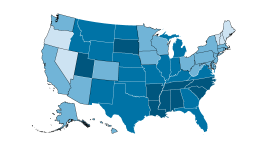
Religious Groups Differ Widely in Their 2026 Midterm Preferences
White evangelical Protestants and White Catholics favor Republicans in the midterms, while other religious groups split or lean Democratic.
Numbers, Facts and Trends Shaping Your World
Read our research on:

White evangelical Protestants and White Catholics favor Republicans in the midterms, while other religious groups split or lean Democratic.

Sent weekly on Wednesday
All
Publications
Introduction and Overview MILLENNIALS This is part of a Pew Research Center series of reports exploring the behaviors, values and opinions of the teens and twenty-somethings that make up the Millennial generation. By some key measures, Americans ages 18 to 29 are considerably less religious than older Americans. Fewer young adults belong to any particular […]
Across predominantly Muslim nations, there is little enthusiasm for the extremist Islamic organizations Hamas and Hezbollah, although there are pockets of support for both groups, especially in the Middle East.
Note: For a more recent overview of the Census Bureau’s history of asking about religion, read this April 2023 article. The U.S. Census Bureau has not asked questions about religion since the 1950s, but the federal government did gather some information about religion for about a century before that. Starting in 1850, census takers began […]
Members of the post-communist generation offer much more positive evaluations of the political and economic changes their countries have undergone over the past two decades than do those who were adults when communism collapsed.
One-in-four American adults believe in astrology, including 23% of Christians.
Across 25 countries, Americans are the most likely to see the morality and ethics of people in their country as somewhat or very bad.
Singapore is the world’s most religiously diverse country overall as of 2020, while Yemen is the least diverse. But the U.S. ranks first among nations with very large populations, followed by Nigeria and Russia.
The Christian share of the population, after years of decline, has been relatively stable since 2019. And the religiously unaffiliated population, after rising rapidly for decades, has leveled off – at least temporarily.
The Global Religious Futures (GRF) project is jointly funded by The Pew Charitable Trusts and The John Templeton Foundation. Here are some big-picture findings from the GRF, together with context from other Pew Research Center studies.