2020 election reveals two broad voting coalitions fundamentally at odds
If one takeaway from the election is historic voter participation, another may be the political polarization that has come to define the U.S.
All
Publications
If one takeaway from the election is historic voter participation, another may be the political polarization that has come to define the U.S.
Partisanship remains the strongest factor dividing the American public. Yet there are substantial divisions within both parties on fundamental political values, views of current issues and the severity of the problems facing the nation.
Trump has evoked strong feelings as president – both positive and negative. How would you feel discussing him at a dinner party with a group of people who have opposing views from your own? In this interactive, see how your views compare with those of other Americans.
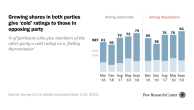
Division and animosity between the two political parties in the U.S. has deepened. Most partisans view the other side as ‘closed-minded’; Republicans see Democrats as ‘unpatriotic.’
When Republicans assess the climate for political discourse, they see a more hospitable environment for Democrats than for members of their own party.
Most independents are not all that “independent” politically. And the small share of Americans who are truly independent stand out for their low level of interest in politics.
Partisans have moved apart not just in political values and approaches to addressing issues, but also on the issues they identify as top priorities.
Partisan loyalty and dislike of the opposing party and its candidates were major factors for voters’ choices in this month’s midterms.
Republicans are far more likely than Democrats to view the Democratic Party as very liberal. And the pattern is similar, though less pronounced, in views of the GOP’s ideology: More Democrats than Republicans see the Republican Party as very conservative. When asked to evaluate the Democratic Party’s ideology, a majority of Republicans (55%) give […]
Interactive chart that illustrates the shift in the American public’s political values from 1994-2017, using a scale of 10 questions asked together on seven Pew Research Center surveys.