The United States at 250: How the Country Has Changed in the Past 50 Years
As America turns 250, explore how demographics, work, family and economics have shifted since 1976, based on 50 years of Census data.
All
Publications
As America turns 250, explore how demographics, work, family and economics have shifted since 1976, based on 50 years of Census data.
In 2023, 46% of all managers in the U.S. were women. This is up from 29% in 1980 but still slightly lower than the 49% of all workers who were women as of 2023.
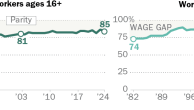
In 2024, women earned an average of 85% of what men earned, according to an analysis of median hourly earnings of both full- and part-time workers.
In 2022, single women without children had a median wealth of $87,200, while the typical single man had $82,100.
Republican men stand out in views of their own masculinity, the impact of changing gender roles and men’s progress in recent decades.
Among the 10 largest occupations held by young adults without a college degree, large numbers are employed as retail salespersons and first-line supervisors of sales workers.
Government data shows gains in education, employment and earnings for Hispanic women, but gaps with other groups remain.
Many juggle cultural expectations and gender roles from both Latin America and the U.S., like doing housework and succeeding at work.
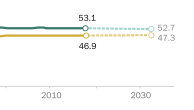
Women made up 47% of the U.S. civilian labor force in 2023, up from 30% in 1950 – but growth has stagnated.
Women now make up 35% of workers in the United States’ 10 highest-paying occupations – up from 13% in 1980.