Religious Groups Differ Widely in Their 2026 Midterm Preferences
White evangelical Protestants and White Catholics favor Republicans in the midterms, while other religious groups split or lean Democratic.
Numbers, Facts and Trends Shaping Your World
Read our research on:

White evangelical Protestants and White Catholics favor Republicans in the midterms, while other religious groups split or lean Democratic.

Sent weekly on Wednesday
All
Publications
There are deep divisions in Israeli society over political values and religion’s role in public life — not only between Jews and the Arab minority, but also among the religious subgroups that make up Israeli Jewry.
We looked at nine major religious organizations in the U.S. that both ordain women and allow them to hold top leadership slots.
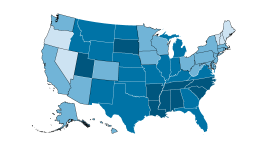
Looking at the religious makeup of individual states, and at each party’s potential voters within a particular state, can help in understanding the electoral landscape.
From 1965 to 2015, more than 16 million Mexicans migrated to the U.S. in one of the largest mass migrations in modern history. But Mexican migration to the U.S. has slowed in recent years. Today, Mexico also increasingly serves as a land bridge for Central American immigrants traveling to the U.S.
A historic event within global Christianity is set to take place Friday as Pope Francis meets Russian Orthodox Patriarch Kirill in Cuba – the first-ever meeting between the leaders of the Catholic and Russian Orthodox churches since the Orthodox tradition broke away from Catholicism nearly 1,000 years ago.
Mexico is home to not only the largest Spanish-speaking population in the world, but one of the biggest Catholic populations, too.
Half of Americans say the next president should be careful not to criticize Islam as a whole when speaking about Islamic extremists, while four-in-ten want the next president to speak bluntly about Islamic extremists even if the statements are critical of Islam as a whole.
If Hillary Clinton ends up being the Democratic Party’s nominee for president, her politics won’t be the only thing many Republicans and Democrats disagree about during the coming campaign.
Religion has long been entangled in America’s politics and its political campaigns.
GOP contender Donald Trump is not widely viewed as religious, even among Republicans. And the share of Americans who say Hillary Clinton is not a religious person has risen sharply since she first ran for president eight years ago.
Across 25 countries, Americans are the most likely to see the morality and ethics of people in their country as somewhat or very bad.
Singapore is the world’s most religiously diverse country overall as of 2020, while Yemen is the least diverse. But the U.S. ranks first among nations with very large populations, followed by Nigeria and Russia.
The Christian share of the population, after years of decline, has been relatively stable since 2019. And the religiously unaffiliated population, after rising rapidly for decades, has leveled off – at least temporarily.
The Global Religious Futures (GRF) project is jointly funded by The Pew Charitable Trusts and The John Templeton Foundation. Here are some big-picture findings from the GRF, together with context from other Pew Research Center studies.