Religious Groups Differ Widely in Their 2026 Midterm Preferences
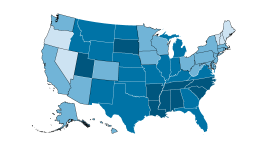
White evangelical Protestants and White Catholics favor Republicans in the midterms, while other religious groups split or lean Democratic.
Numbers, Facts and Trends Shaping Your World
Read our research on:

White evangelical Protestants and White Catholics favor Republicans in the midterms, while other religious groups split or lean Democratic.

Sent weekly on Wednesday
All
Publications
10 a.m.-Noon Rescheduled from February 18 Washington, D.C. Featured Speakers: Stanley Carlson-Thies, Fellow, Center for Public Justice; former White House Associate Director for Cabinet Affairs Barry Lynn, Executive Director, Americans United for Separation of Church and State Respondents: Anne Farris, Washington Correspondent, the Roundtable on Religion and Social Welfare Policy Fredrica D. Kramer, Senior Consultant […]
3:00 – 5:00 p.m. (reception to follow) Washington, D.C. Speakers Wilfred McClay, SunTrust Chair of Humanities and Professor of History, University of Tennessee at Chattanooga Hugh Heclo, Robinson Professor of Public Affairs, George Mason University E.J. Dionne Jr., Co-Chair, the Pew Forum on Religion and Public Life; Senior Fellow, the Brookings Institution; and columnist, the […]
Remarks of Andrew Kohut to The Senate Foreign Relations Committee Hearing
10 a.m.-12:00 p.m. Washington, D.C. Presenters: Fr. Bryan Hehir, President, Catholic Charities, USA; Distinguished Professor of Ethics and International Affairs, School of Foreign Service, Georgetown University Michael Walzer, Professor, Institute for Advanced Study, Princeton, N.J.; Author, Just and Unjust Wars and Spheres of Justice: A Defense of Pluralism and Equality Respondents: Charles Krauthammer, Columnist, Washington […]
4:00 p.m. University of Chicago Divinity School Chicago, Illinois Dr. Max Stackhouse is director of the Kuyper Center for Public Theology and Stephen Colwell Professor of Christian Ethics at Princeton Theological Seminary. He is the author and editor of numerous books on a wide variety of topics including most recently (with Peter Paris) a three-volume […]
More than three-quarters of Internet users went online this season for some kind of holiday activity. For many email was vital for planning gatherings or sending greetings. Online holiday shopping was up slightly from the previous year.
Introduction and Summary Religion is much more important to Americans than to people living in other wealthy nations. Six-in-ten (59%) people in the U.S. say religion plays a very important role in their lives. This is roughly twice the percentage of self-avowed religious people in Canada (30%), and an even higher proportion when compared with […]
Overview For an updated analysis of the link between religiosity and wealth, see World Publics Welcome Global Trade — But Not Immigration. Religion is much more important to Americans than to people living in other wealthy nations. Six-in-ten (59%) people in the U.S. say religion plays a very important role in their lives. This is […]
This survey was designed to explore the attitudes and experiences of Latinos on a wide variety of topics.
Across 25 countries, Americans are the most likely to see the morality and ethics of people in their country as somewhat or very bad.
Singapore is the world’s most religiously diverse country overall as of 2020, while Yemen is the least diverse. But the U.S. ranks first among nations with very large populations, followed by Nigeria and Russia.
The Christian share of the population, after years of decline, has been relatively stable since 2019. And the religiously unaffiliated population, after rising rapidly for decades, has leveled off – at least temporarily.
The Global Religious Futures (GRF) project is jointly funded by The Pew Charitable Trusts and The John Templeton Foundation. Here are some big-picture findings from the GRF, together with context from other Pew Research Center studies.