What we know about veterans who work for the federal government
As of September 2024, more than 700,000 veterans worked in various federal departments and agencies.
Numbers, Facts and Trends Shaping Your World
Read our research on:

All
Publications
As of September 2024, more than 700,000 veterans worked in various federal departments and agencies.
These groups are far apart in their enthusiasm and predictions for AI, but both want more personal control and worry about too little regulation.
Among blue-collar workers, 43% say they feel extremely or very satisfied with their jobs; by comparison, 53% of other workers express this level of satisfaction.
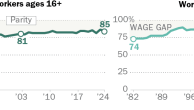
In 2024, women earned an average of 85% of what men earned, according to an analysis of median hourly earnings of both full- and part-time workers.
American workers have mixed feelings about how AI technologies, like ChatGPT, will affect jobs in the future.
Overall, a slim majority of Americans (55%) express a great deal or fair amount of confidence in federal career employees, while 44% have little or no confidence.
While Black-owned businesses have grown significantly in the U.S. in recent years, they still make up a small share of overall firms and revenue.
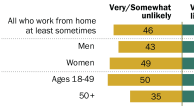
Among employed adults who have a job that can be done from home, 75% are working remotely at least some of the time.
U.S. workers feel their jobs are secure and few are seeking a job change. But only half are highly satisfied with their job overall.
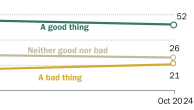
About half of workers (52%) now say focusing on increasing DEI at work is mainly a good thing, down from 56% in February 2023.