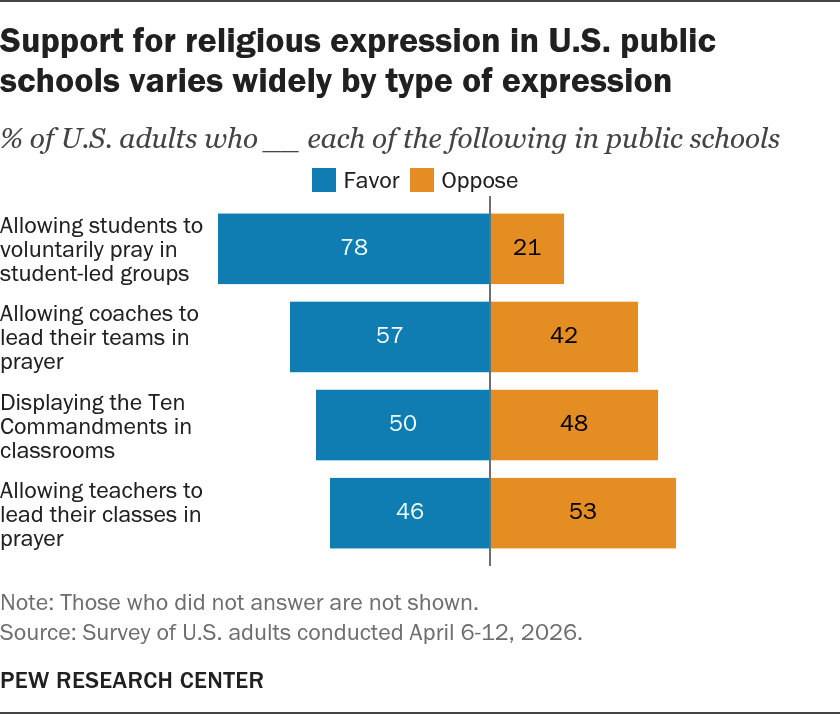
Several states recently have passed or proposed legislation to incorporate prayer or display the Ten Commandments in public schools. A new Pew Research Center survey shows that many Americans are receptive to religious expressions at public schools:
| Favor | Oppose | |
|---|---|---|
| Allowing students to voluntarily pray in student-led groups | 78% | 21% |
| Allowing coaches to lead their teams in prayer | 57% | 42% |
| Displaying the Ten Commandments in classrooms | 50% | 48% |
| Allowing teachers to lead their classes in prayer | 46% | 53% |
- 78% of U.S. adults favor allowing students to voluntarily pray in student-led groups.
- 57% favor allowing coaches to lead their teams in prayer.
- 50% favor displaying the Ten Commandments in classrooms.
- 46% favor allowing teachers to lead their classes in prayer.
But the April 2026 survey also shows that relatively few Americans think it should be mandatory for students to participate in teacher-led school prayer.
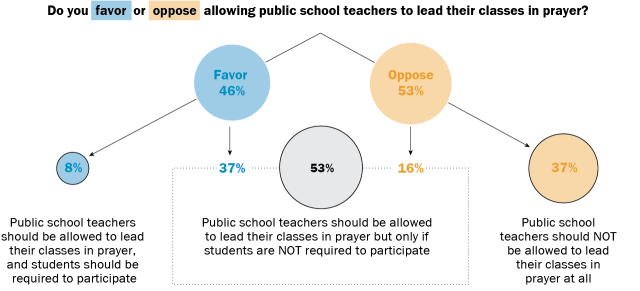
The survey asked respondents whether they favor or oppose allowing public school teachers to lead their classes in prayer, with a follow-up question depending on their answer:
- Those who favor teacher-led prayer were asked whether they think it should be required of students or whether it should be allowed only if students are not required to participate.
- Those who oppose teacher-led prayer were asked whether teachers should not be allowed to lead classes in prayer at all or whether it should be allowed only if students are not required to participate.
When responses to these questions are combined, 8% of Americans say they favor teacher-led prayer and believe that students should be required to participate. Far more (53%) say they favor teacher-led prayer but only if students are not required to participate. An additional 37% say teacher-led prayer should not be allowed at all.
Taken together, about six-in-ten Americans support allowing some form of teacher-led school prayer, but the vast majority of them think students’ participation should be optional.
| % of U.S adults who … | Share | % of U.S. adults who say … | Share |
|---|---|---|---|
| Favor allowing public school teachers to lead their classes in school prayer | 46% | Public school teachers should be allowed to lead their classes in prayer, and students should be required to participate | 8% |
| Oppose allowing public school teachers to lead their classes in school prayer | 53% | Public school teachers should be allowed to lead their classes in prayer, but only if students are not required to participate | 53% |
| Public school teachers should not be allowed to lead their classes in prayer at all | 37% |
How U.S. subgroups view teacher-led prayer in public schools

| Be allowed to lead their classes in prayer, and students should be required to participate | Be allowed to lead their classes in prayer, but only if students are not required to participate | Not be allowed to lead their classes in prayer at all | Don’t know/Refused | Group | |
|---|---|---|---|---|---|
| All U.S. adults | 8% | 53% | 37% | 2% | 1 |
| White evangelical Prot. | 7% | 80% | 11% | 2% | 2 |
| Black Protestant | 23% | 55% | 18% | 4% | 2 |
| Catholic | 10% | 57% | 32% | 2% | 2 |
| White Prot., not evang. | 6% | 56% | 37% | 1% | 2 |
| Religiously unaffiliated | 4% | 35% | 59% | 2% | 2 |
| Rep/lean Rep | 10% | 69% | 19% | 1% | 3 |
| Dem/lean Dem | 6% | 38% | 54% | 1% | 3 |
| Ages 50+ | 9% | 55% | 34% | 2% | 4 |
| Ages 18-49 | 8% | 51% | 39% | 2% | 4 |
| South | 11% | 58% | 29% | 2% | 5 |
| Midwest | 6% | 56% | 36% | 2% | 5 |
| Northeast | 9% | 47% | 42% | 2% | 5 |
| West | 5% | 46% | 47% | 2% | 5 |
In most political, religious and demographic subgroups of the U.S. population, relatively few people say public school teachers should be allowed to lead their classes in prayer and that students should be required to participate.
The far more common view is that public school teachers should be allowed to lead prayers but that students should not be required to participate.
Religiously unaffiliated Americans – those who identify as atheist, agnostic or “nothing in particular” when asked about their religion – mostly say teachers should not be allowed to lead their classes in prayer at all (59% say this).
People of many faiths were included in the survey, but the sample does not contain enough Jews, Muslims or members of other relatively small U.S. religious groups to allow their opinions to be reported separately.
Most Republicans and Republican-leaning independents support teacher-led prayer in some form. By contrast, a slight majority of Democrats and Democratic leaners oppose teacher-led prayer in classrooms, even if it’s voluntary.
Americans ages 50 and older are slightly more likely than adults under age 50 to support some form of teacher-led prayer. And adults who live in the South and Midwest are more likely than those who live in the Northeast and West to support some form of teacher-led prayer.
How U.S. subgroups view other forms of religious expression in public schools

| Favor | Oppose | Group | |
|---|---|---|---|
| All U.S. adults | 78% | 21% | 1 |
| White evangelical Prot. | 96% | 4% | 2 |
| Black Protestant | 88% | 10% | 2 |
| White Prot., not evang. | 85% | 14% | 2 |
| Catholic | 79% | 20% | 2 |
| Religiously unaffiliated | 64% | 35% | 2 |
| Rep/lean Rep | 90% | 10% | 3 |
| Dem/lean Dem | 69% | 30% | 3 |
| Ages 50+ | 80% | 19% | 4 |
| Ages 18-49 | 77% | 22% | 4 |
| South | 82% | 17% | 5 |
| Midwest | 80% | 19% | 5 |
| Northeast | 75% | 23% | 5 |
| West | 73% | 26% | 5 |
A majority of Americans in both political parties, all major geographic regions and most of the country’s large religious groups favor allowing public school students to voluntarily pray in student-led groups.
This includes roughly two-thirds of religiously unaffiliated Americans (64%).
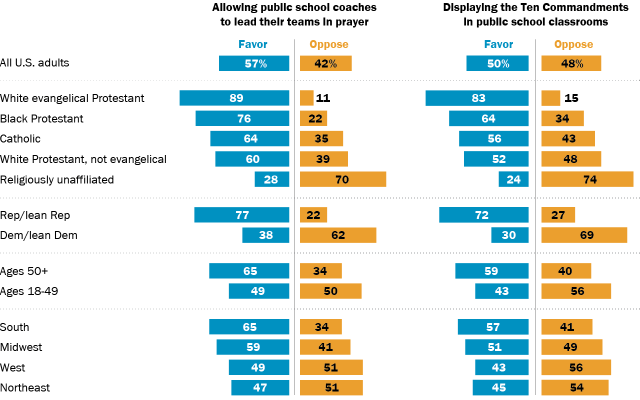
There’s less consensus on whether coaches should be allowed to lead public school sports teams in prayer, as well as whether the Ten Commandments should be displayed in public school classrooms.
Large majorities of White evangelical Protestants and Black Protestants favor these forms of religious expression in public schools. The same is true for half or more of Catholics and White nonevangelical Protestants.
By contrast, most religiously unaffiliated Americans oppose allowing coaches to lead their teams in prayer and also oppose displaying the Ten Commandments in classrooms.
Clear majorities of Republicans support coach-led prayer and displaying the Ten Commandments in public school classrooms. Most Democrats oppose these religious expressions.
Older Americans are more likely than younger Americans to support both types of expression. For example, 59% of adults ages 50 and older favor displaying the Ten Commandments in public school classrooms, compared with 43% of adults under 50.
Attitudes also differ considerably by region. Americans who live in the South and Midwest are generally more likely than Americans in the Northeast and West to support these two religious expressions in public schools.
| Favor allowing public school coaches to lead their teams in prayer | Oppose allowing public school coaches to lead their teams in prayer | Favor displaying the Ten Commandments in public school classrooms | Oppose displaying the Ten Commandments in public school classrooms | |
|---|---|---|---|---|
| All U.S. adults | 57% | 42% | 50% | 48% |
| White evangelical Prot. | 89% | 11% | 83% | 15% |
| Black Protestant | 76% | 22% | 64% | 34% |
| Catholic | 64% | 35% | 56% | 43% |
| White Prot., not evang. | 60% | 39% | 52% | 48% |
| Religiously unaffiliated | 28% | 70% | 24% | 74% |
| Rep/lean Rep | 77% | 22% | 72% | 27% |
| Dem/lean Dem | 38% | 62% | 30% | 69% |
| Ages 50+ | 65% | 34% | 59% | 40% |
| Ages 18-49 | 49% | 50% | 43% | 56% |
| South | 65% | 34% | 57% | 41% |
| Midwest | 59% | 41% | 51% | 49% |
| West | 49% | 51% | 43% | 56% |
| Northeast | 47% | 51% | 45% | 54% |
Note: Here are the questions used for this analysis, along with responses and the survey methodology.