Millions of Latin Americans will head to the polls this year, with presidential elections planned in Peru in April, Colombia in May and Brazil in October. Clear majorities in these three countries see a role for religion in key aspects of public life, as do many others elsewhere in the region, according to Pew Research Center surveys conducted in 2024.
Protestants – who account for a relatively small share of the population in each of the six Latin American countries we surveyed – often stand out as especially inclined to favor a strong role for Christianity in their country’s leadership, national identity and laws.
Religion and national leaders
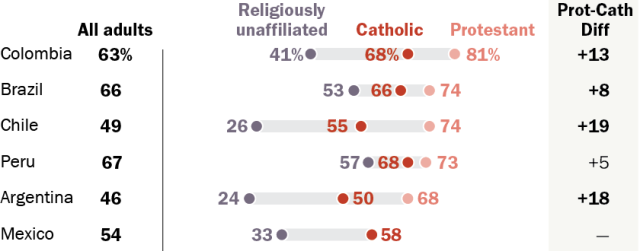
As of 2024, around two-thirds of adults in Brazil, Colombia and Peru say having a president who stands up for people with their religious beliefs is somewhat or very important (rather than not too or not at all important). In Argentina, Chile and Mexico, closer to half of all adults take the same position.
| All adults | Religiously unaffiliated | Catholic | Protestant | Prot-Cath Diff | |
|---|---|---|---|---|---|
| Colombia | 63% | 41% | 68% | 81% | +13 |
| Brazil | 66% | 53% | 66% | 74% | +8 |
| Chile | 49% | 26% | 55% | 74% | +19 |
| Peru | 67% | 57% | 68% | 73% | +5 |
| Argentina | 46% | 24% | 50% | 68% | +18 |
| Mexico | 54% | 33% | 58% | — | — |
While the region’s three largest religious groups all tend to value national leaders who defend their beliefs, Protestants are generally the most likely to express this view. For example, 74% of Chilean Protestants say it’s important for a president to stand up for their religious beliefs, compared with 55% of Catholics and 26% of unaffiliated adults – that is, people who identify as atheist, agnostic or “nothing in particular.”
Unaffiliated adults, sometimes called “nones,” tend to place less importance on whether the president of their country stands up for their views on religion. Still, at least half of unaffiliated adults in Brazil (53%) and Peru (57%) see it as an important trait.
Our surveys also asked people how important it is for a president to have strong religious beliefs in general – even if they differ from their own – and how important it is for a president to have the same religious beliefs as they do.
Views of these two traits vary across the region. For example, 35% of adults in Chile – compared with 59% in Peru – say it’s important for a president to have the same religious beliefs as they do. But Protestants generally place greater importance on this than do Catholics or “nones” in each country.
Related: Comparing levels of religious nationalism around the world
There also seems to be a link between Christian identity and political ideology on these questions. Latin American Catholics and Protestants often lean right ideologically, and adults on the right tend to be more likely than those on the left to want a national leader with these religious characteristics.
Religion and national identity
Many Latin Americans also see Christianity as central to national belonging.
| All adults | Religiously unaffiliated | Catholic | Protestant | Prot-Cath Diff | |
|---|---|---|---|---|---|
| Brazil | 71% | 43% | 78% | 84% | +6 |
| Peru | 72% | 42% | 74% | 81% | +7 |
| Colombia | 57% | 36% | 61% | 72% | +11 |
| Chile | 36% | 13% | 45% | 55% | +10 |
| Argentina | 36% | 15% | 41% | 55% | +14 |
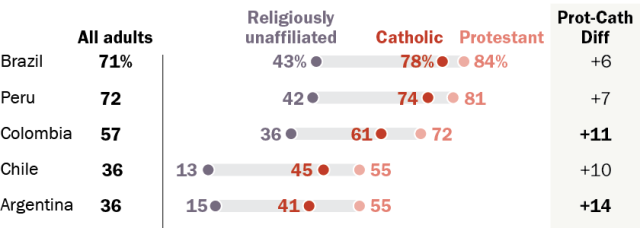
Majorities of adults in Brazil, Colombia and Peru say that being a Christian is somewhat or very important to be a true member of their nation (for example, to be “truly Brazilian” or “truly Peruvian”). Similar shares of Protestants and Catholics in Brazil and Peru take this position. But Protestants stand out in Colombia: 72% link Christianity with their national identity, compared with 61% of Catholics.
Fewer adults overall in Argentina and Chile see a link between Christian identity and national belonging.
The Bible’s role in the law
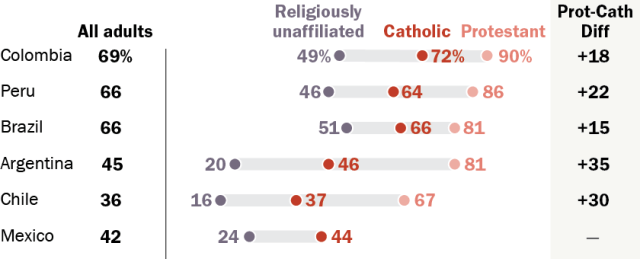
In several Latin American nations, many people want the Bible to influence their country’s legal system. About two-thirds of adults in Brazil, Colombia and Peru say the Bible should have a fair amount or great deal of influence (as opposed to not much influence or none at all) on the laws of their country.
| All adults | Religiously unaffiliated | Catholic | Protestant | Prot-Cath Diff | |
|---|---|---|---|---|---|
| Colombia | 69% | 49% | 72% | 90% | +18 |
| Peru | 66% | 46% | 64% | 86% | +22 |
| Brazil | 66% | 51% | 66% | 81% | +15 |
| Argentina | 45% | 20% | 46% | 81% | +35 |
| Chile | 36% | 16% | 37% | 67% | +30 |
| Mexico | 42% | 24% | 44% | — | — |
As with the other questions about religion and public life, Protestants are considerably more likely than Catholics to say the Bible should influence their country’s laws. In Argentina, for example, 81% of Protestants hold this view, compared with 46% of Catholics.
In addition, about half of religiously unaffiliated adults in Brazil (51%) and Colombia (49%) say the Bible should shape their country’s laws. Nearly as many in Peru (46%) hold this belief. In the other countries we surveyed, no more than about a quarter of religious “nones” say the same.
Religion’s official place in national laws varies across Latin America. The constitutions of Chile and Peru recognize the separation of church and state, though Peru also recognizes Catholicism as “an important element in the historical, cultural and moral foundation” of the country. In Argentina, the Catholic Church has preferential legal status, though the constitution does not recognize a state religion.
Colombia’s constitution states that “all religious faiths and churches are equally free before the law,” and the country does not claim a religious or nonreligious identity. Similarly, both Brazil’s and Mexico’s constitutions prohibit the government from supporting or restricting any religion.
Note: Here are the questions used for this analysis, along with responses, and the survey methodology.