

Illinois and New York recently joined 11 other states and the District of Columbia in allowing people with serious illnesses to end their lives with a doctor’s help. While most states still ban physician-assisted death, a majority of Americans see the practice as morally permissible or don’t consider it a moral issue, according to a recent Pew Research Center survey.
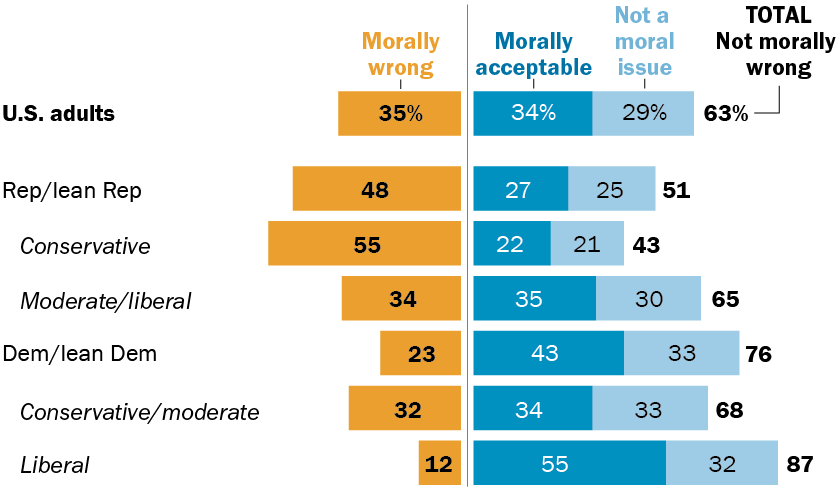
About six-in-ten Americans say that patients choosing to end their lives with the help of a doctor is either morally acceptable (34%) or not a moral issue (29%). Another 35% say it’s morally wrong, according to the survey, which was conducted in spring 2025.
Physician-assisted death is also sometimes called “medical aid in dying,” “doctor-assisted death” or “physician-assisted suicide.” (Refer to the terminology box for more details.)
Attitudes toward physician-assisted death vary by political party, as they do on most of the 15 behaviors we asked about in our surveys on moral issues.
| Morally wrong | Morally acceptable | Not a moral issue | TOTAL Not morally wrong | |
|---|---|---|---|---|
| U.S. adults | 35% | 34% | 29% | 63% |
| Rep/lean Rep | 48% | 27% | 25% | 51% |
| >Conservative | 55% | 22% | 21% | 43% |
| >Moderate/liberal | 34% | 35% | 30% | 65% |
| Dem/lean Dem | 23% | 43% | 33% | 76% |
| >Conservative/moderate | 32% | 34% | 33% | 68% |
| >Liberal | 12% | 55% | 32% | 87% |
About three-quarters of Democrats and Democratic-leaning independents see physician-assisted death as morally acceptable (43%) or as a moral nonissue (33%). By comparison, only about half of Republicans and GOP leaners take those positions. Republicans are twice as likely as Democrats to call the practice morally wrong (48% vs. 23%).
Physician-assisted death has been hotly debated in the United States since at least the 1990s, when Oregon passed the country’s first “Death with Dignity” bill. The practice aims to grant terminally ill patients more control over suffering at the end of life, though it has often raised questions around consent and eligibility. Some religious leaders also have condemned it as immoral or unethical.
| Morally wrong | Morally acceptable | Not a moral issue | TOTAL Not morally wrong | |
|---|---|---|---|---|
| Religiously affiliated | 44% | 28% | 26% | 54% |
| Protestant | 48% | 26% | 25% | 51% |
| > White evang. Prot. | 60% | 18% | 20% | 38% |
| > White Prot., not evang. | 25% | 46% | 28% | 74% |
| > Black Protestant | 52% | 18% | 30% | 48% |
| Catholic | 40% | 31% | 27% | 59% |
| Jewish | 23% | 53% | 23% | 76% |
| Religiously unaffiliated | 12% | 51% | 36% | 87% |
| Atheist | 5% | 66% | 29% | 95% |
| Agnostic | 6% | 63% | 30% | 93% |
| Nothing in particular | 17% | 39% | 41% | 80% |
| Among those who say religion is __ important in their life | ||||
| Very | 59% | 17% | 22% | 39% |
| Somewhat | 31% | 36% | 32% | 67% |
| Not too | 14% | 52% | 33% | 85% |
| Not at all | 8% | 56% | 36% | 91% |
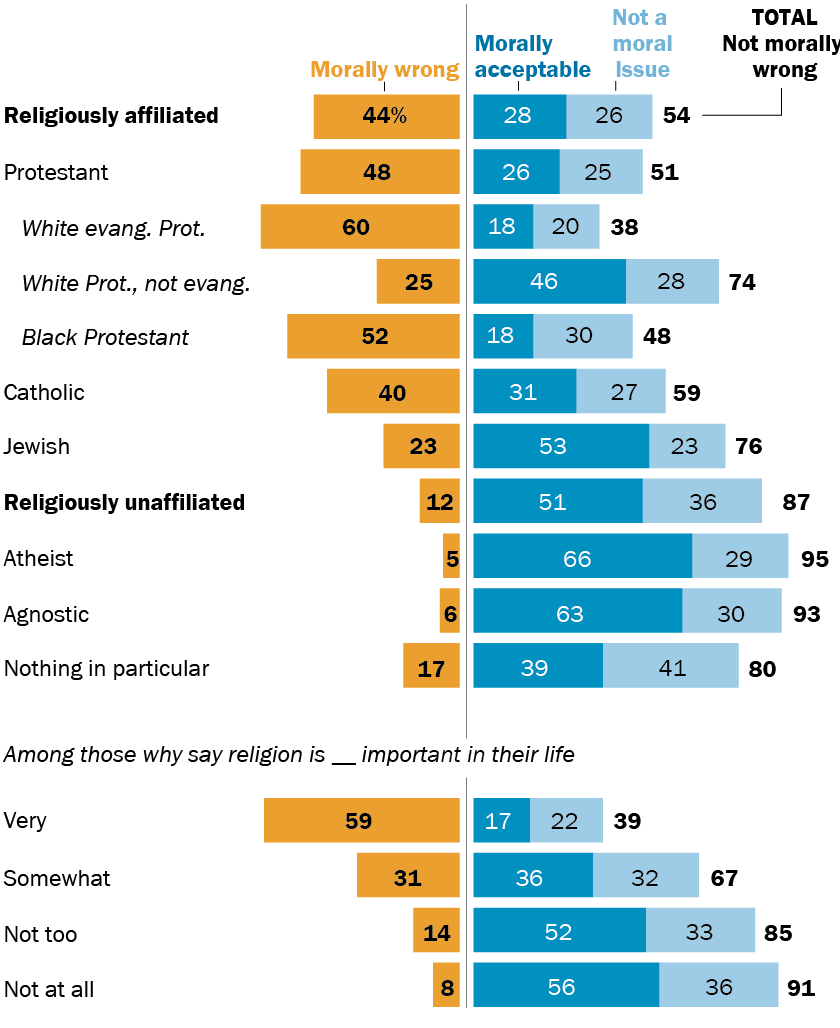
Our latest survey data shows that most U.S. Jews (76%) and White nonevangelical Protestants (74%) see the practice as morally permissible, as do a majority of Catholics (59%), even though Catholic doctrine prohibits medical assistance in dying.
The vast majority of religiously unaffiliated adults, including 95% of atheists and 93% of agnostics, express no moral opposition to the practice.
On the other hand, 60% of White evangelical Protestants and 52% of Black Protestants say it’s morally wrong for patients to end their lives with medical aid.
In general, adults who are highly religious tend to take a stronger stance against medical assistance in dying. For example, Americans who say religion is very important in their lives (59%) are far more likely than those who say religion is personally not too important (14%) or not at all important (8%) to see physician-assisted death as morally wrong.
Note: Here are our survey questions, along with responses, and the survey methodology.
