
Some of the movies nominated for Academy Awards in 2026 were big box office success stories. But with the rise of streaming services, some Americans may be opting to watch them from home instead of on the big screen.
How many Americans have seen a movie in theaters recently? Here’s a snapshot of U.S. moviegoing habits, based on Pew Research Center surveys and ticket sales data.
Who is going to the movies?
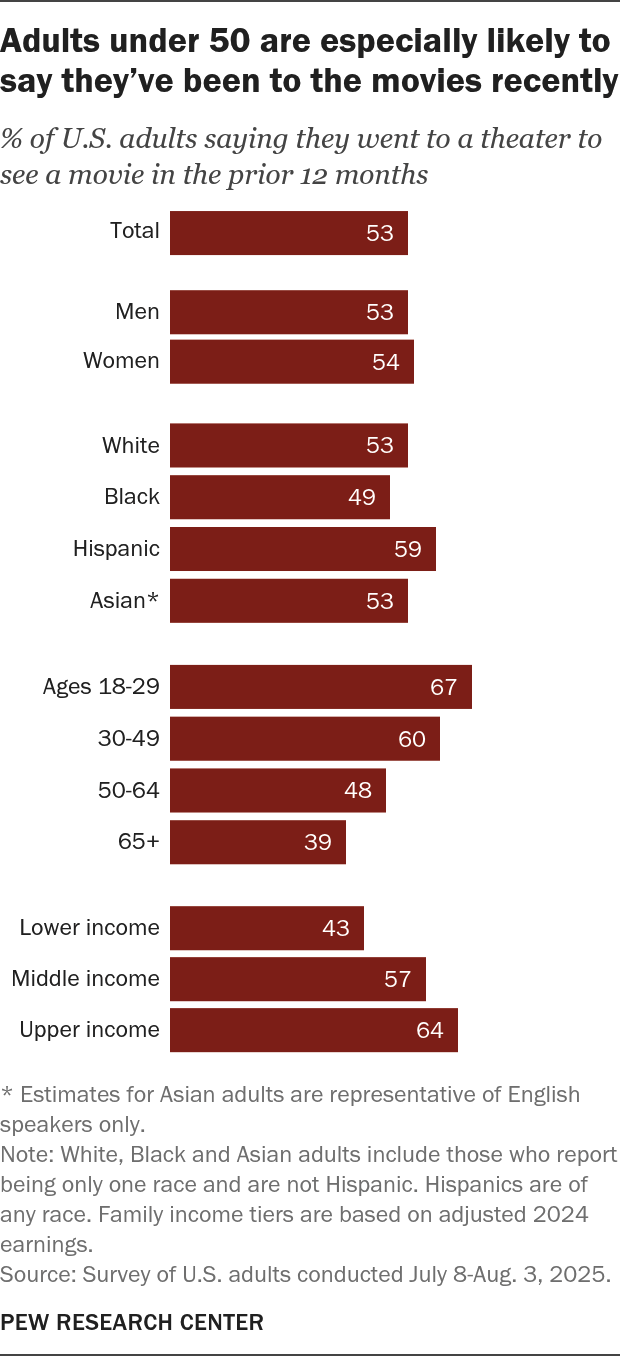
About half of Americans (53%) said in a summer 2025 survey that they had seen a movie in theaters in the past year. A small share (7%) said they’d never seen a movie in theaters.
Note: White, Black and Asian adults include those who report being only one race and are not Hispanic. Hispanics are of any race. Family income tiers are based on adjusted 2024 earnings.
| Population | Group | % |
|---|---|---|
| Total | total | 53 |
| Men | gender | 53 |
| Women | gender | 54 |
| White | race and ethnicity | 53 |
| Black | race and ethnicity | 49 |
| Hispanic | race and ethnicity | 59 |
| Asian* | race and ethnicity | 53 |
| Ages 18-29 | age | 67 |
| 30-49 | age | 60 |
| 50-64 | age | 48 |
| 65+ | age | 39 |
| Lower income | income | 43 |
| Middle income | income | 57 |
| Upper income | income | 64 |
Note: White, Black and Asian adults include those who report being only one race and are not Hispanic. Hispanics are of any race. Family income tiers are based on adjusted 2024 earnings.
Younger U.S. adults were more likely than older ones to say they’d been to a movie theater in the past year. Two-thirds of those ages 18 to 29 had done this, compared with 39% of Americans ages 65 and older.
Several other demographic groups were also especially likely to have hit the silver screen:
- Hispanic adults: 59% of Hispanic adults had been to a movie theater in the past year, compared with smaller shares of White (53%) and Black adults (49%). (The share of Asian adults is not statistically different.)
- Higher-income Americans: 64% of adults with upper incomes, versus 57% of those with middle incomes and 43% of those with lower incomes.
- Democrats: 58% of Democrats and Democratic-leaning independents, versus half of Republicans and Republican leaners.
Men (53%) and women (54%) were about equally likely to say they’d been to a movie theater in the past year.
Are people seeing fewer movies in theaters?
By one metric, the peak year for seeing movies in U.S. and Canadian theaters was 2002. About 1.6 billion movie tickets were sold in both countries that year. That’s just under five tickets per person, according to data from Nash Information Services, an entertainment industry consulting firm. (The movie industry typically considers the U.S. and Canada as a single market.)
| Year | # of tickets sold (in millions) |
|---|---|
| 1995 | 1221.8 |
| 1996 | 1305.8 |
| 1997 | 1349.8 |
| 1998 | 1445.1 |
| 1999 | 1452.4 |
| 2000 | 1401.8 |
| 2001 | 1437.3 |
| 2002 | 1570.0 |
| 2003 | 1528.6 |
| 2004 | 1512.2 |
| 2005 | 1377.0 |
| 2006 | 1406.2 |
| 2007 | 1406.4 |
| 2008 | 1360.5 |
| 2009 | 1418.5 |
| 2010 | 1326.7 |
| 2011 | 1284.6 |
| 2012 | 1353.7 |
| 2013 | 1345.5 |
| 2014 | 1279.4 |
| 2015 | 1332.8 |
| 2016 | 1316.6 |
| 2017 | 1230.8 |
| 2018 | 1300.1 |
| 2019 | 1229.7 |
| 2020 | 231.6 |
| 2021 | 444.0 |
| 2022 | 702.1 |
| 2023 | 819.0 |
| 2024 | 760.8 |
| 2025 | 769.2 |
Ticket sales drifted lower over the next decade and a half, though in 2019 there were still more than 1.2 billion movie tickets (3.3 per person) sold in the U.S. and Canada. But in 2020, sales plunged 81%, to 231.6 million, as many theaters shuttered because of the COVID-19 pandemic.
The recovery since then has been slow. In 2025, moviegoers in the U.S. and Canada bought 769.2 million tickets, or about two per person. That was more than triple the volume in 2020 but still less than half of the 2002 volume.
In addition to tickets sold, we can also measure moviegoing by how much revenue theaters earned. Box office revenue also peaked in 2002, when theaters sold $16.4 billion in tickets (measured in constant 2025 dollars), according to Nash. Several big franchise installments were released in 2002, including “Spider-Man,” “The Lord of the Rings: The Two Towers,” “Harry Potter and the Chamber of Secrets” and “Star Wars: Episode II – Attack of the Clones.”
Annual ticket revenue mostly fluctuated between $14 billion and $16 billion (adjusted for inflation) during the 2000s and 2010s. But it plummeted to less than $3 billion in 2020.
As with ticket sales, box-office revenue has recovered since then, but not all the way. Last year, movie theaters sold just over $9 billion worth of tickets, according to data from the media analytics company Comscore.
Note: Here are the questions we used for this analysis, the detailed responses and the survey methodology.