
As of 2023, about 218 million of the 262 million adults in the United States said they believe in God or a universal spirit. Large numbers like these can be difficult to picture, but what if we scaled down the numbers by imagining a town of 100 people?
We previously did this to show Americans’ religious affiliations, using data from Pew Research Center’s 2023-24 Religious Landscape Study. In this analysis, we look at Americans’ religious beliefs and practices.
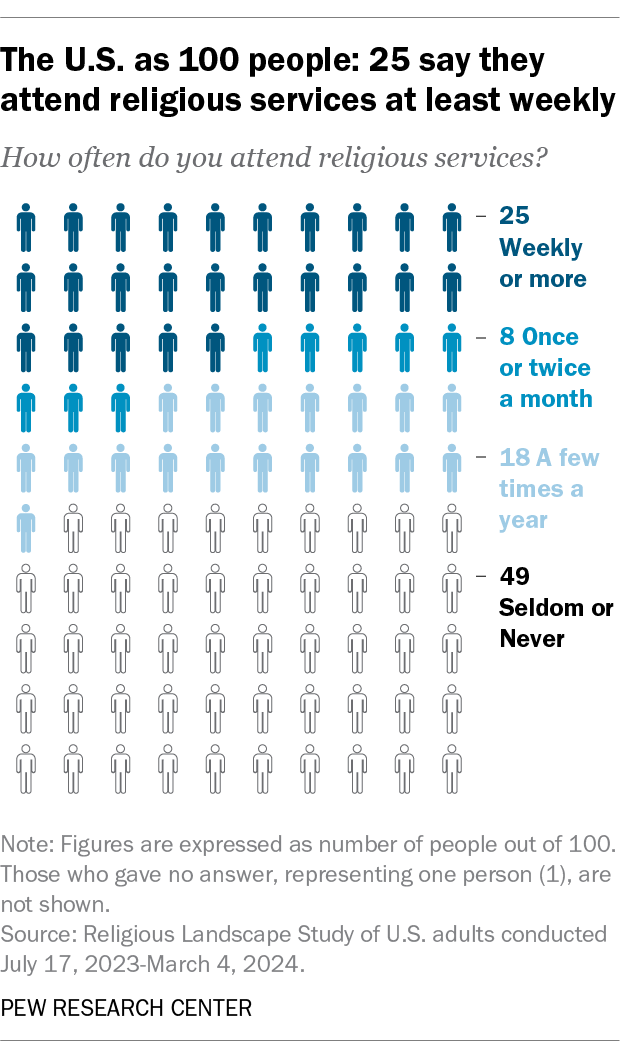
Religious service attendance
If the U.S. was a town of 100 people, 25 of them would attend religious services in person weekly or more often. Another eight would go once or twice a month, and 18 would go a few times a year. Forty-nine people would seldom or never attend religious services in person.
Belief in God
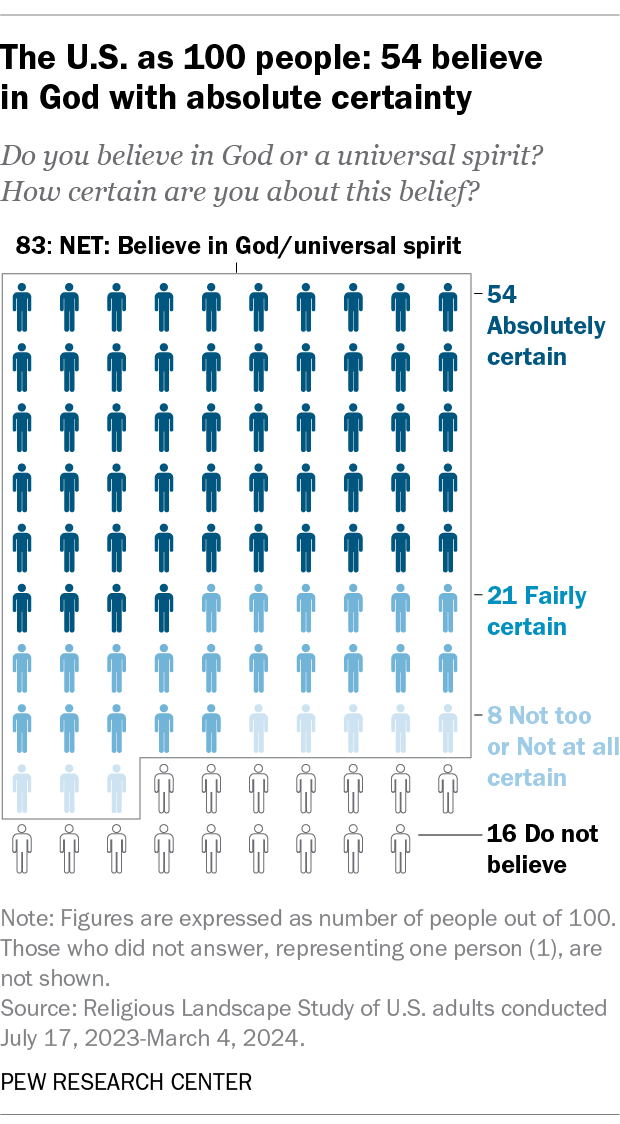
Among the 100 people, 83 would believe in God or a universal spirit. Of these:
- 54 would believe with absolute certainty.
- 21 would be fairly certain.
- 8 would be not too or not at all certain.
Meanwhile, 16 of the 100 people would not believe in God or a universal spirit.
Importance of religion
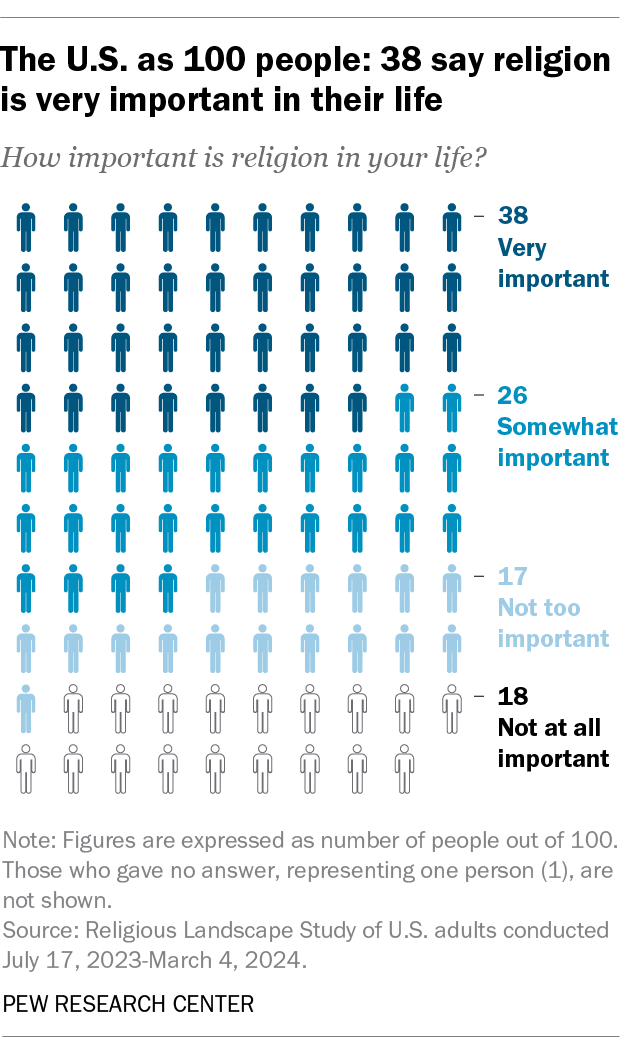
In our hypothetical town, 38 people would say religion is very important in their life. Another 26 would say religion is somewhat important to them. By contrast, 35 would say that religion is either not too important (17) or not at all important (18) in their lives.
Prayer frequency
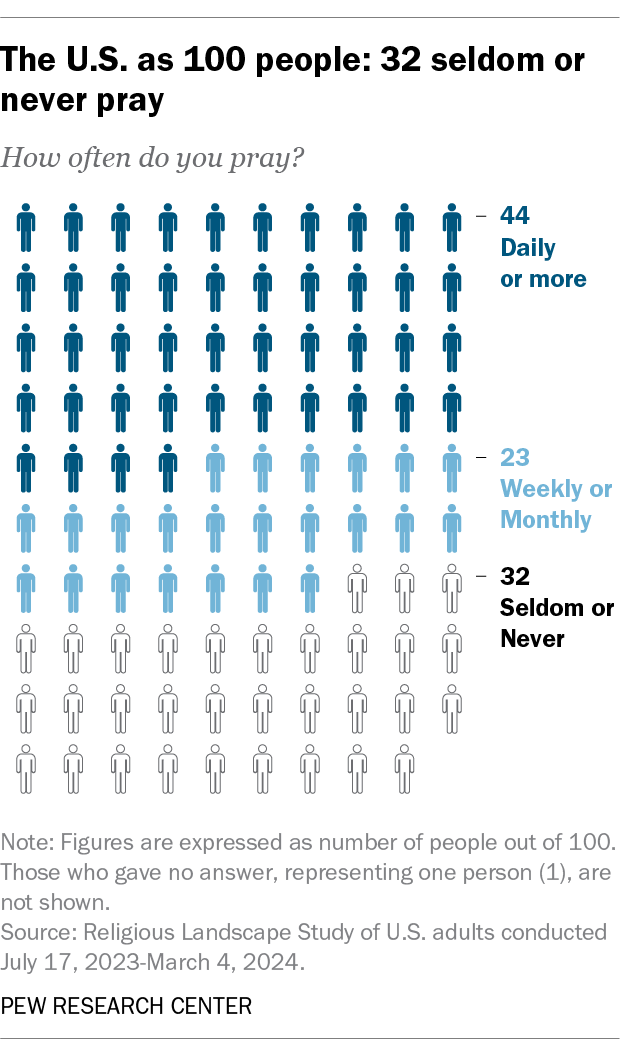
If the U.S. had 100 people, 44 would pray every day, while 23 would pray on a weekly or monthly basis. And 32 people would seldom or never pray.
Belief in heaven and/or hell
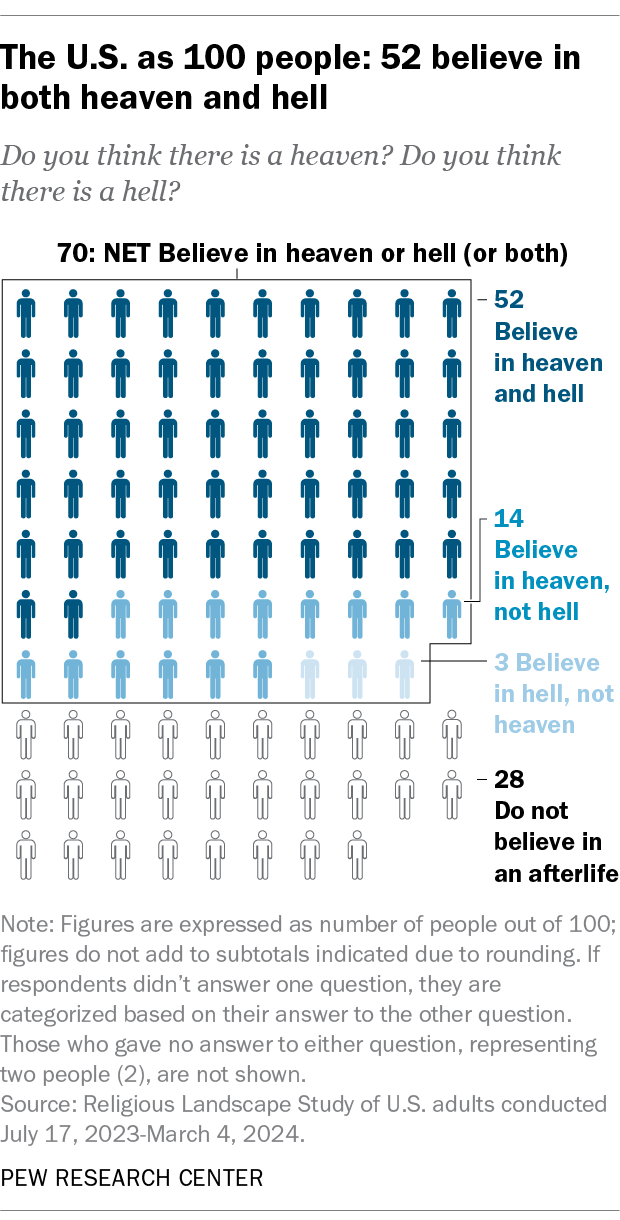
Among the 100 people, 70 would believe in an afterlife. Of these:
- 52 would believe in heaven and hell.
- 14 would believe in heaven but not hell.
- 3 would believe in hell but not heaven.
Another 28 people would not believe in an afterlife.
Note: This is an update of an analysis originally published on Dec. 1, 2016.