
Most Americans say it is important to have public discussions about the country’s historical successes – as well as its failures, according to a recent Pew Research Center survey:
Source: Survey of U.S. adults conducted Nov. 17-30, 2025.
| Groups | % who say it is __ important to have public discussions about the country’s historical … | Extremely/Very | Somewhat | Not too/Not at all |
|---|---|---|---|---|
| All U.S. adults | Successes and strengths | 66 | 27 | 6 |
| Successes and strengths | ||||
| Rep/Lean Rep | Successes and strengths | 68 | 26 | 6 |
| Dem/Lean Dem | Successes and strengths | 67 | 26 | 6 |
| All U.S. adults | Failures and flaws | 66 | 26 | 7 |
| Failures and flaws | ||||
| Rep/Lean Rep | Failures and flaws | 60 | 30 | 10 |
| Dem/Lean Dem | Failures and flaws | 75 | 19 | 5 |
Source: Survey of U.S. adults conducted Nov. 17-30, 2025.
- 66% of U.S. adults say it is extremely or very important to publicly discuss the country’s historical successes and strengths.
- 66% say the same about discussing the country’s historical failures and flaws.
Wide majorities of Republicans and Democrats alike view both the positive and negative aspects of the nation’s history as important to focus on. But Republicans are less likely than Democrats to say discussions of historical failures and flaws are important.
The survey of 10,357 U.S. adults was conducted Nov. 17-30, 2025. It comes as the nation’s 250th anniversary approaches and as Trump administration actions have de-emphasized negative aspects of American history in some national parks, museums and schools.
Partisans’ views
Roughly two-thirds of those in both partisan coalitions say it’s at least very important to publicly talk about the country’s successes and strengths. In contrast, 75% of Democrats and Democratic leaners say it is at least very important to discuss the country’s failures and flaws, compared with 60% of Republicans and Republican-leaning independents.
Views among demographic groups
Majorities of Americans across several demographic subgroups say it is important to discuss both the nation’s successes and its failures.
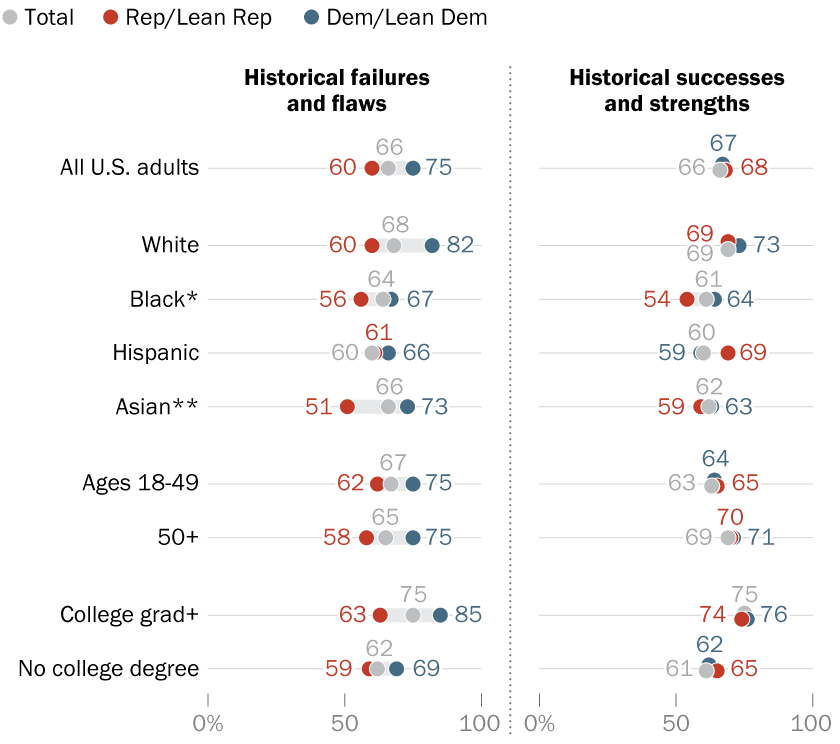
** Estimates for Asian adults are representative of English speakers only.
Note: White, Black and Asian adults include those who report being only one race and are not Hispanic. Hispanics are of any race.
Source: Survey of U.S. adults conducted Nov. 17-30, 2025.
| Historical failures and flaws | Historical failures and flaws | Historical failures and flaws | Historical successes and strengths | Historical successes and strengths | Historical successes and strengths | |
|---|---|---|---|---|---|---|
| Total | Rep/Lean Rep | Dem/Lean Dem | Total | Rep/Lean Rep | Dem/Lean Dem | |
| All U.S. adults | 66 | 60 | 75 | 66 | 68 | 67 |
| White | 68 | 60 | 82 | 69 | 69 | 73 |
| Black* | 64 | 56 | 67 | 61 | 54 | 64 |
| Hispanic | 60 | 61 | 66 | 60 | 69 | 59 |
| Asian** | 66 | 51 | 73 | 62 | 59 | 63 |
| Ages 18-49 | 67 | 62 | 75 | 63 | 65 | 64 |
| 50+ | 65 | 58 | 75 | 69 | 70 | 71 |
| College grad+ | 75 | 63 | 85 | 75 | 74 | 76 |
| No college degree | 62 | 59 | 69 | 61 | 65 | 62 |
** Estimates for Asian adults are representative of English speakers only.
Note: White, Black and Asian adults include those who report being only one race and are not Hispanic. Hispanics are of any race.
Source: Survey of U.S. adults conducted Nov. 17-30, 2025.
However, adults ages 50 and older (69%) are slightly more likely than those under 50 (63%) to say it’s important to discuss historical successes and strengths.
In addition, adults with a college degree are more likely than those without a degree to view discussing both America’s successes and its failures as important. This pattern largely holds in both partisan coalitions.
Note: Here are the survey questions used for this analysis, the detailed responses and the survey methodology.