
Baby Boomers will soon reach another milestone: In 2026, the oldest members of this generation will turn 80.
The Baby Boom generation refers to adults born between 1946 and 1964. The name reflects the sharp and prolonged increase in fertility that occurred in the wake of World War II.
The United States saw a total of 76 million births during the boom, with the annual number surpassing 4 million in 1954 and remaining above that level until 1965. The annual number of births would not surpass 4 million again until 1989.
| Year | Births | Baby Boomer births |
|---|---|---|
| 1928 | 2.7 | |
| 1929 | 2.6 | |
| 1930 | 2.6 | |
| 1931 | 2.5 | |
| 1932 | 2.4 | |
| 1933 | 2.3 | |
| 1934 | 2.4 | |
| 1935 | 2.4 | |
| 1936 | 2.4 | |
| 1937 | 2.4 | |
| 1938 | 2.5 | |
| 1939 | 2.5 | |
| 1940 | 2.6 | |
| 1941 | 2.7 | |
| 1942 | 3.0 | |
| 1943 | 3.1 | |
| 1944 | 2.9 | |
| 1945 | 2.9 | |
| 1946 | 3.4 | |
| 1947 | 3.8 | |
| 1948 | 3.6 | |
| 1949 | 3.6 | |
| 1950 | 3.6 | |
| 1951 | 3.8 | |
| 1952 | 3.9 | |
| 1953 | 4.0 | |
| 1954 | 4.1 | |
| 1955 | 4.1 | |
| 1956 | 4.2 | |
| 1957 | 4.3 | |
| 1958 | 4.2 | |
| 1959 | 4.3 | |
| 1960 | 4.3 | |
| 1961 | 4.3 | |
| 1962 | 4.2 | |
| 1963 | 4.1 | |
| 1964 | 4.0 | |
| 1965 | 3.8 | |
| 1966 | 3.6 | |
| 1967 | 3.5 | |
| 1968 | 3.5 | |
| 1969 | 3.6 | |
| 1970 | 3.7 | |
| 1971 | 3.6 | |
| 1972 | 3.3 | |
| 1973 | 3.1 | |
| 1974 | 3.2 | |
| 1975 | 3.1 | |
| 1976 | 3.2 | |
| 1977 | 3.3 | |
| 1978 | 3.3 | |
| 1979 | 3.5 | |
| 1980 | 3.6 | |
| 1981 | 3.6 | |
| 1982 | 3.7 | |
| 1983 | 3.6 | |
| 1984 | 3.7 | |
| 1985 | 3.8 | |
| 1986 | 3.8 | |
| 1987 | 3.8 | |
| 1988 | 3.9 | |
| 1989 | 4.0 | |
| 1990 | 4.2 | |
| 1991 | 4.1 | |
| 1992 | 4.1 | |
| 1993 | 4.0 | |
| 1994 | 4.0 | |
| 1995 | 3.9 | |
| 1996 | 3.9 | |
| 1997 | 3.9 | |
| 1998 | 3.9 | |
| 1999 | 4.0 | |
| 2000 | 4.1 | |
| 2001 | 4.0 | |
| 2002 | 4.0 | |
| 2003 | 4.1 | |
| 2004 | 4.1 | |
| 2005 | 4.1 | |
| 2006 | 4.3 | |
| 2007 | 4.3 | |
| 2008 | 4.2 | |
| 2009 | 4.1 | |
| 2010 | 4.0 | |
| 2011 | 4.0 | |
| 2012 | 4.0 | |
| 2013 | 3.9 | |
| 2014 | 4.0 | |
| 2015 | 4.0 | |
| 2016 | 3.9 | |
| 2017 | 3.9 | |
| 2018 | 3.8 | |
| 2019 | 3.7 | |
| 2020 | 3.6 | |
| 2021 | 3.7 | |
| 2022 | 3.7 | |
| 2023 | 3.6 | |
| 2024 | 3.6 |
Besides marking the end of the Baby Boom generation, 1964 also marked the peak of the generation as a share of the total U.S. population. The Census Bureau estimated that there were 72.5 million Baby Boomers on July 1, 1964, accounting for 37% of the population.
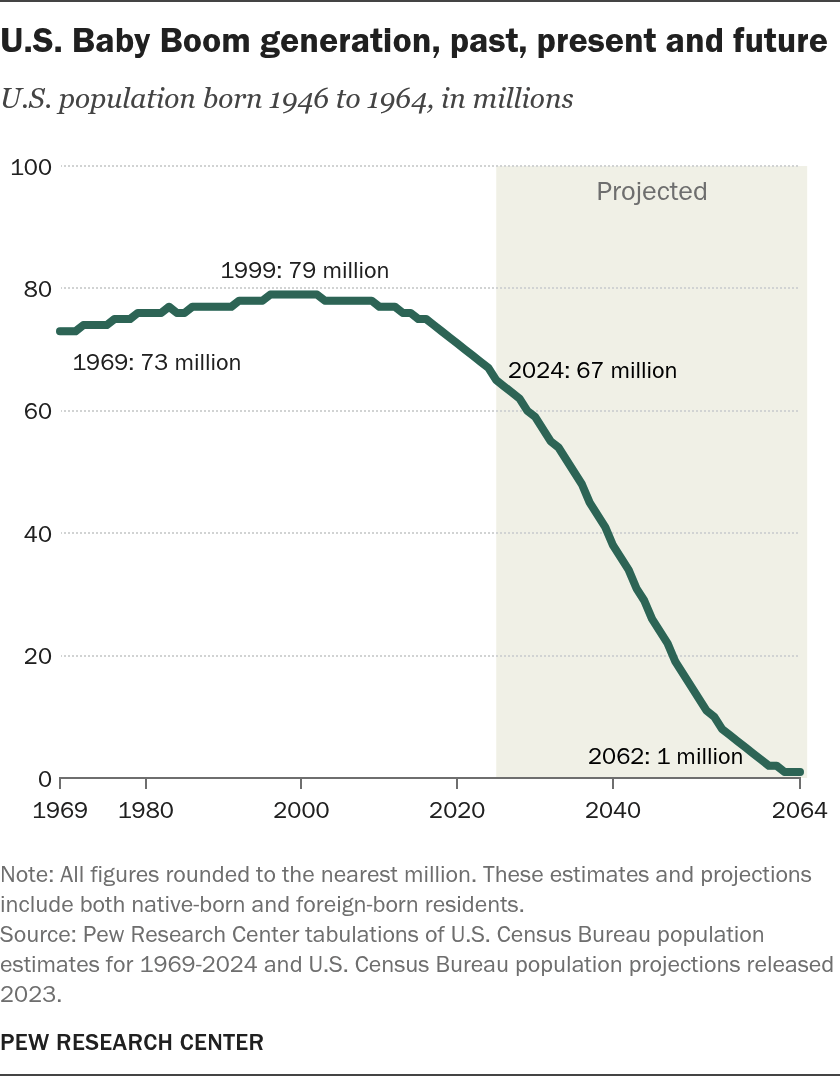
While Boomers peaked as a share of the population in 1964, their absolute number peaked at 79 million in 1999. This increase was due to increased immigration to the U.S. in the second half of the 20th century.
| Year | Population |
|---|---|
| 1969 | 73 |
| 1970 | 73 |
| 1971 | 73 |
| 1972 | 74 |
| 1973 | 74 |
| 1974 | 74 |
| 1975 | 74 |
| 1976 | 75 |
| 1977 | 75 |
| 1978 | 75 |
| 1979 | 76 |
| 1980 | 76 |
| 1981 | 76 |
| 1982 | 76 |
| 1983 | 77 |
| 1984 | 76 |
| 1985 | 76 |
| 1986 | 77 |
| 1987 | 77 |
| 1988 | 77 |
| 1989 | 77 |
| 1990 | 77 |
| 1991 | 77 |
| 1992 | 78 |
| 1993 | 78 |
| 1994 | 78 |
| 1995 | 78 |
| 1996 | 79 |
| 1997 | 79 |
| 1998 | 79 |
| 1999 | 79 |
| 2000 | 79 |
| 2001 | 79 |
| 2002 | 79 |
| 2003 | 78 |
| 2004 | 78 |
| 2005 | 78 |
| 2006 | 78 |
| 2007 | 78 |
| 2008 | 78 |
| 2009 | 78 |
| 2010 | 77 |
| 2011 | 77 |
| 2012 | 77 |
| 2013 | 76 |
| 2014 | 76 |
| 2015 | 75 |
| 2016 | 75 |
| 2017 | 74 |
| 2018 | 73 |
| 2019 | 72 |
| 2020 | 71 |
| 2021 | 70 |
| 2022 | 69 |
| 2023 | 68 |
| 2024 | 67 |
| 2025 | 65 |
| 2026 | 64 |
| 2027 | 63 |
| 2028 | 62 |
| 2029 | 60 |
| 2030 | 59 |
| 2031 | 57 |
| 2032 | 55 |
| 2033 | 54 |
| 2034 | 52 |
| 2035 | 50 |
| 2036 | 48 |
| 2037 | 45 |
| 2038 | 43 |
| 2039 | 41 |
| 2040 | 38 |
| 2041 | 36 |
| 2042 | 34 |
| 2043 | 31 |
| 2044 | 29 |
| 2045 | 26 |
| 2046 | 24 |
| 2047 | 22 |
| 2048 | 19 |
| 2049 | 17 |
| 2050 | 15 |
| 2051 | 13 |
| 2052 | 11 |
| 2053 | 10 |
| 2054 | 8 |
| 2055 | 7 |
| 2056 | 6 |
| 2057 | 5 |
| 2058 | 4 |
| 2059 | 3 |
| 2060 | 2 |
| 2061 | 2 |
| 2062 | 1 |
| 2063 | 1 |
| 2064 | 1 |
So how many Boomers are there today? As of July 1, 2024 – the most recent available data – there were an estimated 67 million Boomers, accounting for only 20% of the nation’s population.
The Census Bureau also periodically releases projections of the U.S. population. The bureau projects that the Boomer population will be about 1 million in 2062, when the youngest turn 98.
Related: U.S. centenarian population is projected to quadruple over the next 30 years