As has been the case in recent years, younger adults continue to be much less likely than older adults to place importance on the United States taking an active role on the world stage.
How important is it for the U.S. to be active internationally?
Source: Survey of U.S. adults conducted Nov. 17-30, 2025.
| Extremely | Very | Somewhat | Not too | Not at all | Category | |
|---|---|---|---|---|---|---|
| Total | 19 | 35 | 36 | 8 | 3 | Total |
| Ages 18-29 | 10 | 29 | 41 | 14 | 5 | Age |
| 30-49 | 14 | 30 | 43 | 9 | 3 | Age |
| 50-64 | 22 | 37 | 33 | 6 | 1 | Age |
| 65+ | 30 | 43 | 24 | 2 | 1 | Age |
| Rep/Lean Rep | 17 | 34 | 37 | 9 | 3 | Party |
| Dem/Lean Dem | 22 | 37 | 33 | 6 | 2 | Party |
Source: Survey of U.S. adults conducted Nov. 17-30, 2025.
Overall, 53% of Americans say it is extremely or very important for the U.S. to take an active role in world affairs, according to a Pew Research Center survey conducted Nov. 17-30, 2025, among 10,357 adults.
Younger adults are much less likely than their elders to value active U.S. engagement in world affairs:
- 39% of adults ages 18 to 29 and 44% of those 30 to 49 say it is extremely or very important that the U.S. play an active role in world affairs.
- By comparison, 59% of those 50 to 64 and 73% of those 65 and older say the same.
Partisan differences on this question are much more modest:
- 59% of Democrats and Democratic-leaning independents say it is extremely or very important for the U.S. to play an active role, as do 50% of Republicans and Republican leaners.
- Just 8% of Democrats and 12% of Republicans say it is not too or not at all important for the U.S. to be active in international affairs.
How important is America’s military superpower status?
Overall, 38% of adults say that in the future it is extremely or very important for the U.S. to be the only military superpower in the world. A third say this is somewhat important, while 27% say it is not too or not at all important.
Younger adults are far less likely than older adults to prioritize the U.S. maintaining military superiority over other countries. For example, a quarter of adults under 30 view this as important. This rises to 52% among those 65 and older.
Source: Survey of U.S. adults conducted Nov. 17-30, 2025.
| Extremely | Very | Somewhat | Not too | Not at all | Category | |
|---|---|---|---|---|---|---|
| Total | 16 | 21 | 33 | 19 | 9 | Total |
| Ages 18-29 | 10 | 15 | 32 | 26 | 14 | Age |
| 30-49 | 14 | 18 | 35 | 21 | 10 | Age |
| 50-64 | 19 | 25 | 32 | 17 | 6 | Age |
| 65+ | 23 | 28 | 32 | 11 | 4 | Age |
| Rep/Lean Rep | 25 | 28 | 30 | 11 | 4 | Party |
| Dem/Lean Dem | 8 | 17 | 35 | 26 | 12 | Party |
Source: Survey of U.S. adults conducted Nov. 17-30, 2025.
There is also a wide partisan gap on this measure, with Republicans about twice as likely as Democrats (53% vs. 25%) to say it is extremely or very important for the U.S. to be the sole military superpower in the future.
In both parties, views on U.S. involvement in world affairs differ by age
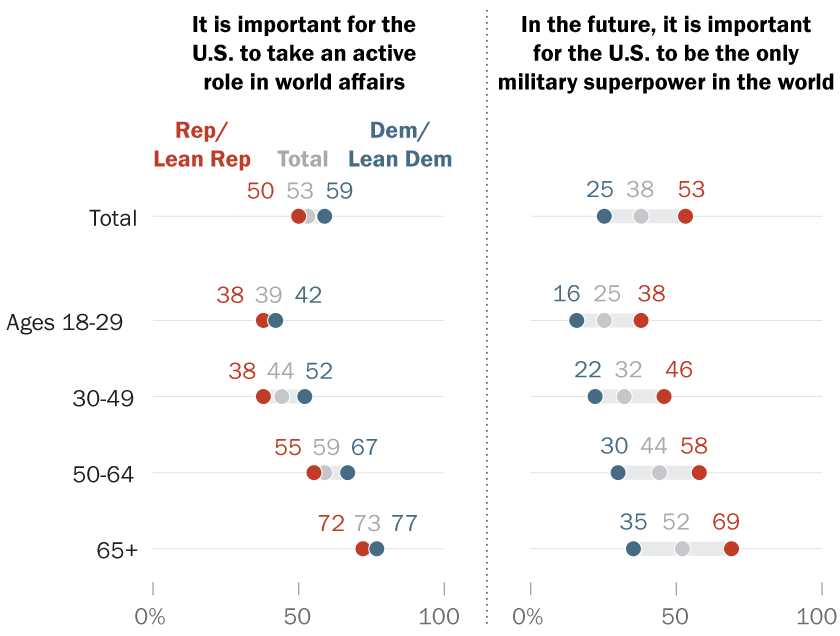
In both partisan coalitions, younger adults are less likely than older adults to say it is important that the U.S. take an active role in international affairs and for the country to be the sole global superpower.
How important is it for the U.S. to be active internationally?
| Category | Group | Total | Rep/Lean Rep | Dem/Lean Dem |
|---|---|---|---|---|
| It is important for the U.S. to take an active role in world affairs | Total | 53 | 50 | 59 |
| It is important for the U.S. to take an active role in world affairs | Ages 18-29 | 39 | 38 | 42 |
| It is important for the U.S. to take an active role in world affairs | Ages 30-49 | 44 | 38 | 52 |
| It is important for the U.S. to take an active role in world affairs | Ages 50-64 | 59 | 55 | 67 |
| It is important for the U.S. to take an active role in world affairs | Ages 65+ | 73 | 72 | 77 |
| It is important for the U.S. to be the only military superpower in the world | Total | 38 | 53 | 25 |
| It is important for the U.S. to be the only military superpower in the world | Ages 18-29 | 25 | 38 | 16 |
| It is important for the U.S. to be the only military superpower in the world | Ages 30-49 | 32 | 46 | 22 |
| It is important for the U.S. to be the only military superpower in the world | Ages 50-64 | 44 | 58 | 30 |
| It is important for the U.S. to be the only military superpower in the world | Ages 65+ | 52 | 69 | 35 |
Among Republicans, 38% of those under 50 say it is at extremely or very important for the U.S. to be active in international relations. This figure rises to 63% among Republicans ages 50 and older.
Among Democrats, 48% of those under 50 express this view, compared with a much larger share (72%) of Democrats ages 50 and older.
How important is America’s military superpower status?
Younger Republicans are also less likely than older Republicans to say it is extremely or very important for the U.S. to be the only military superpower in the future: 43% of Republicans under 50 say this, compared with 63% of Republicans 50 and older.
In every age group, Democrats are far less likely than Republicans to say American military dominance is important. But the age pattern is similar – though less pronounced – among Democrats. Just 16% of Democrats under 30 say it’s extremely or very important for the U.S. to be the only military superpower, compared with 35% of Democrats 65 and older.
Note: Here are the questions used for this analysis, the topline and the survey methodology.