Social trust plays an important role in society. In the United States, people who trust others are more likely to help their neighbors or friends in times of need and have greater confidence in institutions, according to recent Pew Research Center studies.
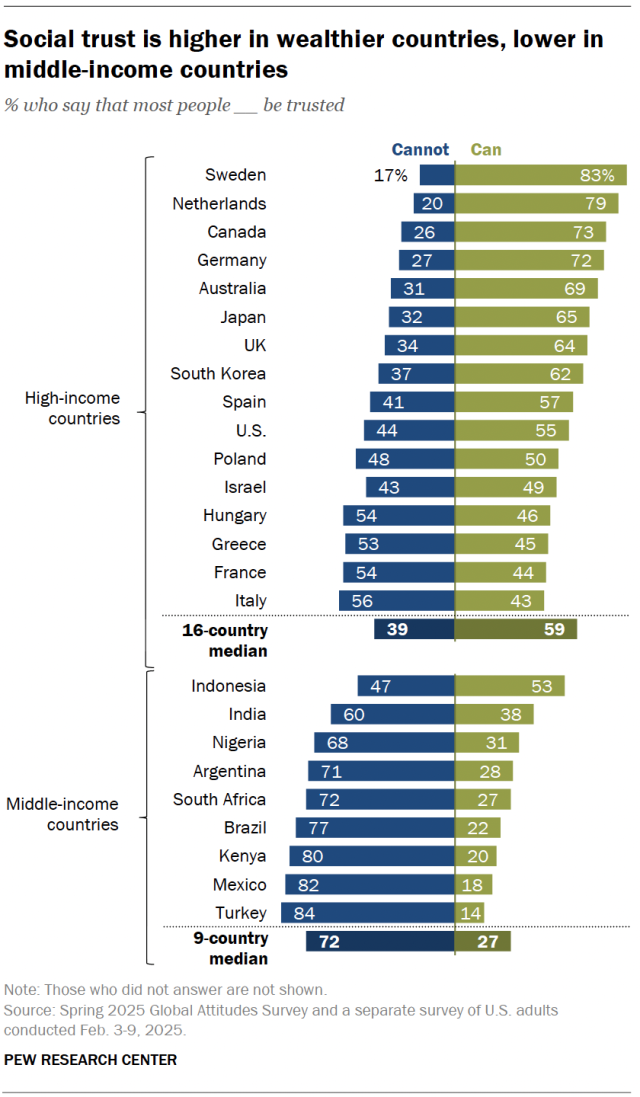
Yet in the U.S. and many other nations, social trust is far from ubiquitous. While a majority of U.S. adults (55%) say most people can be trusted, a sizable share (44%) say most people can’t be trusted.
Across all 25 countries we surveyed earlier this year, trust in others varies widely. In Sweden, for example, 83% of adults say most people can be trusted. But in Turkey, only 14% express this view.
Trust tends to be higher in the high-income countries surveyed than in the middle-income ones. And within mostly high-income countries, we also see gaps in trust by education, income and age. (Read more about country income classifications.)
How we did this
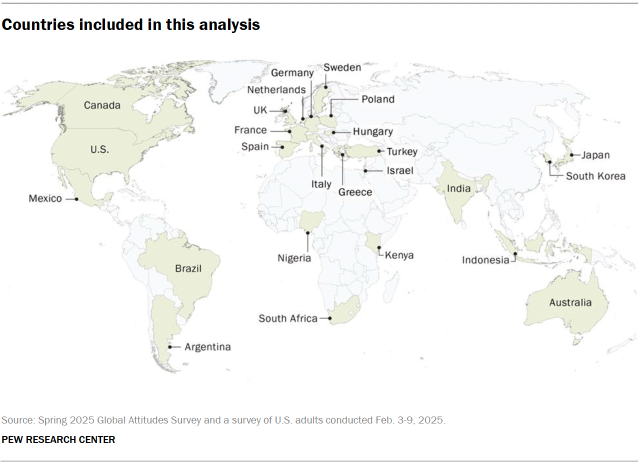
This Pew Research Center analysis focuses on social trust in 25 countries across North America, Europe, the Middle East, the Asia-Pacific region, sub-Saharan Africa and Latin America.
For non-U.S. data, this analysis draws on nationally representative surveys of 28,333 adults conducted Jan. 8 to April 26, 2025. All surveys were conducted over the phone with adults in Canada, France, Germany, Greece, Hungary, Italy, Japan, the Netherlands, Poland, South Korea, Spain, Sweden and the United Kingdom. Surveys were conducted face-to-face in Argentina, Brazil, India, Indonesia, Israel, Kenya, Mexico, Nigeria, South Africa and Turkey. In Australia, we used a mixed-mode probability-based online panel.
In the United States, we surveyed 9,544 U.S. adults from Feb. 3 to 9, 2025. Everyone who took part in this survey is a member of the Center’s American Trends Panel (ATP), a group of people recruited through national, random sampling of residential addresses who have agreed to take surveys regularly. This kind of recruitment gives nearly all U.S. adults a chance of selection. Surveys were conducted either online or by telephone with a live interviewer. The survey is weighted to be representative of the U.S. adult population by gender, race, ethnicity, partisan affiliation, education and other categories. Read more about the ATP’s methodology.
We conducted simultaneous telephone and face-to-face surveys in Hungary and Poland in 2024. The 2024 data in this report comes from the telephone survey for direct comparison to our 2025 telephone data.
In each country surveyed, only religious groups with large enough sample sizes for analysis are included.
To compare educational groups across countries, we standardize education levels based on the United Nations’ International Standard Classification of Education.
We classify populist parties using three external measures and define a party as populist when at least two of these three sources classify it as such. For more information, read “Classifying European political parties.”
Here are the questions used for this analysis, along with the responses, and the survey methodology.
In this analysis, you will find:
- How social trust varies by country and region
- How social trust relates to a country’s economic output
- How social trust has changed over time
- How social trust varies by demographic group
- How trust varies by ideology and support for right-wing populist parties
How social trust varies by country and region
In Canada and the U.S., majorities say most people can be trusted, though Canadians are much more likely than Americans to say this. (Read more about how we measure social trust in the U.S.)
Related: Americans’ Trust in One Another
Europeans are more divided. In Sweden, the Netherlands, Germany, the United Kingdom and Spain, majorities say most people can be trusted. But in Hungary, Greece, France and Italy, more say the opposite.
In the Asia-Pacific region, at least half of adults in Australia, Japan, South Korea and Indonesia say most people can be trusted. A majority of adults in India say the reverse.
Views on this question are divided in Israel. But in Turkey, a broad majority of adults (84%) say most people can’t be trusted.
In the three sub-Saharan African countries we surveyed – Kenya, Nigeria and South Africa – large majorities also say most people can’t be trusted. The same is true in the Latin American countries Argentina, Brazil and Mexico.
How social trust relates to a country’s economic output
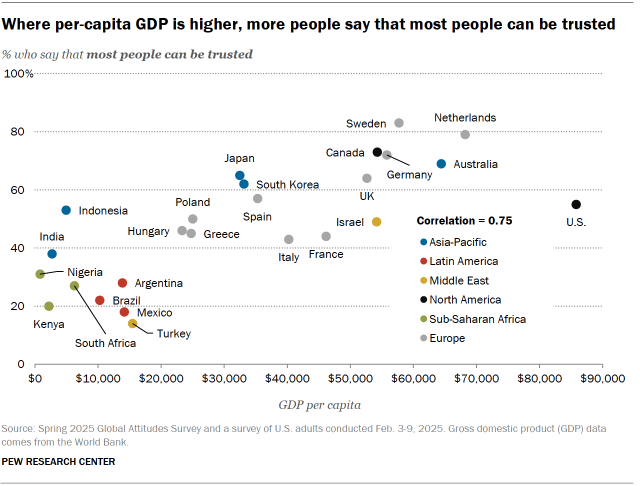
Across the 16 high-income countries we surveyed, a median of 59% of adults say most people can be trusted, compared with a median of 27% in the nine middle-income countries. Social trust is highest in the high-income countries of Sweden and the Netherlands. It is lowest in the middle-income countries of Turkey, Mexico, Kenya and Brazil.
While the U.S. has the highest per-capita gross domestic product (GDP) of the countries surveyed, the share of Americans who say most people can be trusted is similar to that in less wealthy nations like Indonesia and Spain.
Related: How connected do Americans feel to their neighbors?
How social trust has changed over time
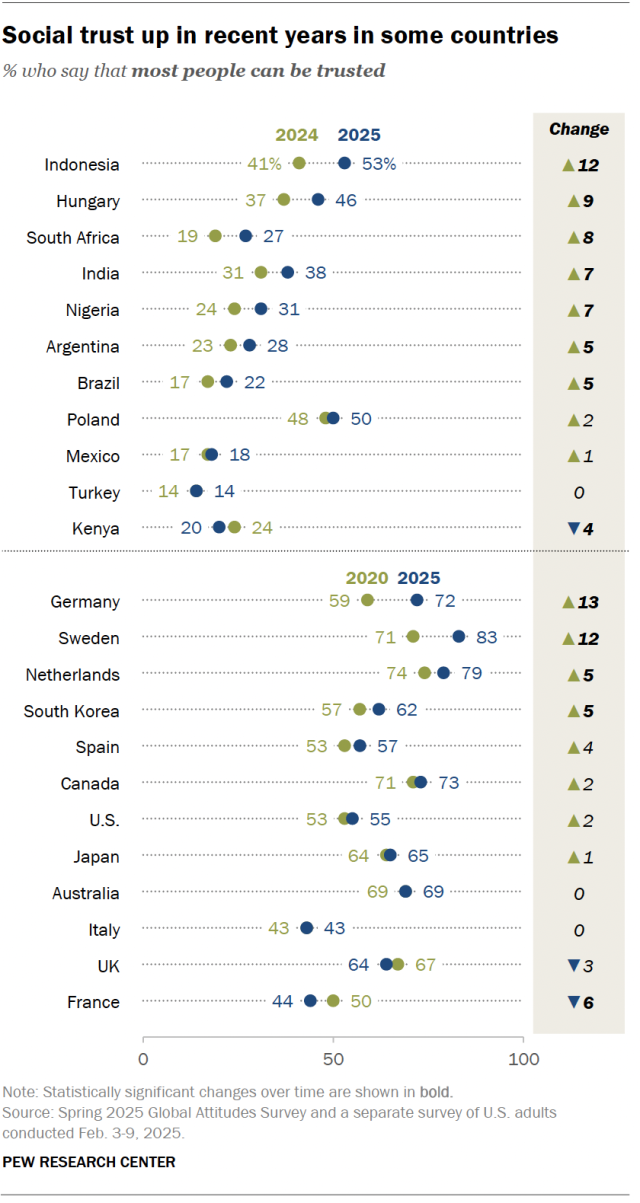
Social trust has increased in recent years in some places surveyed.
In Indonesia, for example, 53% of adults say most people can be trusted, up from 41% last year.
Elsewhere, we last asked this question in 2020 amid the early days of the COVID-19 pandemic. Since then, social trust has increased the most in Germany (+13 percentage points) and Sweden (+12 points).
Not all countries have seen increases. French adults, for instance, are 6 points less likely than in 2020 to say most people can be trusted.
How social trust varies by demographic group
Social trust differs by education, income, age and other demographic factors.
Education and income
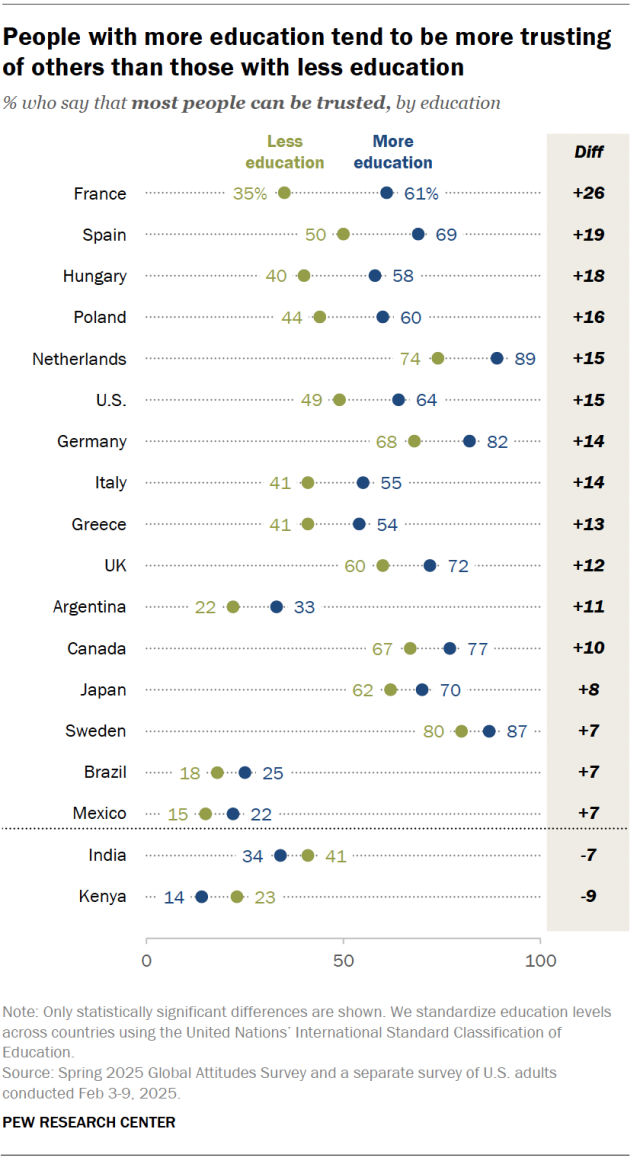
In most countries surveyed, people with more education are more trusting than those with less. This is particularly true in high-income countries.
In France, for example, 61% of adults with higher levels of education say most people can be trusted, compared with 35% of those with less education.
In 12 mostly wealthier nations, people with higher incomes are also more likely to trust others.
Age
In 11 mostly high-income nations, older adults are more trusting than younger ones. For example, 80% of Australians ages 50 and older say most people can be trusted – compared with 66% of Australians ages 35 to 49 and 55% of those ages 34 and younger.
Gender
In seven countries, men are more likely than women to say most people can be trusted. In Argentina, Hungary and Indonesia, men are at least 10 percentage points more likely than women to say this.
Race and ethnicity
Social trust also varies by race and ethnicity in some of the countries where we collect this information.
In the U.S., White Americans are more trusting than Americans of other races or ethnicities. Black and Hispanic Americans report the lowest levels of trust. (Refer to our data essay for more information on how social trust relates to race and ethnicity in the U.S.) Similarly, in Brazil, White adults (29%) are more trusting than Brazilians who are mixed race (20%) or Black (12%).
In Israel, Jewish adults are much more trusting than Arab adults (53% vs. 32%).
Religion
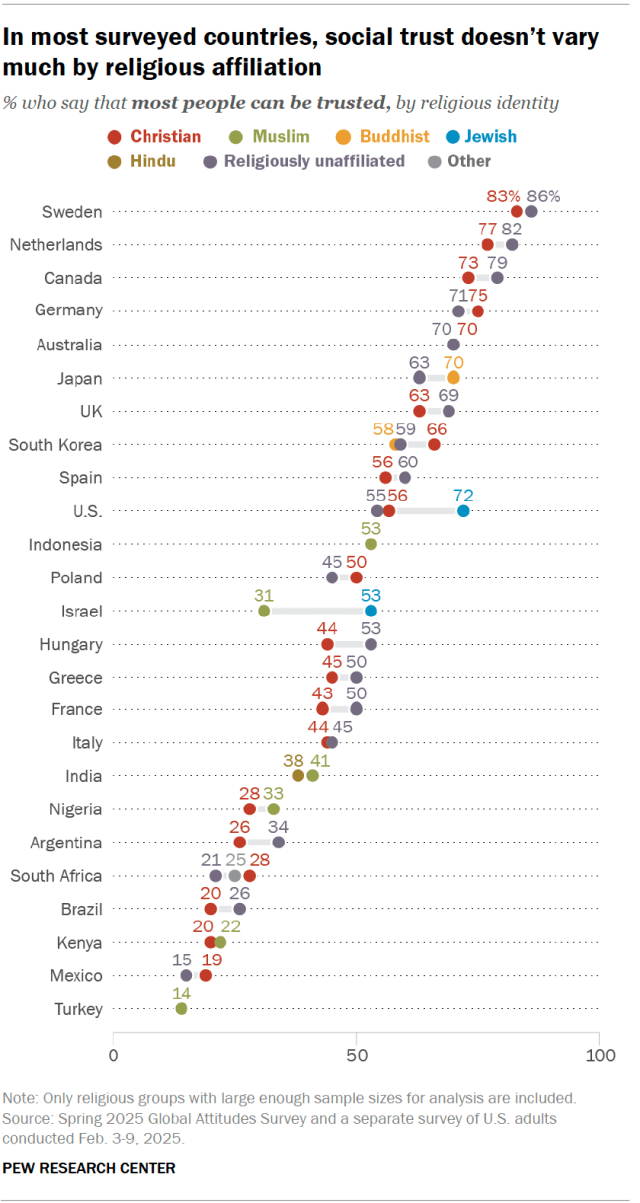
In most of the countries surveyed, there are no major differences in trust by religion. And where there are differences, they’re often related to other characteristics such as age, education and political ideology.
However, there are a couple notable exceptions. In the U.S., Jewish adults stand out: 70% say most people can be trusted, compared with 56% of Christians and 55% of the religiously unaffiliated. (A separate Center analysis this year found that in the U.S., Hindus and members of the Church of Jesus Christ of Latter-day Saints are also particularly trusting.)
In Israel, around half of Jewish adults also say most people can be trusted, compared with a much smaller share (31%) of Israeli Muslims.
How trust varies by ideology and support for right-wing populist parties
In seven of the high-income countries surveyed, people on the ideological left are more likely than those on the right to trust others.
For instance, roughly half of Italians on the ideological left say most people can be trusted, compared with about a third of Italians on the ideological right.
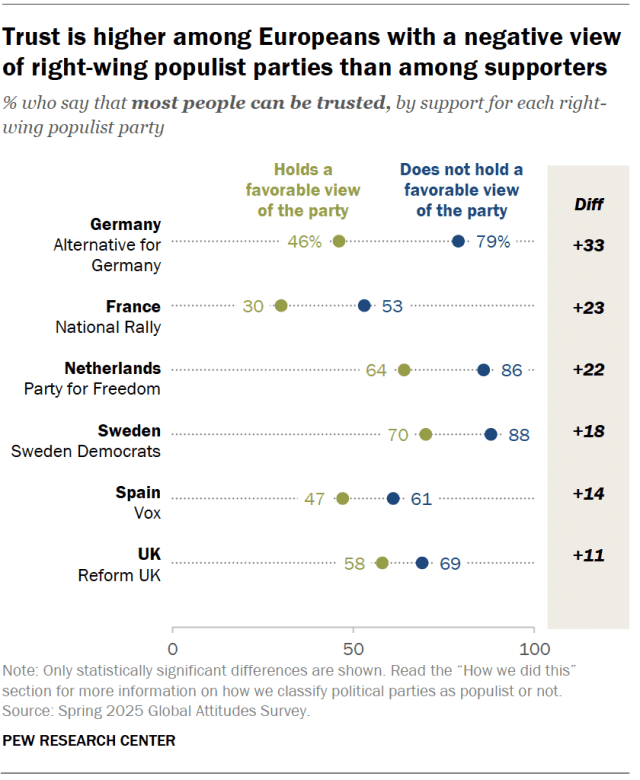
Similarly, Europeans who view some right-wing populist parties unfavorably are more trusting than people who view these parties favorably. In Germany, for instance, adults with an unfavorable opinion of the Alternative for Germany party are 33 percentage points more likely than supporters to say most people can be trusted.
CORRECTION (Dec. 2, 2025): The chart “In most surveyed countries, social trust doesn’t vary much by religious affiliation” originally showed an incorrect percentage for Jews in the U.S. who say most people can be trusted. The figure in the text (70%) was correct.
Note: Here are the questions used for this analysis, along with the responses, and the survey methodology.