Social trust – the notion that most people can be trusted – is usually about the relationships between people. But whether people trust those around them also relates to how they think about interactions between countries, according to a new Pew Research Center analysis.
Specifically, people who say most people can be trusted are more likely than those who say most people can’t be trusted to support various cooperative foreign policies. They’re also more likely to view certain international organizations positively.
How we did this
This Pew Research Center analysis focuses on the relationship between social trust and opinions about foreign policy. We used data from 25 countries across the Asia-Pacific region, Europe, Latin America, the Middle East-North Africa region, North America and sub-Saharan Africa.
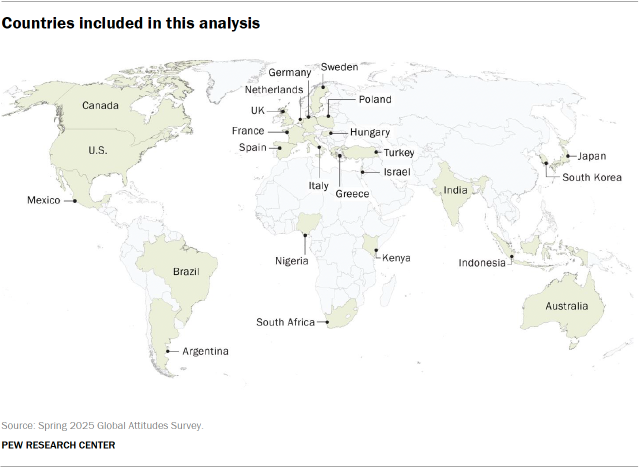
The non-U.S. data is from nationally representative surveys of 28,333 adults conducted from Jan. 8 to April 26, 2025. We conducted these surveys:
- Over the phone in Canada, France, Germany, Greece, Hungary, Italy, Japan, the Netherlands, Poland, South Korea, Spain, Sweden and the United Kingdom
- Face-to-face in Argentina, Brazil, India, Indonesia, Israel, Kenya, Mexico, Nigeria, South Africa and Turkey
- Using a mixed-mode probability-based online panel in Australia
In the United States, we surveyed 9,544 U.S. adults from Feb. 3 to 9, 2025. We asked respondents if, generally speaking, most people can or can’t be trusted. We then surveyed 3,605 U.S. adults from March 24 to 30, 2025, which included 3,430 adults who also participated in the February survey.
Everyone who took part in the U.S. surveys is a member of the Center’s American Trends Panel (ATP), a group of people recruited through national, random sampling of residential addresses who have agreed to take surveys regularly. This kind of recruitment gives nearly all U.S. adults a chance of selection. Surveys were conducted either online or by telephone with a live interviewer. The surveys are weighted to be representative of the U.S. adult population by gender, race, ethnicity, partisan affiliation, education and other categories. Read more about the ATP’s methodology.
Here are the questions and responses used for how much trust people have in one another; the questions and responses for Americans’ support for international engagement, cooperation and foreign aid; and the survey methodology.
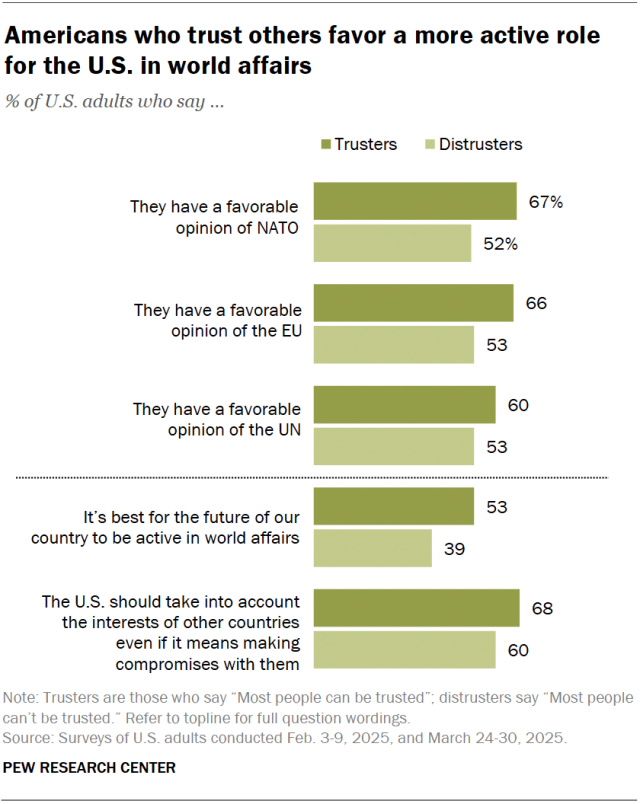
In the United States, those who trust others are more likely to say:
- They have favorable views of NATO, the European Union and the United Nations
- The U.S. should be active in world affairs, rather than pay less attention to problems overseas and concentrate on problems at home
- The U.S. should take into account the interests of other countries even if it means making compromises, rather than follow its own interests even when other countries strongly disagree
- The U.S. should give foreign aid for various purposes
This relationship between social trust and views of international organizations also holds in many European nations we surveyed this year. And the pattern persists when we statistically control for age, education, gender and people’s political ideology.
Social trust and foreign policy attitudes in the U.S.
In the U.S., 55% of adults say most people can be trusted, while 44% say most people can’t be trusted. There are no significant differences in the shares of Democrats and Democratic-leaning independents (57%) and Republicans and Republican leaners (55%) who say that most people can be trusted.
Related: Where most people trust others and where they don’t around the world
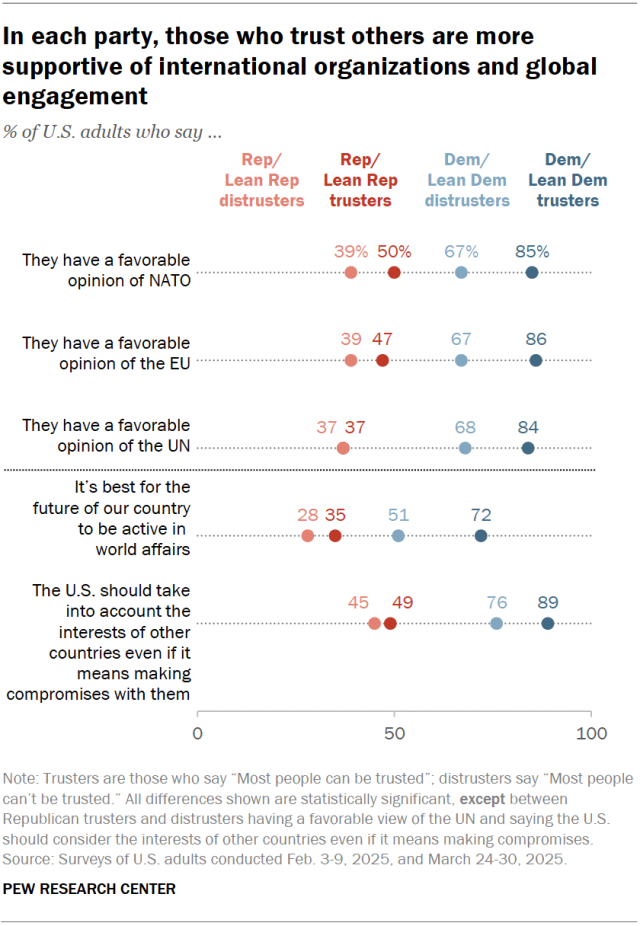
However, partisans do disagree in how they view foreign policy. Democrats generally view international organizations favorably, while Republicans tend to be more negative or ambivalent toward them. Democrats (62%) are also roughly twice as likely as Republicans (32%) to say that it’s best for the U.S. to be active in world affairs.
Within each party, trusters are generally more likely than distrusters to view international organizations positively and support the U.S. being active in world affairs. This pattern is more pronounced among Democrats than Republicans.
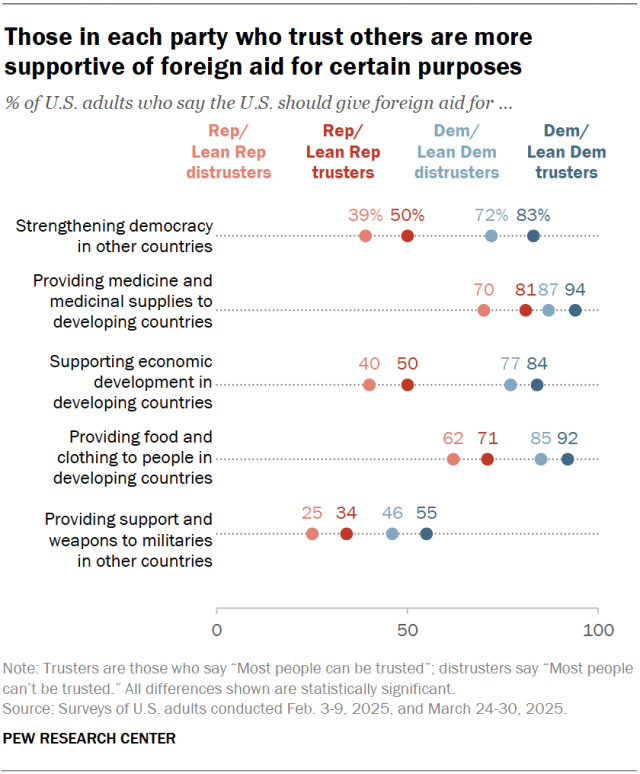
Similarly, trusters in each party are more likely than distrusters to say the U.S. should give foreign aid for various reasons.
For example, half of Republican trusters support foreign aid for the purpose of strengthening democracy in other countries, compared with 39% of Republican distrusters. Among Democrats, 83% of trusters and 72% of distrusters support this.
Related: Majorities of Americans Support Several – But Not All – Types of Foreign Aid
Social trust and views of international organizations in other countries
In many countries outside the U.S., those with higher levels of social trust are also more likely to view several international organizations positively.
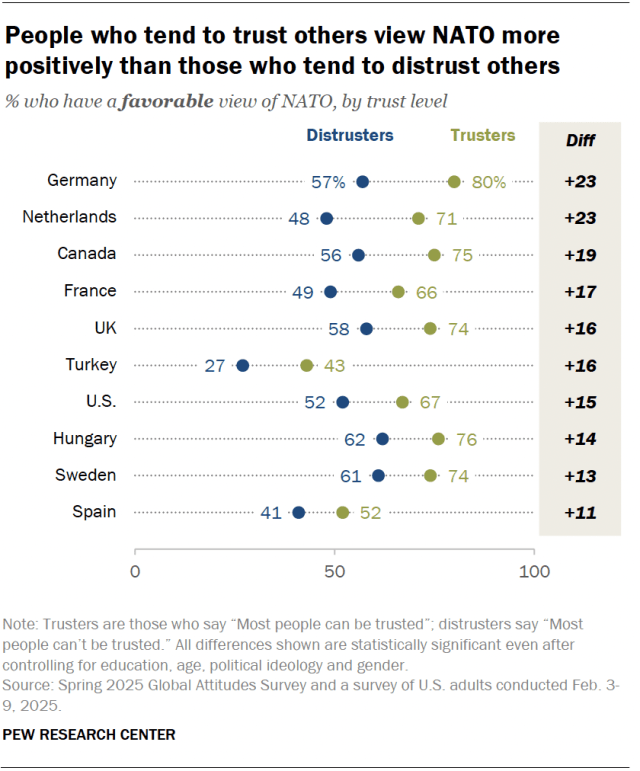
In most of the NATO member nations surveyed, those who say most people can be trusted view NATO more positively than those who say most people can’t be trusted. For example, 71% of Dutch adults who say most people can be trusted view NATO favorably, compared with 48% of those who say most people can’t be trusted.
Related: NATO Viewed Favorably Across 13 Member Nations
The same is true in most European countries surveyed when it comes to views of the EU. For instance, 78% of Germans who say most people can be trusted have a positive view of the EU, compared with 51% of those who say most people can’t be trusted. In some non-European countries, though, the differences between trusters and distrusters were smaller.
As with the U.S., this pattern is not unique to any one side of the political aisle. Take France, where trusters of any ideology are more likely than distrusters to view the EU positively. On the left, French trusters (76%) have significantly more positive views of the EU than distrusters (51%). The same is true on the right, with trusters (56%) viewing the EU more favorably than distrusters (43%).
Note: Here are the questions and responses used for how much trust people have in one another; the questions and responses for Americans’ support for international engagement, cooperation and foreign aid; and the survey methodology.