

Key takeaways:
- Large shares of both Republicans and Democrats see being a world leader in science as important.
- Yet, Republicans and Democrats sharply diverge in their views of the direction of scientific research in the United States. The share of Democrats who say the U.S. is losing ground in science compared with other countries is up 28 percentage points since 2023.
- Most Republicans and Democrats continue to see government investments in scientific research as worthwhile, but Republicans are far more open to saying that it is possible for private investment alone to drive scientific progress.
- A majority of U.S. adults say colleges and universities make significant contributions to science, but Democrats are much more likely than Republicans to hold this view.
The Trump administration has reshaped federal science policy in the last year. It has reduced the number of research grants and cut the size of the federal science and health workforce. The Trump administration has also shifted priorities away from climate change research while increasingly focusing on artificial intelligence.
In this changing environment, Democrats and Republicans continue to largely agree that being a world leader in science is important and government investments in research are worthwhile. But they strongly disagree on whether the country is keeping up with other countries in science, with the share of Democrats who say the country is losing ground in scientific achievements up sharply in the last two years.
This mirrors underlying other partisan differences in attitudes around science we have been tracking for years. In particular, the partisan differences in trust in scientists and the value of science for society are far wider than they were before the COVID-19 pandemic. Republicans have become less confident in scientists and less likely to say science has had a mostly positive effect on society, while Democratic views are largely unchanged.
We surveyed 5,111 U.S. adults to understand how they are thinking about the state of science in the U.S. and funding scientific research.
This research builds on our longstanding work studying trust in science and views on the value of science in society.
This analysis covers the public’s views on the following questions:
- How important is it for the U.S. to be a world leader in science?
- Is the U.S. gaining or losing ground in science?
- Are government investments in scientific research worthwhile?
- How much do key institutions, such as colleges and universities, contribute to science?
How important is it for the U.S. to be a world leader in science?
Republicans and Democrats broadly agree on the importance of the United States being a world leader in scientific achievements.
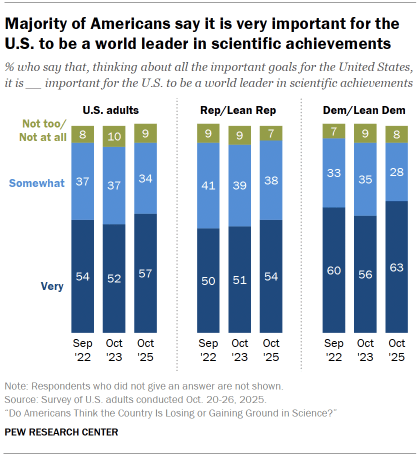
Almost all Democrats and Republicans say it is at least somewhat important that the U.S. is a world leader in science. And more than half of Republicans and Democrats say this is very important (although Democrats are modestly more likely to say this).
The share of Americans who say it is very important for the U.S. to be a world leader in science is up five percentage points since 2023.
What do Americans think of the direction of American science?
While there’s bipartisan agreement about the importance of being a world science leader, partisans sharply disagree on how the country is faring. Democrats have become far more negative and Republicans less negative on the direction of science in the United States in the last two years.
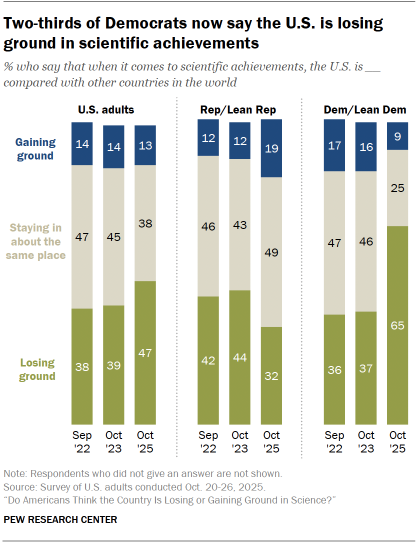
About two-thirds of Democrats say the U.S. is losing ground compared with other countries when it comes to scientific achievements, a 28 percentage point increase since it was last asked in 2023 (during the Biden presidency).
By contrast, just one-third of Republicans and those who lean to the GOP say the country is losing ground, down 12 points from 2023.
Democrats and Democratic leaners are now 33 points more likely than Republicans to say the country is losing ground to other countries in science. Two years ago, the difference was the opposite and far more modest: Democrats were seven points less likely to say this than Republicans.
What do Americans think of government funding of science?
Most Americans, including large majorities of Democrats and Republicans, say government investments in science are worthwhile.
In May 2025, the Trump administration proposed a federal budget that would drastically cut science funding, but Congress has been working on bills that could reject some of those cuts.
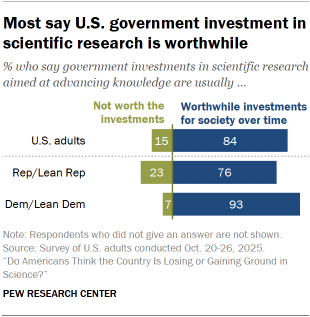
More than eight-in-ten Americans (84%) say government investments in scientific research aimed at advancing knowledge are worthwhile, while only 15% say they are not worth the investments. Large majorities of both Democrats (93%) and Republicans (76%) say these government investments are worthwhile (although Democrats are more likely to say this).
Most U.S. adults have consistently said government investments in science are worth it in Center surveys over the years. The share of U.S. adults who say this is up six percentage points since 2023, driven by Republicans.
Although Americans in both parties largely agree that government investments in science are worthwhile, Democrats and Republicans disagree to a far greater degree if they are essential for scientific progress.
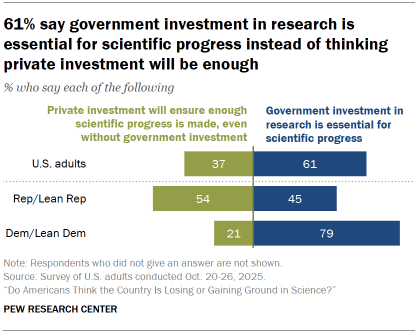
While most Republicans see government investment as worthwhile, they are far less likely to say government investment is essential. A slight majority of Republicans say private investment will ensure enough scientific progress is made, even without government investment (54%).
Democrats tilt to a far greater degree in the other direction, with about eight-in-ten saying government investment in research is essential for scientific progress.
Which institutions contribute to science in the U.S.?
We asked Americans how much four institutions – colleges and universities, private companies, federal government agencies and charitable foundations – contribute to America’s scientific achievements.
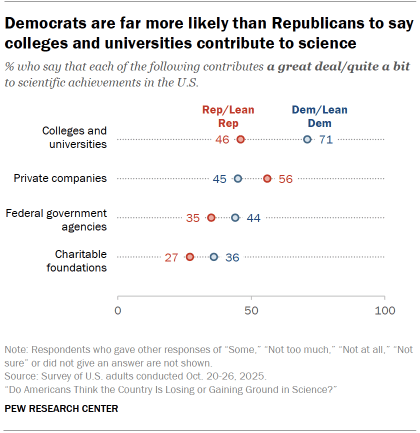
Democrats are most likely to say colleges and universities contribute a great deal or quite a bit to science (71%), while Republicans are most likely to say private companies contribute at least quite a bit (56%).
The share of Republicans who say private companies contribute at least quite a bit is similar to the share who think private investment alone can drive scientific progress.
Republicans and Democrats also differ in how they rate the higher education system, including how it does in research and innovation.


