About Pew Research Center’s Spring 2024 Global Attitudes Survey
Pew Research Center’s Spring 2024 Global Attitudes Survey was conducted in 36 countries via telephone, face-to-face and online interviews, under the direction of Gallup, Langer Research Associates, Social Research Centre and Verian. The results are based on national samples, unless otherwise noted.
This report draws on nationally representative face-to-face surveys of 6,234 adults conducted from Jan. 22 to April 27, 2024, in Argentina, Brazil, Chile, Colombia, Mexico and Peru. Here are more details about our international survey methodology and country-specific sample designs.
Analysis
In addition to presenting findings for the general adult populations in these countries, we analyzed respondents’ attitudes based on a number of religious and demographic traits, such as their religious identification, frequency of prayer, age, gender and educational attainment.
(Refer to the detailed tables for more information about how each measure varies by frequency of prayer and across demographic groups.)
Religious identification
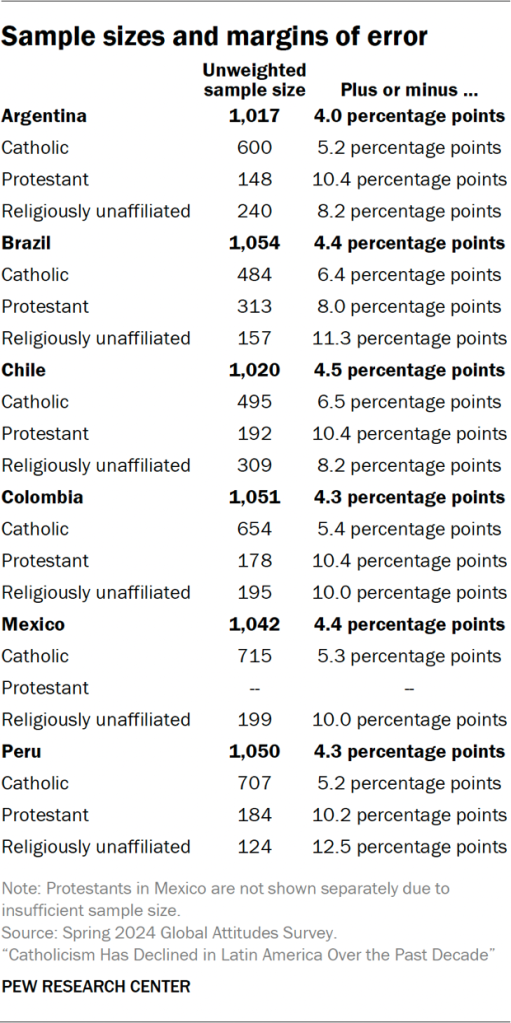
In each country surveyed, respondents were asked about their current religious identification. We then analyzed religious groups with sufficiently large sample sizes to produce reliable estimates. There were not enough Protestants in Mexico to analyze them separately. Refer to the table for the number of respondents in each religious group, and the error attributable to sampling that would be expected at the 95% level of confidence, in each of the six countries discussed in this report.
Pentecostals
We estimated the share of Pentecostal Protestants in this survey using two questions. We asked all Christians whether they describe themselves as Pentecostal, or not. We also asked all Protestants what kind of church they belong to, with one option being “a Pentecostal church, for example, Assemblies of God or the Universal Church of the Kingdom of God.” If respondents who identified as Protestant said “yes” to the first question (they consider themselves Pentecostal), or they indicated they belong to a Pentecostal church in the second question – or both – they were categorized as Pentecostal. Refer to the report topline for full question and response option wording.
Educational attainment
To compare educational groups across countries, we standardized education levels based on the United Nations’ International Standard Classification of Education (ISCED).
Determining how the share of Catholics in Latin America has changed since 1900
Estimates for the share of the population in each country who were Catholic in 1900, 1970 and 2000 come from the World Religion Database (WRD) and include adjusted estimates for adults and children.
Estimates for 2013-14 come from Pew Research Center’s “Religion in Latin America” survey, which does not include children. Estimates for 2024 come from the Center’s Global Attitudes Survey (upon which this report is based) and do not include children.
We adjusted the WRD data to ensure that religious groups are categorized consistently across the century. The WRD includes a category of Christians with double affiliation, “where Christians are counted more than once by two or more denominations.” This group was proportionally subtracted from the population of Catholics within each country.
To give an example, WRD estimates that there were 37,214,000 Argentines in 2000, with 33,996,000 who were Christian (including 31,570,000 who were Catholic and 946,000 who were double-affiliated). As such, Catholics were estimated to make up 92.9% of the entire Christian population in Argentina, and we subtracted 92.9% of the double-affiliated Christians (i.e., 878,492 people) from the total Catholic estimate of 31,570,000, resulting in a new, adjusted estimate of 30,691,508 Catholics, which is 82% of the total population.