
The Briefing
☀️ Happy Thursday! The Briefing is your guide to the world of news and information. Sign up here!
In today’s email:
- Featured story: Society of Professional Journalists updates Code of Ethics
- In other news: Trump administration supports OpenAI in New York Times copyright lawsuit
- Looking ahead: California passes bill to support local news with tax credits
- Chart of the week: Americans see using smartphones as helpful for staying informed
🔥 Featured story
The Society of Professional Journalists has updated its Code of Ethics for the first time in 12 years. The code has long been a guiding document for professional journalists and news organizations. Editors chose to revise it this year to address both the rapid evolution of artificial intelligence and the recent uptick in independent journalists who do not work for traditional news organizations.
A new line in the document does not mention AI by name but calls on journalists to “remember that speed, technology or medium do not excuse inaccuracy or unfairness.” Americans agree that accuracy is one of the most important functions of journalism: In a 2025 Center survey that asked respondents what the people they get news from should or shouldn’t do, the largest share of Americans said they definitely should “report the news accurately.”
SPJ’s leaders are hopeful that the code will apply broadly to those who report the news at a time when Americans do not always agree on what makes someone a journalist. Just under half of U.S. adults (46%) say their news mostly comes from people they consider to be journalists, and 8% say their news mostly comes from people they do not think are journalists. About a third (32%) say their news comes from roughly an even split of journalists and others.
📌 In other news
- Trump administration supports OpenAI in New York Times copyright lawsuit
- Pentagon reduces access to classified information after Washington Post reporting
- Judge allows Arkansas Democrat-Gazette to continue publishing details from confidential documents about data center
- When influencers talk about politics, they don’t always disclose payments
- Tycoon found not guilty in murder of journalist in Malta
- Trump administration to send $4 million to right-wing media in Europe
- The Saturday Evening Post to stop print edition after 205 years; several Michigan newspapers also will stop printing
- Politico to launch global app, combining U.S. and Europe coverage
📅 Looking ahead
California lawmakers recently passed the Community NEWS Act, which would create tax credits for newsrooms that could generate millions in revenues for the state’s local news outlets. It is now up to Gov. Gavin Newsom to decide whether to sign it into law. The bill includes job retention credits that reward news organizations for maintaining employees, as well as new hire credits for organizations that expand the size of their workforces.
While a majority of Americans (57%) think their local news outlets are doing very or somewhat well financially, according to a 2025 Center survey, the share who say they are not doing well has increased from 24% in 2018 to 39% in 2025. A large majority of U.S. adults (80%) say local news outlets are at least somewhat important to the well-being of their local community, although just 12% say they have paid or given money to a local news source in the past year, whether by subscribing, donating or becoming a member.
📊 Chart of the week
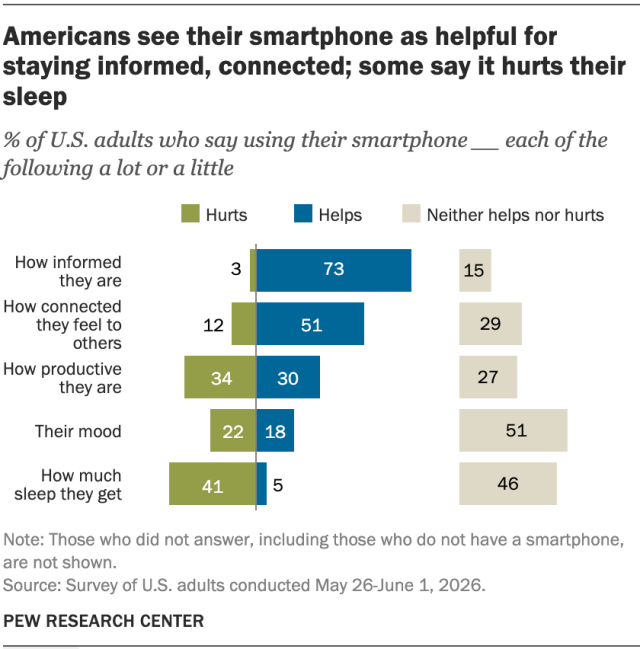
This week’s chart comes from a new analysis looking at Americans’ thoughts on how they use smartphones.
Americans see both benefits and drawbacks to smartphone use. For example, just over half of U.S. adults say they spend too much time on their phone. But they see being informed as one of the benefits: Nearly three-quarters (73%) of Americans say using their smartphone helps how informed they are, compared with just 3% who say it hurts in this area.
👋 That’s all for this week.
The Briefing is compiled by Pew Research Center staff, including Naomi Forman-Katz, Christopher St. Aubin, Emily Tomasik, Joanne Haner and Sawyer Reed. It is edited by Michael Lipka and copy edited by Mia Hennen.
Do you like this newsletter? Email us at journalism@pewresearch.org or fill out this two-question survey to tell us what you think.
