
☀️ Happy Thursday! The Briefing is your guide to the world of news and information. Sign up here!
In today’s email:
- Featured story: FCC to review ABC’s broadcast license
- In other news: Conspiracy theories spread about shooting at White House Correspondents’ Association dinner
- Looking ahead: Australia plans to tax tech companies to fund journalism
- Chart of the week: Where Americans get health information
🔥 Featured story
The Federal Communications Commission has ordered an early review of ABC’s broadcast licenses, citing the network’s diversity, equity and inclusion policies. The move also follows criticism of ABC’s late-night host Jimmy Kimmel by President Donald Trump and his wife Melania over jokes Kimmel made last week before a shooter attempted to open fire at the White House Correspondents’ Association dinner.
About a third of U.S. adults (36%) say they regularly get news from ABC News, placing it among the most widely used news sources. While 44% of Americans say they trust ABC News as a source of news, 25% say they distrust it.
Democrats are much more likely than Republicans to say they both regularly get news from ABC News (46% vs. 27%) and trust ABC News (61% vs. 26%).
📌 In other news
- Conspiracy theories spread about shooting at White House Correspondents’ Association dinner
- Pentagon can temporarily require escorts for journalists, court rules; Pentagon fires ombudsman for military newspaper Stars and Stripes
- American journalist Shelly Kittleson details her kidnapping in Iraq
- Polish-Belarusian journalist Andrzej Poczobut freed after five years in prison in Belarus
- Reporters Without Borders releases 2026 World Press Freedom Index
- Politico journalists meet with parent company executives after staff raise concerns about CEO’s political views
- CBS News replaces London bureau chief
- Forbes tests mock prediction market platform with stories
📅 Looking ahead
The Australian government announced a new plan this week to tax major technology companies in order to generate revenue for journalists and news organizations. Companies that could face these taxes include Google, Meta (which owns Facebook and Instagram), and TikTok. “We believe it’s only fair that large digital platforms contribute to the hard work of journalism that enriches their feeds and that drives their revenue,” Australian Communications Minister Anika Wells said. But major tech companies have pushed back strongly, with a Meta spokesperson calling the proposal “simply wrong.”
The growing usage of tech companies’ products for news consumption is part of the government’s justification for the policy. In the U.S., 38% of adults say they regularly get news on Facebook, a similar share (35%) regularly gets news on YouTube, and 20% each get news on TikTok and Instagram. A majority of Americans also say they often (19%) or sometimes (44%) get news from search engines like Google.
📊 Chart of the week
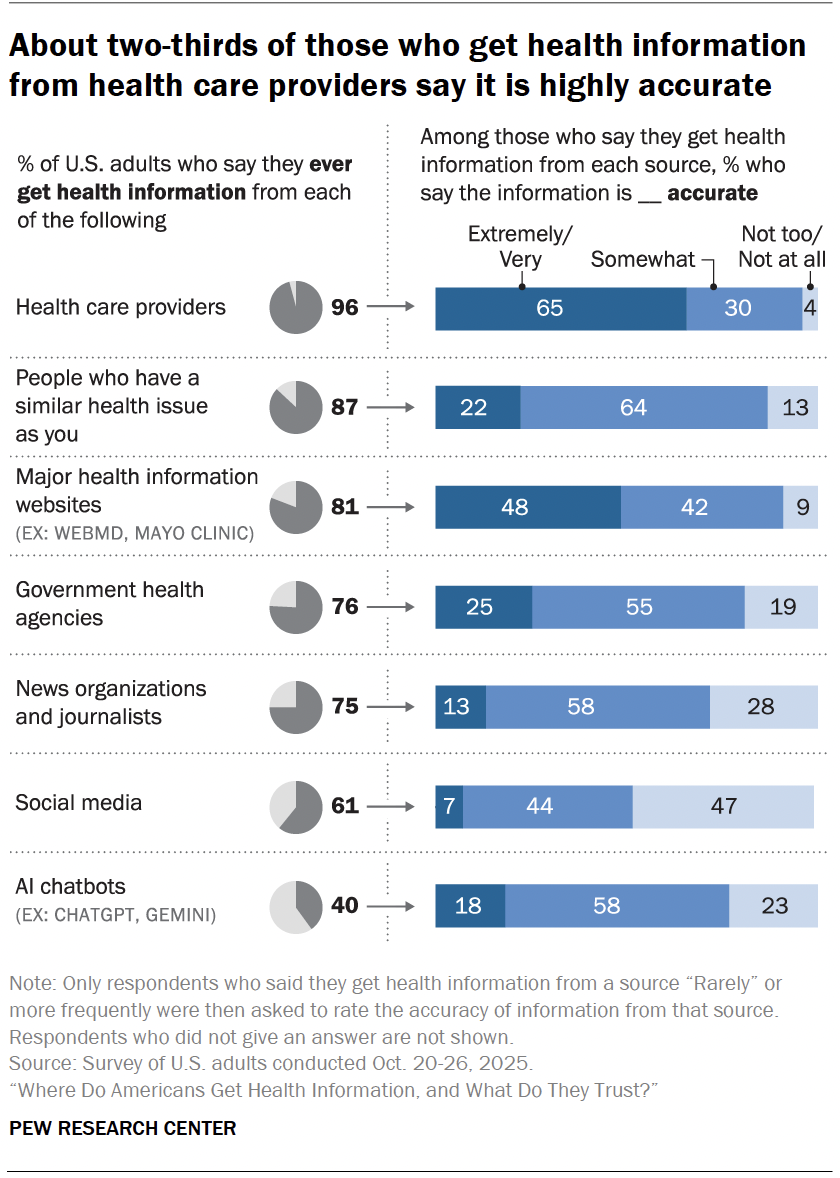
This week’s chart comes from a new Pew Research Center analysis of where Americans get health information, based on a 2025 survey.
Americans get health information from a wide array of people, platforms and institutions, including health care providers, websites that specialize in health information, and news organizations.
When it comes to accuracy of the information, health care providers get the most positive assessments: About two-thirds of those who ever get health information from providers (65%) say the information is extremely or very accurate. Meanwhile, social media stands out for the lowest ratings of accuracy. Roughly half of Americans who get health information from social media say the information is not too or not at all accurate (47%), while just 7% say it is highly accurate.
👋 That’s all for this week.
The Briefing is compiled by Pew Research Center staff, including Naomi Forman-Katz, Christopher St. Aubin, Joanne Haner and Sawyer Reed. It is edited by Michael Lipka and copy edited by Mia Hennen.
Do you like this newsletter? Email us at journalism@pewresearch.org or fill out this two-question survey to tell us what you think.
