
☀️ Happy Thursday! The Briefing is your guide to the world of news and information. Sign up here!
In today’s email:
- Featured story: The rise of a Spanish-language news influencer
- In other news: American journalist kidnapped in Iraq
- Looking ahead: Salt Lake Tribune to drop paywall
- Chart of the week: Americans differ by age in where they turn for breaking news
🔥 Featured story
A recent profile in The New Yorker looks at the rise of Carlos Eduardo Espina, a Uruguayan American content creator who has amassed more than 20 million followers across TikTok, Instagram, YouTube and Facebook. Espina, who posts mainly in Spanish, provides viewers with updates and commentary on news stories, addressing what he saw as a need for Spanish-language news content on social media.
Roughly a quarter of all U.S. Hispanic adults say they prefer to get news in Spanish (24%), while 51% prefer getting news in English and 23% have no preference, according to a 2024 Pew Research Center survey. Among Hispanic immigrants, the share who prefer getting Spanish-language news is higher (47%).
As a relatively young population, Hispanic Americans are somewhat more likely than U.S. adults overall to get news on social media in general and from news influencers in particular. And when we asked Americans who regularly get news from these influencers to name the first one who comes to mind, Espina was one of the most common answers.
📌 In other news
- American freelance journalist Shelly Kittleson kidnapped in Iraq
- Federal judge orders pause to Nexstar-Tegna merger, but companies say they can’t comply
- Judge rules Trump executive order barring federal funding of NPR and PBS is unconstitutional
- TMZ increases coverage of vacationing members of Congress
- Politico names Jonathan Greenberger new top editor
- Creator platform Beehiiv breaks into podcasting
- Independent newsletter creators experiment with bundling subscriptions
- The Guardian releases AI tool that gives readers links to related articles
📅 Looking ahead
The Salt Lake Tribune announced this week that it will soon remove its paywall, making all new articles free to read online. The nonprofit newsroom also asked current subscribers to send donations to ensure its business model is successful, offering extra perks to those who do so.
When Americans encounter news paywalls, very few (1%) say they usually pay, a 2025 Center survey found. Roughly half of those who encounter paywalls (53%) say they typically try to find the information somewhere else instead, while 32% give up on trying to access it.
Just 16% of all U.S. adults say they have paid for news in the past year, and an even smaller share (8%) say individual Americans have a responsibility to pay for news. The public is much more likely to say news organizations should primarily make money by selling ads or sponsorships (45%) than through subscriptions or memberships (11%).
📊 Chart of the week
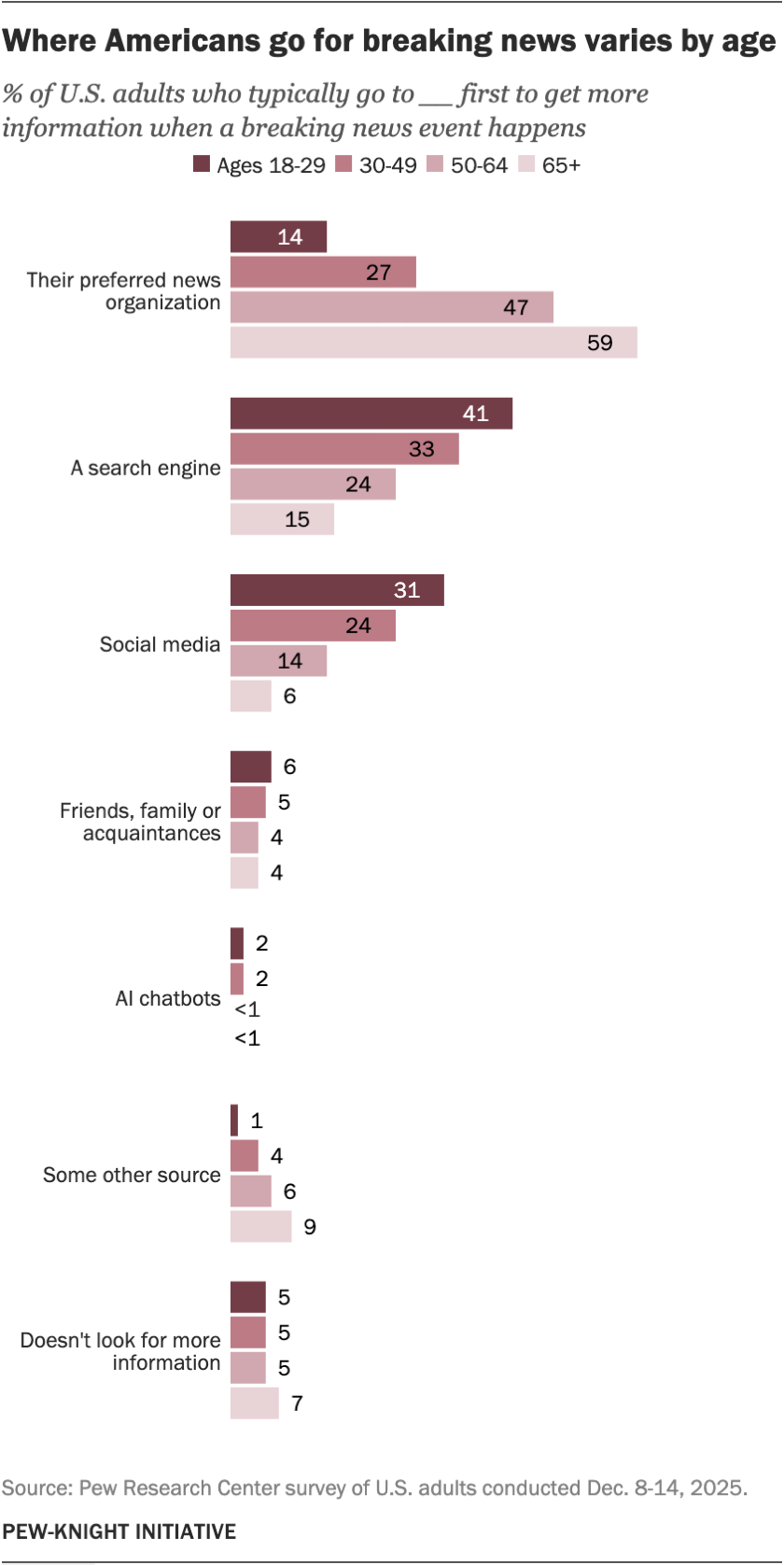
This week’s chart comes from our recent analysis about where Americans turn for information about breaking news events, based on a 2025 Pew Research Center survey.
When a breaking news event happens, Americans ages 65 and older are around four times as likely as those ages 18 to 29 to say they turn to their preferred news organization to learn more (59% vs. 14%).
Meanwhile, younger adults are more likely to say they first turn to search engines and social media.
👋 That’s all for this week.
The Briefing is compiled by Pew Research Center staff, including Naomi Forman-Katz, Christopher St. Aubin, Joanne Haner, and Sawyer Reed. It is edited by Michael Lipka and Kirsten Eddy and copy edited by Anna Jackson.
Do you like this newsletter? Email us at journalism@pewresearch.org or fill out this two-question survey to tell us what you think.
