
☀️ Happy Thursday! The Briefing is your guide to the world of news and information. Sign up here!
In today’s email:
- Featured story: Right-wing media figures sue Washington state House over denied press credentials
- New from Pew Research Center: Email newsletters as a source of news
- In other news: Stephen Colbert says CBS pulled interview with Senate candidate over FCC concerns
- Looking ahead: Homeland Security seeking info on social media users who criticize ICE
- Chart of the week: Americans are far more confident in their own ability to check the accuracy of news than in others
🔥 Featured story
Three members of the media in Washington state have filed a lawsuit against the state House of Representatives after their applications for statehouse press passes were denied over their political advocacy. All three plaintiffs have been involved with both journalism and right-wing advocacy. They claim that the denial of press credentials is a violation of their First Amendment rights. But the House clerk, in a rejection letter related to the press passes, maintained that “the press should act as an independent observer and monitor of the proceedings, not as an involved party.”
Americans express mixed views on the question of whether journalists can also be advocates, according to a 2025 Pew Research Center survey. But they are much less likely to say it’s okay for journalists to express their political views in their reporting – just 13% say this is always or usually acceptable.
🚨 New from Pew Research Center
Email newsletters have become a familiar format for news. But this pathway to news remains somewhat niche, and even among Americans who get news from email newsletters, a majority say they don’t end up reading most of the newsletters they receive, according to a new Pew Research Center report.
📌 In other news
- Stephen Colbert says CBS pulled interview with Senate candidate over Federal Communications Commission concerns
- Journalists arrested in Cameroon while investigating facility holding migrants deported from the U.S.
- Warner Bros. Discovery reopens merger talks with Paramount alongside pending Netflix deal
- CNN anchor Anderson Cooper is leaving 60 Minutes
- German public broadcaster Deutsche Welle faces budget cuts
- The Guardian to launch new flagship video podcast, as Apple pivots its podcasting platforms to embrace video and Crooked Media podcasts to air on MS NOW
- A look at how AI is transforming freelance journalism
- Atlantic essay on measles prompts confusion and debate about journalism ethics
📅 Looking ahead
The Department of Homeland Security has been asking tech companies for information about accounts that criticize or track Immigration and Customs Enforcement, according to a New York Times report. The government has issued hundreds of subpoenas to several companies, including Google and Meta, seeking identifying data on individual users.
A 2023 Pew Research Center study explored Americans’ views on digital privacy, finding that 72% said they had little to no understanding about the laws and regulations to protect their data privacy that were in place at the time. Majorities of U.S. adults also said they were concerned about how companies and the government use their data. And most felt they had little to no control over or understanding of what happens with this data.
📊 Chart of the week
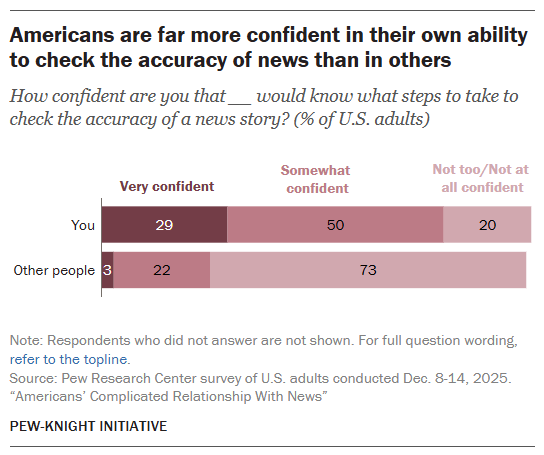
This week’s chart comes from a recent Pew Research Center study of Americans’ relationship with news, which finds that Americans are much more confident in themselves than in other people to check the facts in the news. Most U.S. adults say they are very (29%) or somewhat (50%) confident they would know what steps to take to verify the accuracy of a news story. But only a quarter are very (3%) or somewhat (22%) confident in other people’s ability to do so.
👋 That’s all for this week.
The Briefing is compiled by Pew Research Center staff, including Naomi Forman-Katz, Christopher St. Aubin, Joanne Haner and Sawyer Reed. It is edited by Michael Lipka and copy edited by Mia Hennen.
Do you like this newsletter? Email us at journalism@pewresearch.org or fill out this two-question survey to tell us what you think.
