
☀️ Happy Thursday! The Briefing is your guide to the world of news and information. Sign up here!
In today’s email:
- Featured story: Pittsburgh Post-Gazette to shut down
- In other news: How the new Pentagon press corps covered Venezuela
- Looking ahead: What news influencers and social media stars mean for the future of journalism
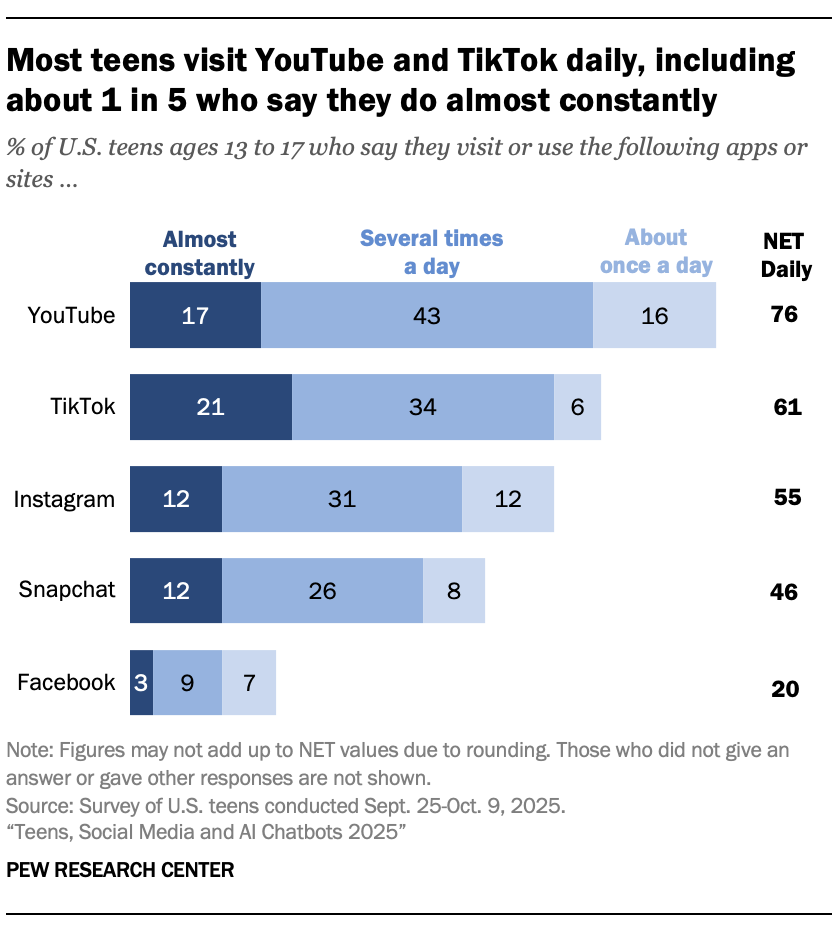
- Chart of the week: Most teens visit YouTube and TikTok daily, including about 1 in 5 who say they do almost constantly
🔥 Featured story
The Pittsburgh Post-Gazette, which started publishing in the late 1700s and won a Pulitzer Prize as recently as 2019, will shut down on May 3. Its unionized workers recently ended a more than three-year strike after a court ruling in favor of the union, but the Post-Gazette’s owners said that the newspaper has lost more than $350 million over the past 20 years, making “continued cash losses at this scale no longer sustainable.”
Fewer Americans say they are getting local news from daily newspapers: A third said in 2024 that they do this at least sometimes, down from 43% in 2018. This fits with the broader decline of local newspapers, which have suffered major losses in revenue since their business model was disrupted by the arrival of the internet and eventually smartphones.
📌 In other news
- The new Pentagon press corps covered Venezuela with few scoops and high praise
- White House debuts site about what happened on Jan. 6 with false claims
- What will happen to public media now that the Corporation for Public Broadcasting has voted to shut down?
- A timeline of content deals between AI companies and publishers in 2025
- A closer look at the first few months of Bari Weiss’ CBS News tenure
- New York Mayor Mamdani holds City Hall tour and private news conference for “new media” and social media influencers
- Copycat website poses as Colorado student paper to push AI slop
- Warner Bros. Discovery board again rejects Paramount takeover bid
📅 Looking ahead
After YouTube creator Nick Shirley’s viral video raised allegations of fraud surrounding child care funding in Minnesota, a new article in The New Yorker looks at the rise of investigative journalism by news influencers and social media personalities – and asks what this new realm of journalism means for the future of the field.
About one-in-five Americans (21%) say they regularly get news from news influencers, according to our recent survey. When asked why they use news influencers to get news, people who regularly get news from this source name several factors as major reasons, including 54% who say influencers offer help understanding current events and civic issues and 46% who say they share different information than other sources.
A separate 2024 analysis found that 77% of news influencers had no current or past affiliation with a news organization, signaling many news influencers’ independence from legacy media. And about half of news influencers (52%) explicitly identify with a particular political orientation.
📊 Chart of the week
A majority of U.S. teens ages 13 to 17 use YouTube, TikTok and Instagram daily, according to a September-October Pew Research Center survey. About three-quarters (76%) of teens report visiting YouTube daily, while 61% say the same about TikTok and 55% are on Instagram every day.
This includes around one-in-five teens who say they use TikTok and YouTube almost constantly (21% and 17%, respectively) and 12% who say this about Instagram.
👋 That’s all for this week.
The Briefing is compiled by Pew Research Center staff, including Naomi Forman-Katz, Christopher St. Aubin, Emily Tomasik, Joanne Haner, and Sawyer Reed. It is edited by Michael Lipka and copy edited by David Kent.
Do you like this newsletter? Email us at journalism@pewresearch.org or fill out this two-question survey to tell us what you think.
