The United States will recognize 11 public holidays this year at the federal level. That’s slightly below the global median: Across 190 members of the United Nations we analyzed, the typical country will observe 13 public holidays in 2026.
Here’s a closer look at public holidays around the globe, based on our analysis of world calendar data maintained by Time and Date. We also consulted national labor codes, government publications and regional news sources.
Note that national public holiday schedules are subject to change throughout the year. In a few cases, we manually adjusted our counts to reflect real-world technicalities. Refer to “What counts as a public holiday?” or the methodology for more details. And click below to read about specific topics:
- Which countries have the most public holidays in 2026?
- Which countries have the fewest?
- What kinds of public holidays are widely observed?
- Religious holidays worldwide
- Holidays from multiple religions
Which countries have the most public holidays in 2026?
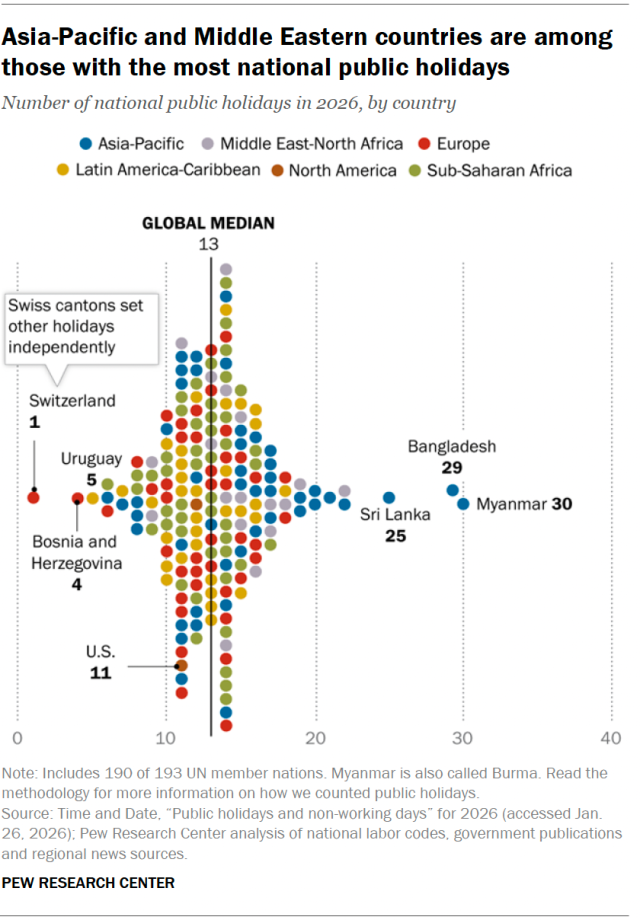
Myanmar, also called Burma (30), Bangladesh (29) and Sri Lanka (25) are among the countries with the most national public holidays in 2026.
Myanmar and Sri Lanka are predominantly Buddhist, with many holidays that are tied to lunar calendars. Myanmar’s holiday schedule includes multiple days off for Lunar New Year and Buddhist New Year (Thingyan), as well as certain full moon days commemorating events in the life of Buddha. In Sri Lanka, all full moon days are public holidays, known there as Poya days.
Bangladesh’s population is mostly Muslim, with a large Hindu minority and smaller shares of Buddhists and Christians. Its public holiday calendar includes certain observances from all four religions: several days off for Eid al-Fitr and Eid al-Adha, a public holiday for Janmashtami (celebrating the birth of Krishna), one for Vesak (sometimes called Buddha Day or Buddha Purnima) and one for Christmas. This year, Bangladeshis will also get two public holidays for their national elections.
Related: Many religions are heavily concentrated in a few countries
Other countries with a lot of public holidays include Cambodia, Iran and Lebanon, which each have more than 20. Nepal typically falls among the countries with the most holidays, too, but its full holiday calendar for 2026 is not yet released.
Which countries have the fewest?
In Switzerland, there’s technically just one public holiday at the federal level: Swiss National Day on Aug. 1. The country’s 26 cantons set other holidays independently. Each canton recognizes at least eight public holidays this year, including Swiss National Day.
Bosnia and Herzegovina and Uruguay have the next-fewest public holidays, with four and five, respectively.
- Bosnia and Herzegovina generally lacks unified national holidays because of its decentralized political system. Its two main self-governing entities – the Federation of Bosnia and Herzegovina (predominantly Muslim and Catholic) and the Republic of Srpska (predominantly Eastern Orthodox) – set separate holiday schedules.
- In Uruguay, widely celebrated occasions like Carnival, Holy Week (officially called Tourism Week) and the birthday of national hero José Artigas are considered working holidays by law.
What kinds of public holidays are widely observed?
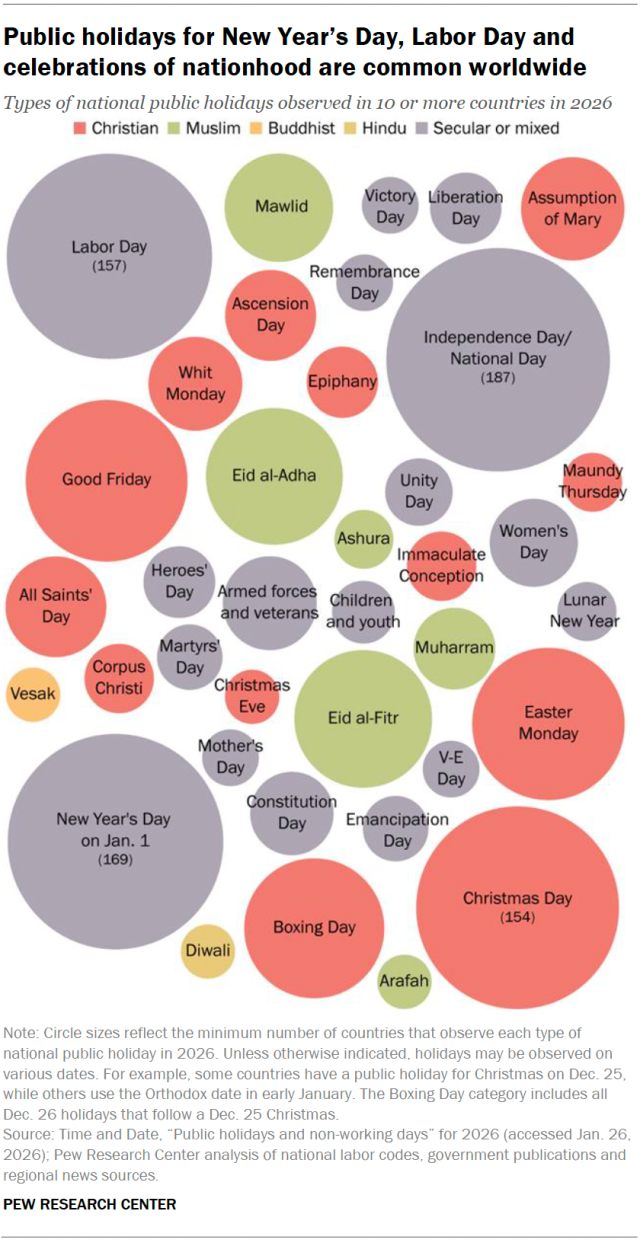
By our count, New Year’s Day is the most common public holiday worldwide, celebrated on Jan. 1 in at least 169 countries. Four other countries officially recognize a different holiday on Jan. 1.
- Some countries don’t have a public holiday on Jan. 1 but mark the new year of a different calendar. For example, Malaysia observes Lunar New Year, this year in February; Israel celebrates Rosh Hashanah, this year in September; and Egypt and Libya mark the Islamic New Year at the start of Muharram, which in 2026 falls in June.
International Labor Day on May 1, also called May Day, is a public holiday in at least 144 countries. Another 13 nations, including Canada, Jamaica, New Zealand and the U.S., have a holiday honoring workers on a different date.
Nearly every UN member nation we analyzed has a public holiday for their Independence Day or National Day (at least 187). The origins of these holidays vary: Some commemorate a revolutionary victory, others the creation of a founding document or the life of a patron saint. Denmark and the United Kingdom are among the few countries that do not have this type of public holiday.
International Women’s Day on March 8 is a public holiday in at least 23 countries, and at least six others have a holiday celebrating women on a different date. For example, South Africa has a National Women’s Day on Aug. 9, and Tunisia has one on Aug. 13. (These counts exclude countries where the holiday is a day off for women only, as is the case in a few places.)
Emancipation Day on Aug. 1 and other holidays commemorating the abolition of slavery are observed in 16 countries. The most recent addition to this list is the U.S., which adopted Juneteenth as a federal holiday in 2021.
Other types of holidays that are common worldwide include those that celebrate a specific political or ideological leader, those honoring the armed forces and their service members, and remembrance days for victims of social persecution.
Some holidays are common within a single region, including Africa Day, Carnival, Midsummer, Nowruz and Victory in Europe Day.
Religious holidays worldwide
The vast majority of countries in our analysis observe at least one national public holiday with a religious origin. Christians and Muslims – the world’s two largest religious groups – are well-represented on holiday calendars.
At least 154 countries have a public holiday for Christmas Day. Most of these nations observe Christmas on Dec. 25, though nine solely recognize Orthodox Christmas in early January. A few, including Belarus, Lebanon and Sudan, have public holidays on both dates. Of the countries that celebrate Christmas on Dec. 25, at least 68 will observe Boxing Day, St. Stephen’s Day or another holiday on Dec. 26.
- Good Friday (a public holiday in at least 98 countries) and Easter Monday (at least 87) are also common public holidays worldwide, as are Assumption Day, Ascension Day and Whit Monday. These counts also include Orthodox observances.
Related: Americans Say Religious Aspects of Christmas Are Declining in Public Life
Eid al-Fitr is a public holiday in at least 71 countries. The Muslim festival celebrating the end of the Ramadan fast is known by different names around the world, including Korité in West Africa and Hari Raya Puasa in Southeast Asia. At least 70 countries have a public holiday for Eid al-Adha; at least 66 celebrate both major Eids. Some countries observe just one day off for these festivals, while some observe more.
- At least 44 countries have a public holiday for Mawlid, celebrating the birth of the Prophet Muhammad. In Fiji, Mawlid is the only Muslim observance on the public holiday calendar.
Vesak and Diwali are common public holidays among countries with large Buddhist and Hindu populations, respectively. Only Israel marks Jewish observances with national public holidays.
Related: Many Countries Favor Specific Religions, Officially or Unofficially
Holidays from multiple religions
Many countries observe major holidays from multiple religions at the national level. For instance, at least 52 countries have public holidays for both Christmas and at least one major Eid (that is, Eid al-Adha, Eid al-Fitr or both). More than half of these nations (30) are in Africa.
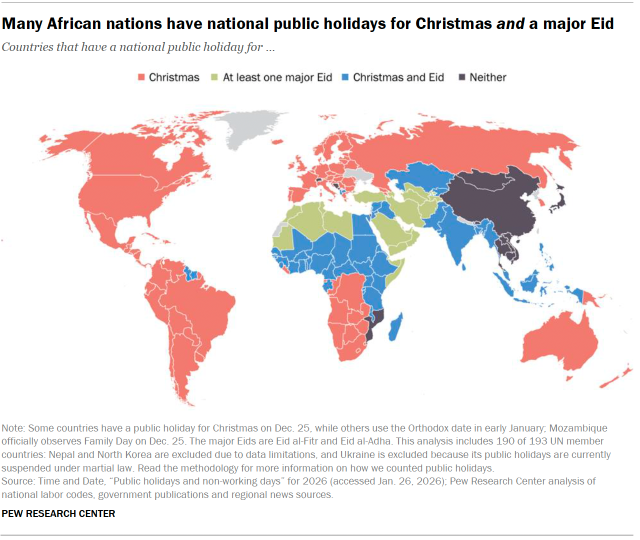
Some countries blend holidays from three, four or even more major religions. Bangladesh, Malaysia, Myanmar, Singapore and Sri Lanka all celebrate holidays associated with Buddhism, Christianity, Hinduism and Islam. And India’s public holiday schedule for 2026 includes holidays associated with Christianity, Buddhism, Hinduism, Islam, Jainism and Sikhism.
Related: Religious Diversity Around the World
Just because a country doesn’t recognize certain religious observances as national public holidays does not mean residents can’t celebrate them. Many countries have a list of optional holidays for religious minorities or otherwise give workers the right to take certain days off for religious reasons.
Note: This analysis benefited greatly from the input of staff at Time and Date.