
The outcome of the Greek parliamentary election Sunday, which gave power to Syriza, the left-wing, anti-austerity party that has pledged to restructure Greece’s crushing government debt, should have come as no surprise given the views of the Greek public about the European Union. Likewise, other Europeans’ views of Greeks suggest the difficulty the new government in Athens faces in getting a better deal from its European partners.
Greeks have little regard for the EU. Only about a third of Greeks have a positive view of the EU, according to a spring 2014 Pew Research Center survey. Just 17% think that European economic integration has been good for Greece.
Despite their frustrations with the EU, and in the face of speculation that restructuring of Greek debt could lead to abandonment of the common European currency, 69% of Greeks want to keep the euro and not return to the drachma.
Greeks feel abandoned by their EU partners. An overwhelming majority of Greeks (85%) say that the EU does not understand the needs of its citizens. And 74% judge as inadequate the financial assistance the EU has provided to member countries, such as Greece, that are experiencing major financial problems.
Greeks oppose the EU meddling in Greek affairs. More than eight-in-ten Greeks (86%) say the EU is intruding in their country’s business and two-thirds (67%) think it’s inefficient. There’s little wonder, then, that 71% of Greeks oppose giving more decision-making power to the EU to deal with Europe’s economic problems.
Greeks see themselves differently than others see them. Contradictory stereotypes may complicate any resolution of the new Greek crisis.
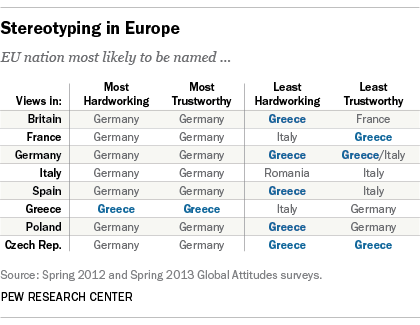
Greeks see themselves as the most hardworking Europeans, according to a 2012 Pew Research Center survey. The British, the Germans, the Spanish, the Poles and the Czechs all see the Greeks as the least hardworking. And the Greeks see themselves as the most trustworthy of Europeans, while the French, the Germans and the Czechs voice the view that Greeks are the least trustworthy, according to a 2013 Pew Research Center survey.