Majority of Americans Continue To Say Abortion Should Be Legal in All or Most Cases
A 60% majority of U.S. adults say abortion should be legal in all or most cases. This share is down slightly from the last few years.
All
Publications
A 60% majority of U.S. adults say abortion should be legal in all or most cases. This share is down slightly from the last few years.
In the 10 years that we have asked this question, Americans overall have consistently been more likely to say their side is losing than to say it’s winning.
Overall, 44% of U.S. adults say they trust the U.S. a lot or some to regulate the use of AI effectively, while 47% have little to no trust in the U.S. to do this.
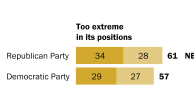
Democrats’ frustration with their own party is up sharply, as many say it hasn’t pushed back hard enough against Trump and the GOP. In contrast, 40% of Republicans say they are frustrated with their party.
About six-in-ten U.S. adults now say they favor more nuclear power plants to generate electricity, up from 43% in 2020.
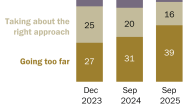
About six-in-ten now say they have an unfavorable view of the Israeli government, with a rising share saying Israel is “going too far.”
Nearly three-in-four U.S. adults (74%) say economic conditions are only fair or poor, up slightly from 72% in January 2024.
Congress has passed all its required appropriations measures on time only four times in nearly five decades.
Half of Americans currently hold an unfavorable opinion of the Supreme Court, while roughly as many view the court favorably.
The share of U.S. workers who belonged to a union in 2024 stood at 9.9%, down from 1983 when 20.1% of American workers were union members.