Why Do Some Americans Leave Their Religion While Others Stay?
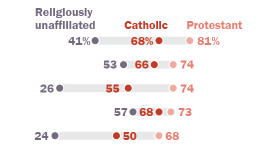
Many U.S. adults (35%) have moved on from the religion of their youth. Yet most Americans have not, including a majority – 56% – who still identify with their childhood religion.
All
Publications
In advance of the 200th anniversary of Charles Darwin’s birthday on Feb. 12, 2009, the Pew Research Center’s Forum on Religion & Public Life recently released a research package exploring the evolution controversy in the U.S. The Pew Forum’s U.S. Religious Landscape Survey found that views on evolution differ widely across religious groups. Source: Pew […]
Updated February 3, 2014 Buddhism Many Buddhists see no inherent conflict between their religious teachings and evolutionary theory. Indeed, according to some Buddhist thinkers, certain aspects of Darwin’s theory are consistent with some of the religion’s core teachings, such as the notion that all life is impermanent. Religion East and West, “Buddhism and Science: Probing […]
Updated February 3, 2014 The debate over whether and how to teach public school students about evolution may be an old one, but it shows no signs of abating. Indeed, in the last decade, questions about what students should learn about Darwin’s theory have been debated in more than half the states in the union […]
A Pew Forum research package gives an overview of the debate, examines its social and legal dimensions and reviews the life and ideas of Charles Darwin. ANALYSIS Updated February 3, 2014 Overview: The Conflict Between Religion and Evolution Almost 150 years after Charles Darwin published his groundbreaking work On the Origin of Species by Means […]
Updated February 3, 2014 Almost 150 years after Charles Darwin published his groundbreaking work On the Origin of Species by Means of Natural Selection, Americans are still fighting over evolution. If anything, the controversy has grown in both size and intensity. In the last decade, debates over how evolution should be taught in schools have […]
Updated February 3, 2014 As with many social and political controversies in the United States, the battle over evolution has been largely fought in courtrooms. This has been particularly true in the last 50 years, as courts have been repeatedly asked to rule on efforts to restrict or change the way public schools teach about evolution […]
A 2008 survey by the Pew Research Center for the People & the Press and the Pew Research Center’s Forum on Religion & Public Life found that while Americans generally support allowing religious groups to apply for government funding to provide social services, they draw the line at letting such organizations hire only people who […]
During his 2008 presidential campaign, then-candidate Barack Obama said that he intended to overturn President George W. Bush’s policy of allowing faith-based groups that receive federal funding to consider a potential employee’s religion when making hiring decisions. Although a 1972 civil rights law generally exempts religious groups from the prohibition on religious discrimination in hiring, […]
Many religious “nones,” which include atheists and agnostics, in 22 countries hold religious or spiritual beliefs, such as in an afterlife or something beyond the natural world.
Nearly half of U.S. adults are connected to Catholicism. Read about going to Mass, Communion, confession and more.
After years of decline, the U.S. Christian share now shows signs of leveling off. The new Religious Landscape Study explores trends in identity, beliefs and practices.
The Global Religious Futures (GRF) project is jointly funded by The Pew Charitable Trusts and The John Templeton Foundation. Here are some big-picture findings from the GRF, together with context from other Pew Research Center studies.