Americans’ Complicated Relationship With News
Most say being informed is essential for voting. Yet views differ on the importance of following news – and many say they’re worn out by it.
All
Publications
Most say being informed is essential for voting. Yet views differ on the importance of following news – and many say they’re worn out by it.
Eight-in-ten U.S. adults say Republican and Democratic voters not only disagree on plans and policies, but also cannot agree on basic facts.
Americans’ confidence in checking COVID-19 information aligns closely with their confidence in checking the accuracy of news stories broadly.
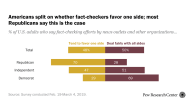
Republicans largely say fact-checking by news outlets and other organizations favors one side. Democrats mostly think it is fair to all sides.
Younger U.S. adults were better than their elders at differentiating between factual and opinion statements in a survey conducted in early 2018.
Read a Q&A with Amy Mitchell, director of journalism research at Pew Research Center, on a new report that explores Americans’ ability to distinguish factual news statements from opinions.
People deal in varying ways with tensions about what information to trust and how much they want to learn. Some are interested and engaged with information; others are wary and stressed.
A majority of U.S. adults (59%) reject the idea of adding interpretation, saying that the news media should present the facts alone