Share of young adults not working or in school is at a 30-year low in U.S.
The 30-year low reflects in part tight labor markets and falling unemployment, but also higher shares of young women at work or in school.
All
Publications
The 30-year low reflects in part tight labor markets and falling unemployment, but also higher shares of young women at work or in school.
Financial independence is one of the many markers used to designate the crossover from childhood into young adulthood, and it’s a milestone most Americans (64%) think young adults should reach by the time they are 22 years old, according to a new Pew Research Center study. But that’s not the reality for most young adults who’ve reached this age.
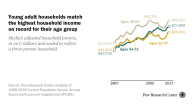
The median adjusted income in a household headed by a Millennial was $69,000 in 2017. The previous peak for households headed by people ages 22 to 37 was in 2000.
They tend to be more left-leaning, more progressive in their social and political views, more receptive to immigrants and more favorable toward the European Union. They are also more mixed in their views of traditional center-left parties than older Western Europeans.
Younger U.S. adults were better than their elders at differentiating between factual and opinion statements in a survey conducted in early 2018.
In the U.S., four-in-ten women and roughly a quarter of adults ages 65 and older say they play video games at least sometimes.
Nearly 790,000 young unauthorized immigrants have received work permits and deportation relief through the federal program created under Obama in 2012.
Through both recession and recovery, the share of young adults living in their parents’ home continues to rise. As of 2016, 15% of 25- to 35-year-old Millennials were living in their parents’ home.
Americans are moving at the lowest rate on record, and recently released Census Bureau data show that a primary reason is that Millennials are moving significantly less than earlier generations of young adults.