Religious Diversity Around the World
Singapore is the world’s most religiously diverse country overall as of 2020, while Yemen is the least diverse. But the U.S. ranks first among nations with very large populations, followed by Nigeria and Russia.
Singapore is the world’s most religiously diverse country overall as of 2020, while Yemen is the least diverse. But the U.S. ranks first among nations with very large populations, followed by Nigeria and Russia.

Sent weekly on Wednesday
All
Publications
Highly religious Americans are much more likely to see society in those terms, while nonreligious people tend to see more ambiguity.
Disagreements among Americans across the religious spectrum extend to personal issues, such as life priorities and gender roles in the family.
Self-identified Christians make up 63% of the U.S. population in 2021, down from 75% a decade ago.
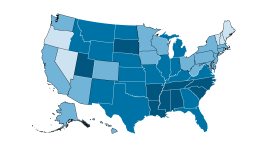
To highlight some of India’s religious, cultural and demographic differences, here are key facts about its states.
Immigrants from sub-Saharan Africa tend to be more religious than U.S.-born Black adults or immigrants from the Caribbean.
As democratic nations have wrestled with economic, social and geopolitical upheaval in recent years, the future of liberal democracy has come into question. Our international surveys reveal key insights into how citizens think about democratic governance.
In the new survey, the Center attempted for the first time to pose some of these philosophical questions to a nationally representative sample of U.S. adults, finding that Americans largely blame random chance – along with people’s own actions and the way society is structured – for human suffering, while relatively few believers blame God or voice doubts about the existence of God for this reason.
Why is there so much suffering and evil in the world? This question can be particularly confounding for those who believe in a good and all-powerful God, as is often described in the Abrahamic religious traditions of Judaism, Christianity and Islam. For centuries, philosophers and theologians have grappled with this “problem of evil.”
Nearly 19,000 adults in publics ranging from the UK, Italy, Greece, Japan, South Korea, Germany, and the U.S., among others, share where they find meaning in their lives and what keeps them going.
Some Americans clearly long for a more avowedly religious and explicitly Christian country, a March survey finds. However, a clear majority of Americans do not accept these views.
Many religious “nones,” which include atheists and agnostics, in 22 countries hold religious or spiritual beliefs, such as in an afterlife or something beyond the natural world.
Nearly half of U.S. adults are connected to Catholicism. Read about going to Mass, Communion, confession and more.
After years of decline, the U.S. Christian share now shows signs of leveling off. The new Religious Landscape Study explores trends in identity, beliefs and practices.
The Global Religious Futures (GRF) project is jointly funded by The Pew Charitable Trusts and The John Templeton Foundation. Here are some big-picture findings from the GRF, together with context from other Pew Research Center studies.