Religious Diversity Around the World
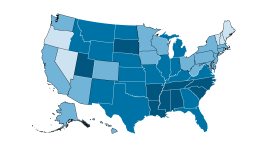
Singapore is the world’s most religiously diverse country overall as of 2020, while Yemen is the least diverse. But the U.S. ranks first among nations with very large populations, followed by Nigeria and Russia.
All
Publications
Overview Public attitudes on a pair of contentious national issues – gun control and abortion – have moved in a more conservative direction over the past year. In both cases, the changes have been driven in part by relatively large shifts among men, while opinions among women have not changed very much. For the first […]
Revised February 2011* Americans change religious affiliation early and often. In total, about half of American adults have changed religious affiliation at least once during their lives. Most people who change their religion leave their childhood faith before age 24, and many of those who change religion do so more than once. These are among […]
On April 27, 1994, South Africa held its first democratic elections after the fall of the apartheid system of racial segregation. Religion played an important role in bringing about this change: Anglican Archbishop Desmond Tutu earned the Nobel Peace Prize in 1984 for his outspoken opposition to apartheid, and many of South Africa’s churches were […]
For many Christians, Easter is the most important religious holiday of the year – a time to celebrate the Resurrection of Jesus Christ and look forward to the Second Coming. According to a 2006 survey by the Pew Research Center’s Forum on Religion & Public Life and the Pew Research Center for the People & […]
American Atheists, a group that advocates on behalf of atheists in the U.S., will hold its national convention later this month. According to the U.S. Religious Landscape Survey, conducted by the Pew Research Center’s Forum on Religion & Public Life, 5% of American adults say they do not believe in God or a universal spirit, […]
Many religious “nones,” which include atheists and agnostics, in 22 countries hold religious or spiritual beliefs, such as in an afterlife or something beyond the natural world.
Nearly half of U.S. adults are connected to Catholicism. Read about going to Mass, Communion, confession and more.
After years of decline, the U.S. Christian share now shows signs of leveling off. The new Religious Landscape Study explores trends in identity, beliefs and practices.
The Global Religious Futures (GRF) project is jointly funded by The Pew Charitable Trusts and The John Templeton Foundation. Here are some big-picture findings from the GRF, together with context from other Pew Research Center studies.