6 facts about economic inequality in the U.S.
Over the past 50 years, the highest-earning 20% of U.S. households have steadily brought in a larger share of the country’s total income.
Numbers, Facts and Trends Shaping Your World
Read our research on:

All
Publications
Over the past 50 years, the highest-earning 20% of U.S. households have steadily brought in a larger share of the country’s total income.
U.S. military veterans and their families have consistently had higher standards of living than non-veterans over the past 40 years.
Household incomes in the United States have rebounded from their 2012 bottom in the wake of the Great Recession. And for the most part, the typical incomes of households headed by less-educated adults as well as more-educated adults have increased.
Democrats are largely united in backing a $15 an hour federal minimum wage. Republican opinion on this issue is more divided.
The overall gain in income among Latino workers is driven by a rise in the share of higher-income immigrants who have lived in the U.S. for more years. Yet the incomes of U.S.-born Latinos are still less than since the recession began.
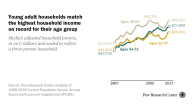
The median adjusted income in a household headed by a Millennial was $69,000 in 2017. The previous peak for households headed by people ages 22 to 37 was in 2000.
Looking for a new religious congregation is common in the U.S. But how likely Americans are to look for a new church varies by their education and income levels.
Although most Americans back a higher minimum wage, wide disparities in local living costs make finding an appropriate rate difficult.
While the size of the U.S. middle class remained relatively stable between 2002 and 2016, financial gains for middle-income Americans were modest compared with those of higher-income households.
Despite some ups and downs over the past several decades, today’s real average wage in the U.S. has about the same purchasing power it did 40 years ago. And most of what wage gains there have been have flowed to the highest-paid tier of workers.