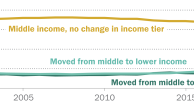
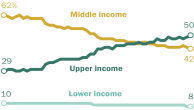
Black and Hispanic Americans, those with less education are more likely to fall out of the middle class each year
In the United States, the transience of economic status varies significantly across racial and ethnic groups and by level of education.
Numbers, Facts and Trends Shaping Your World
All
Publications
In the United States, the transience of economic status varies significantly across racial and ethnic groups and by level of education.
The share of adults who live in middle-class households fell from 61% in 1971 to 50% in 2021, according to a new analysis.
Nearly one-in-five middle-income families report receiving unemployment benefits in 2020.
The gender wage gap is narrower among younger workers nationally, and the gap varies across geographical areas.
Workers who quit a job in 2021 say low pay (63%), no opportunities for advancement (63%) and feeling disrespected at work (57%) were reasons why.
Fewer than half of Black adults say they have a three-month emergency fund, and some have taken multiple jobs to make ends meet.
Immigrants – particularly those from African nations – are a growing share of the U.S. Black population.
American workers in some sectors and industries are seeing far smaller wage gains than those in others.
On key economic outcomes, single adults at prime working age increasingly lag behind those who are married or cohabiting
Earnings overall have held steady through the pandemic in part because lower-wage workers experienced steeper job losses.
Notifications