

Hindus and Jews are much more likely to have a four-year college degree than Americans in other religious groups, according to Pew Research Center’s 2023-24 Religious Landscape Study (RLS).
Seven-in-ten Hindus and 65% of Jews have a bachelor’s degree or more education. That compares with 35% of U.S. adults overall.

| group | Have a bachelor’s degree or more | |
|---|---|---|
| All U.S. adults | all | 35 |
| Hindu | other groups | 70 |
| Jewish | other groups | 65 |
| Orthodox Christian | other groups | 45 |
| Muslim | other groups | 44 |
| Buddhist | other groups | 41 |
| Mainline Protestant | other groups | 40 |
| Religiously unaffiliated | other groups | 37 |
| Latter-day Saint (Mormon) | other groups | 36 |
| Catholic | other groups | 35 |
| Evangelical Protestant | other groups | 29 |
| Historically Black Protestant | other groups | 24 |
On the other end of the spectrum, lower shares of evangelical Protestants (29%) and members of historically Black Protestant denominations (24%) hold college degrees. The shares of college graduates for several other religious groups range from 35% to 45%.
Educational differences by Christian subgroups
Because the RLS is a huge survey, with 36,908 respondents, we can also look at differences within larger religious traditions. For example, we can look at 11 types of evangelical Protestantism, seven groups within mainline Protestantism and two denominations in the historically Black Protestant tradition.
However, the survey did not have enough people in some smaller denominations to show their results separately. For instance, we do not have enough respondents to show separate results for the Church of the Nazarene (in the evangelical tradition), the Disciples of Christ (in the mainline tradition) or the African Methodist Episcopal Church (in the historically Black Protestant tradition).
Evangelical Protestants
Among all evangelical Protestants, 29% have a college degree or more, which is slightly below the national average.
Among the evangelical denominations we could analyze, those with the highest shares of college graduates were the Global Methodist Church (57%) and the Presbyterian Church in America (57%). At the other end of the spectrum, 18% of people in the Assemblies of God have a college degree.
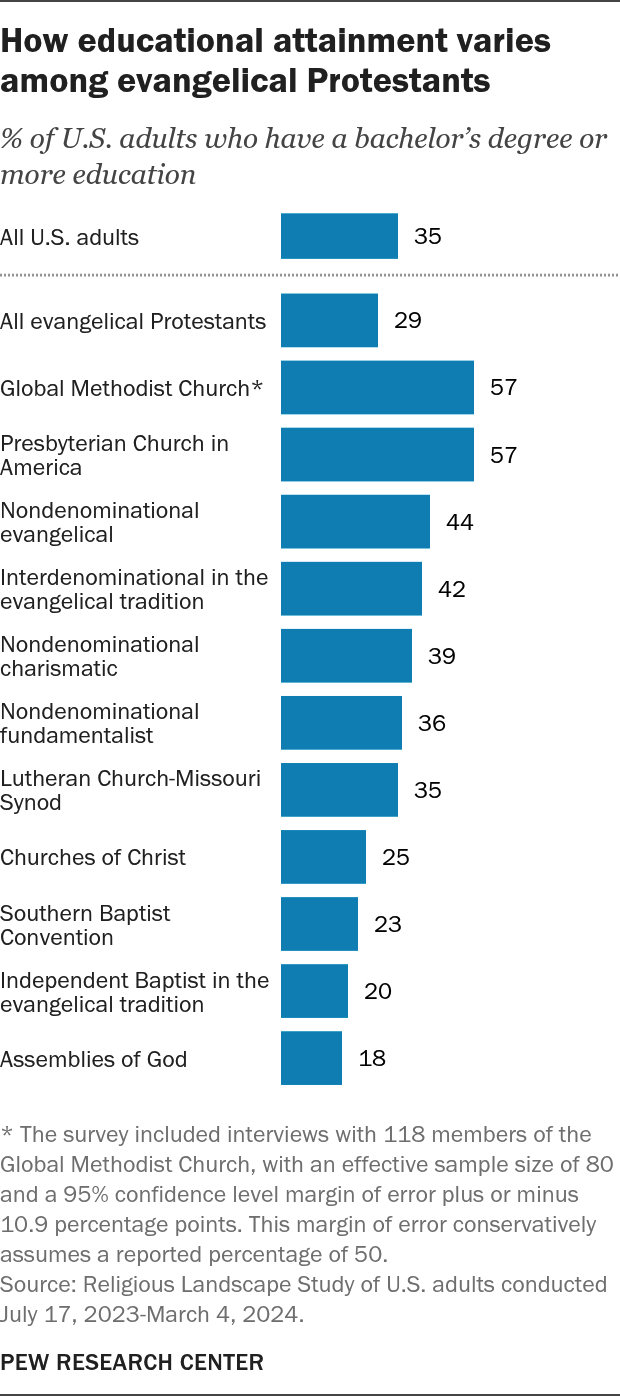
| other | College degree or more | |
|---|---|---|
| All U.S. adults | all | 35 |
| All evangelical Protestants | other groups | 29 |
| Global Methodist Church* | other groups | 57 |
| Presbyterian Church in America | other groups | 57 |
| Nondenominational evangelical | other groups | 44 |
| Interdenominational in the evangelical tradition | other groups | 42 |
| Nondenominational charismatic | other groups | 39 |
| Nondenominational fundamentalist | other groups | 36 |
| Lutheran Church-Missouri Synod | other groups | 35 |
| Churches of Christ | other groups | 25 |
| Southern Baptist Convention | other groups | 23 |
| Independent Baptist in the evangelical tradition | other groups | 20 |
| Assemblies of God | other groups | 18 |
Mainline Protestants
Four-in-ten mainline Protestants are college graduates. That’s slightly higher than the share among U.S. adults overall.
The share of college graduates is especially high among members of the Episcopal Church (67%). Far fewer people who identify with the American Baptist Churches USA are college graduates (13%).
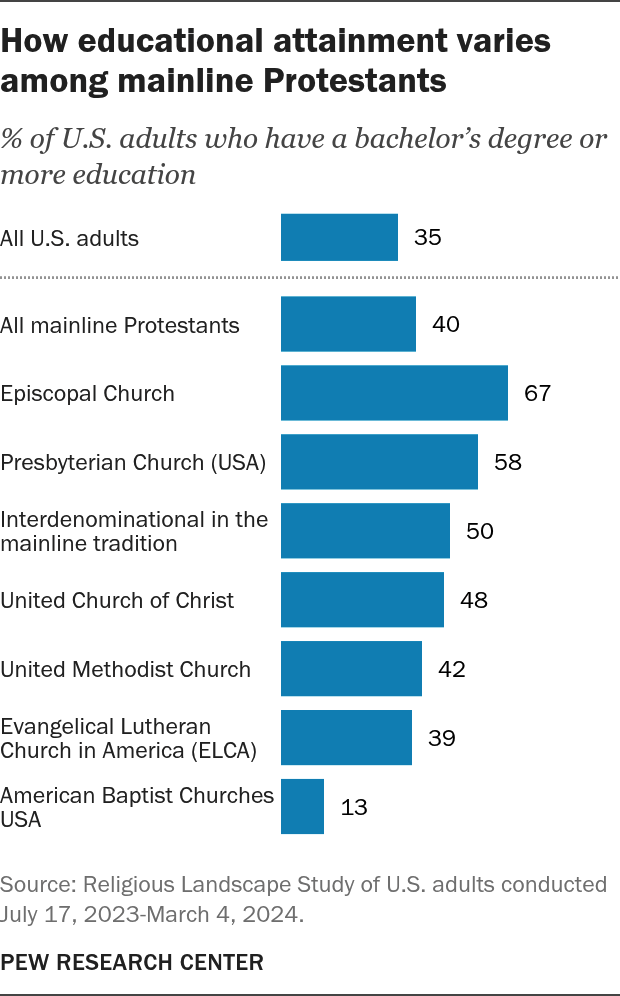
| group | College degree or more | |
|---|---|---|
| All U.S. adults | all | 35 |
| All mainline Protestants | other groups | 40 |
| Episcopal Church | other groups | 67 |
| Presbyterian Church (USA) | other groups | 58 |
| Interdenominational in the mainline tradition | other groups | 50 |
| United Church of Christ | other groups | 48 |
| United Methodist Church | other groups | 42 |
| Evangelical Lutheran Church in America (ELCA) | other groups | 39 |
| American Baptist Churches USA | other groups | 13 |
Members of historically Black Protestant churches

| group | College degree or more | |
|---|---|---|
| All U.S. adults | all | 35 |
| All members of historically Black Protestant churches | other groups | 24 |
| National Baptist Convention, USA | other groups | 24 |
| Church of God in Christ (COGIC)* | other groups | 10 |
About a quarter of members of historically Black Protestant churches (24%) hold a college degree or more. That’s lower than the national average.
Looking at some of the largest denominations in the historically Black Protestant tradition, about a quarter of members of the National Baptist Convention, USA, are college graduates (24%), as are 10% of adults in the Church of God in Christ (COGIC).
Catholics
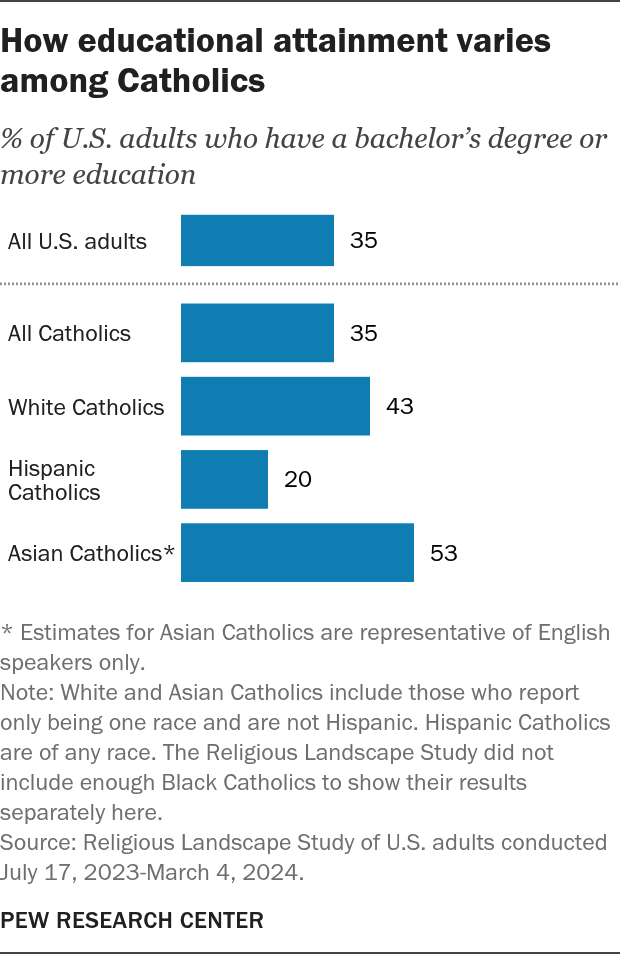
Note: White and Asian Catholics include those who report only being one race and are not Hispanic. Hispanic Catholics are of any race. The Religious Landscape Study did not include enough Black Catholics to show their results separately here.
| group | College degree or more | |
|---|---|---|
| All U.S. adults | all | 35 |
| All Catholics | other groups | 35 |
| White Catholics | other groups | 43 |
| Hispanic Catholics | other groups | 20 |
| Asian Catholics* | other groups | 53 |
Note: White and Asian Catholics include those who report only being one race and are not Hispanic. Hispanic Catholics are of any race. The Religious Landscape Study did not include enough Black Catholics to show their results separately here.
Among U.S. Catholics, 35% are college graduates, matching the share for all U.S. adults. Our previous research has found that Catholics’ social and political views and religious practices tend to vary by race and ethnicity, and the same is true when it comes to education.
For example, 53% of Asian Catholics have a bachelor’s degree or more education, as do 43% of White Catholics. That compares with 20% of Hispanic Catholics.
While the RLS did not include enough Black Catholics to show their results separately, analysis of 2019-20 Pew Research Center survey data shows that 38% of Black Catholics (defined as those who report being one race and are not Hispanic) were college-educated.
Educational differences among the religiously unaffiliated
| group | College degree or more | Some college | High school degree | Less than high school | |
|---|---|---|---|---|---|
| All U.S. adults | all | 35 | 30 | 28 | 7 |
| All religiously unaffiliated | unaffiliated | 37 | 31 | 26 | 6 |
| Agnostic | unaffiliated | 53 | 33 | 13 | 1 |
| Atheist | unaffiliated | 48 | 30 | 21 | 1 |
| Nothing in particular | unaffiliated | 29 | 31 | 31 | 8 |
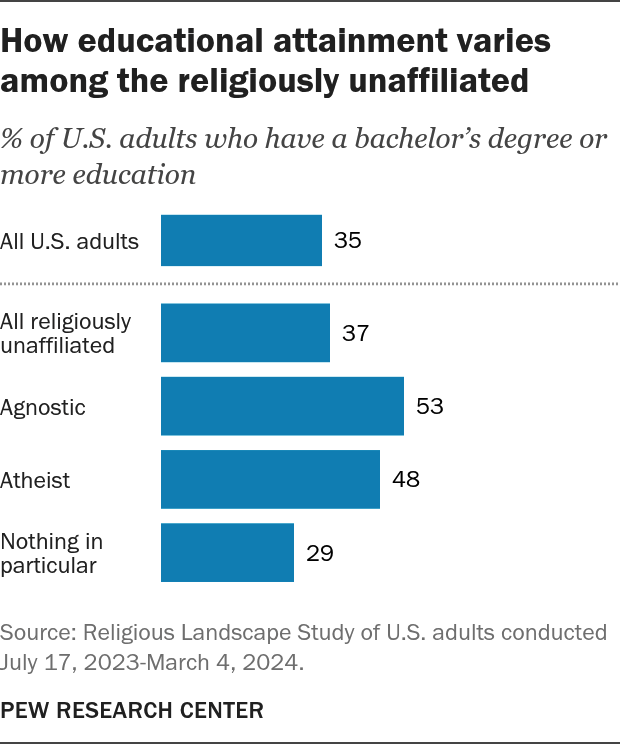
Among religiously unaffiliated Americans, there are notable differences between those who say they are atheists or agnostics and those who describe their religion as “nothing in particular.”
Agnostics (53%) and atheists (48%) are more likely than U.S. adults overall to have completed college. By contrast, people who describe their religion as “nothing in particular” (29%) are less likely than Americans overall to have a bachelor’s degree.
Note: Refer to our detailed table for more information on educational attainment by religious group. This is an update of a post originally published Nov. 4, 2016. That post was written by former senior researcher Caryle Murphy.