So far this year, at least four states have redrawn their congressional districts with the stated goal of advantaging one party or the other in the 2026 midterms. Several others are exploring similar moves.
With this unprecedented wave of voluntary midcycle redistricting in the United States, we wondered how redistricting works in other democracies – and whether the process is as inherently political as it is in the U.S.
We analyzed how 107 democracies elect their national legislatures (mostly unicameral, or the “lower house” in bicameral systems). We found that only one other country uses the same redistricting approach as the U.S. – that is, single-member districts drawn mainly by state legislatures. That country is the Federated States of Micronesia, with a population of around 100,000, which was formerly administered by the U.S. under a United Nations trusteeship.
(Read “How we did this” for details on how we defined democracies and other key concepts in this analysis.)
How districts are used in other countries
For starters, many democracies around the world don’t use single-member districts, at least not to the same extent as the U.S., where they’re universal in both Congress and state legislatures. Single-member districts are those in which one lawmaker is elected to represent a specific geographic area.
Among the 107 democracies we examined, 22 (or 21%) elect all their national legislators from such districts. Of the remaining places:
- 20 elect a substantial share of lawmakers from single-member districts and the rest in some other way, such as from multimember districts or by a national vote.
- 52 use multimember districts primarily or exclusively.
- 13 elect all their lawmakers at-large nationwide.
Of the 42 democracies that use single-member districts exclusively or substantially, all but nine have historical links to either the United Kingdom, the U.S. or one of their former colonies.
Source: Pew Research Center research.
| ISO-3 | ISO | Country* | Category |
|---|---|---|---|
| ALB | 008 | Albania | Primarily use multimember districts |
| AND | 020 | Andorra | Primarily use multimember districts |
| ATG | 028 | Antigua and Barbuda | Make substantial use of single-member districts |
| ARG | 032 | Argentina | Primarily use multimember districts |
| ARM | 051 | Armenia | Employ a nationwide vote |
| AUS | 036 | Australia | Make substantial use of single-member districts |
| AUT | 040 | Austria | Primarily use multimember districts |
| BHS | 044 | Bahamas | Make substantial use of single-member districts |
| BRB | 052 | Barbados | Make substantial use of single-member districts |
| BEL | 056 | Belgium | Primarily use multimember districts |
| BLZ | 084 | Belize | Make substantial use of single-member districts |
| BTN | 064 | Bhutan | Make substantial use of single-member districts |
| BOL | 068 | Bolivia | Make substantial use of single-member districts |
| BWA | 072 | Botswana | Make substantial use of single-member districts |
| BRA | 076 | Brazil | Primarily use multimember districts |
| BGR | 100 | Bulgaria | Primarily use multimember districts |
| CPV | 132 | Cape Verde | Primarily use multimember districts |
| CAN | 124 | Canada | Make substantial use of single-member districts |
| CHL | 152 | Chile | Primarily use multimember districts |
| COL | 170 | Colombia | Primarily use multimember districts |
| CRI | 188 | Costa Rica | Primarily use multimember districts |
| HRV | 191 | Croatia | Primarily use multimember districts |
| CYP | 196 | Cyprus | Primarily use multimember districts |
| CZE | 203 | Czech Republic | Primarily use multimember districts |
| DNK | 208 | Denmark | Primarily use multimember districts |
| DMA | 212 | Dominica | Make substantial use of single-member districts |
| DOM | 214 | Dominican Republic | Primarily use multimember districts |
| TLS | 626 | East Timor | Employ a nationwide vote |
| ECU | 218 | Ecuador | Primarily use multimember districts |
| EST | 233 | Estonia | Primarily use multimember districts |
| FJI | 242 | Fiji | Employ a nationwide vote |
| FIN | 246 | Finland | Primarily use multimember districts |
| FRA | 250 | France | Make substantial use of single-member districts |
| DEU | 276 | Germany | Make substantial use of single-member districts |
| GHA | 288 | Ghana | Make substantial use of single-member districts |
| GRC | 300 | Greece | Primarily use multimember districts |
| GRD | 308 | Grenada | Make substantial use of single-member districts |
| GUY | 328 | Guyana | Primarily use multimember districts |
| HUN | 348 | Hungary | Make substantial use of single-member districts |
| ISL | 352 | Iceland | Primarily use multimember districts |
| IND | 356 | India | Make substantial use of single-member districts |
| IRL | 372 | Ireland | Primarily use multimember districts |
| ISR | 376 | Israel | Employ a nationwide vote |
| ITA | 380 | Italy | Primarily use multimember districts |
| JAM | 388 | Jamaica | Make substantial use of single-member districts |
| JPN | 392 | Japan | Make substantial use of single-member districts |
| KIR | 296 | Kiribati | Primarily use multimember districts |
| XKX | Kosovo | Employ a nationwide vote | |
| LVA | 428 | Latvia | Primarily use multimember districts |
| LSO | 426 | Lesotho | Make substantial use of single-member districts |
| LBR | 430 | Liberia | Make substantial use of single-member districts |
| LIE | 438 | Liechtenstein | Primarily use multimember districts |
| LTU | 440 | Lithuania | Make substantial use of single-member districts |
| LUX | 442 | Luxembourg | Primarily use multimember districts |
| MWI | 454 | Malawi | Make substantial use of single-member districts |
| MYS | 458 | Malaysia | Make substantial use of single-member districts |
| MLT | 470 | Malta | Primarily use multimember districts |
| MHL | 584 | Marshall Islands | Make substantial use of single-member districts |
| MUS | 480 | Mauritius | Primarily use multimember districts |
| MEX | 484 | Mexico | Make substantial use of single-member districts |
| FSM | 583 | Micronesia, Federated States | Make substantial use of single-member districts |
| MDA | 498 | Moldova | Employ a nationwide vote |
| MCO | 492 | Monaco | Employ a nationwide vote |
| MNG | 496 | Mongolia | Primarily use multimember districts |
| MNE | 499 | Montenegro | Employ a nationwide vote |
| NAM | 516 | Namibia | Employ a nationwide vote |
| NRU | 520 | Nauru | Primarily use multimember districts |
| NPL | 524 | Nepal | Make substantial use of single-member districts |
| NLD | 528 | Netherlands | Employ a nationwide vote |
| NZL | 554 | New Zealand | Make substantial use of single-member districts |
| MKD | 807 | North Macedonia | Primarily use multimember districts |
| CYP | 196 | Northern Cyprus | Primarily use multimember districts |
| NOR | 578 | Norway | Primarily use multimember districts |
| PLW | 585 | Palau | Make substantial use of single-member districts |
| PAN | 591 | Panama | Primarily use multimember districts |
| PRY | 600 | Paraguay | Primarily use multimember districts |
| PER | 604 | Peru | Primarily use multimember districts |
| PHL | 608 | Philippines | Make substantial use of single-member districts |
| POL | 616 | Poland | Primarily use multimember districts |
| PRT | 620 | Portugal | Primarily use multimember districts |
| ROU | 642 | Romania | Primarily use multimember districts |
| WSM | 882 | Samoa | Make substantial use of single-member districts |
| SMR | 674 | San Marino | Employ a nationwide vote |
| STP | 678 | Sao Tome and Principe | Primarily use multimember districts |
| SEN | 686 | Senegal | Primarily use multimember districts |
| SYC | 690 | Seychelles | Make substantial use of single-member districts |
| SVK | 703 | Slovakia | Employ a nationwide vote |
| SVN | 705 | Slovenia | Primarily use multimember districts |
| SLB | 090 | Solomon Islands | Make substantial use of single-member districts |
| ZAF | 710 | South Africa | Primarily use multimember districts |
| KOR | 410 | South Korea | Make substantial use of single-member districts |
| ESP | 724 | Spain | Primarily use multimember districts |
| LKA | 144 | Sri Lanka | Primarily use multimember districts |
| KNA | 659 | St. Kitts and Nevis | Make substantial use of single-member districts |
| LCA | 662 | St. Lucia | Make substantial use of single-member districts |
| VCT | 670 | St. Vincent and the Grenadines | Make substantial use of single-member districts |
| SUR | 740 | Suriname | Employ a nationwide vote |
| SWE | 752 | Sweden | Primarily use multimember districts |
| CHE | 756 | Switzerland | Primarily use multimember districts |
| TWN | 158 | Taiwan | Make substantial use of single-member districts |
| TON | 776 | Tonga | Make substantial use of single-member districts |
| TTO | 780 | Trinidad and Tobago | Make substantial use of single-member districts |
| TUV | 798 | Tuvalu | Primarily use multimember districts |
| GBR | 826 | United Kingdom | Make substantial use of single-member districts |
| USA | 840 | United States | Make substantial use of single-member districts |
| URY | 858 | Uruguay | Primarily use multimember districts |
| VUT | 548 | Vanuatu | Primarily use multimember districts |
Source: Pew Research Center research.
Why does the type of district matter?
Single-member districts are closely associated with “first past the post” electoral systems, where the candidate with the most votes – even if less than a majority – wins the seat. Indeed, of the 42 primarily or exclusively single-member district countries referred to above, 39 use this kind of system, including the U.S. (The other three use either two-round or ranked-choice voting systems.)
As a result, how single-member districts are drawn – whether they have reasonably equal populations, whether they include or exclude certain areas or discrete population groups, and so on – can dramatically affect election outcomes. Single-member districts also are especially vulnerable to gerrymandering, where boundaries are intentionally manipulated to favor one party or interest group over another.
Multimember districts, by contrast, are typical of electoral systems that use proportional representation. In fact, of the 52 democracies that rely mainly on multimember districts, 42 elect all their lawmakers through some sort of proportional representation system. Two others, Italy and Panama, employ proportional representation as part of a mixed system. (The other eight multimember countries use a variety of other voting systems.)
Multimember districts tend to be fewer and larger than single-member districts. Countries using such districts can account for population shifts simply by changing how many legislators a district elects, rather than redrawing it. Voters in this type of system also generally choose parties rather than individual candidates, so district boundaries tend to matter less than the number of lawmakers each district elects.
How countries draw single-member districts
In the U.S., 44 states currently have more than one member of the House of Representatives and draw districts for them, normally once a decade after each census. The other six states have only one representative, elected at large.
Of the states with more than one House district, most (25) give their legislatures sole authority for redistricting, while commissions draw the lines in nine states. In the other 10 states, commissions and legislatures share the job to varying degrees.
Note: California has temporarily bypassed its redistricting commission, pursuant to ballot measure approved November 2025. A legislative-drawn map will be in effect through the 2030 election. Refer to the “Data” tab for more information.
Source: Ballotpedia, All About Redistricting, Pew Research Center research.
| Name | FIPS | Primary authority | Redistricted in 2025? |
|---|---|---|---|
| Alabama | 01 | Legislature | No |
| Alaska | 02 | None (1 district) | N/A |
| Arizona | 04 | Commission | No |
| Arkansas | 05 | Legislature | No |
| California | 06 | Commission | Voluntarily, to give one party or the other an electoral advantage |
| Colorado | 08 | Commission | No |
| Connecticut | 09 | Shared | No |
| Delaware | 10 | None (1 district) | N/A |
| Florida | 12 | Legislature | No |
| Georgia | 13 | Legislature | No |
| Hawaii | 15 | Commission | No |
| Idaho | 16 | Commission | No |
| Illinois | 17 | Legislature | No |
| Indiana | 18 | Shared | No |
| Iowa | 19 | Shared | No |
| Kansas | 20 | Legislature | No |
| Kentucky | 21 | Legislature | No |
| Louisiana | 22 | Legislature | No |
| Maine | 23 | Shared | No |
| Maryland | 24 | Legislature | No |
| Massachusetts | 25 | Legislature | No |
| Michigan | 26 | Commission | No |
| Minnesota | 27 | Legislature | No |
| Mississippi | 28 | Legislature | No |
| Missouri | 29 | Legislature | Voluntarily, to give one party or the other an electoral advantage |
| Montana | 30 | Commission | No |
| Nebraska | 31 | Legislature | No |
| Nevada | 32 | Legislature | No |
| New Hampshire | 33 | Legislature | No |
| New Jersey | 34 | Commission | No |
| New Mexico | 35 | Shared | No |
| New York | 36 | Shared | No |
| North Carolina | 37 | Legislature | Voluntarily, to give one party or the other an electoral advantage |
| North Dakota | 38 | None (1 district) | N/A |
| Ohio | 39 | Shared | Pursuant to state law or a court order |
| Oklahoma | 40 | Legislature | No |
| Oregon | 41 | Legislature | No |
| Pennsylvania | 42 | Legislature | No |
| Rhode Island | 44 | Shared | No |
| South Carolina | 45 | Legislature | No |
| South Dakota | 46 | None (1 district) | N/A |
| Tennessee | 47 | Legislature | No |
| Texas | 48 | Legislature | Voluntarily, to give one party or the other an electoral advantage |
| Utah | 49 | Shared | Pursuant to state law or a court order |
| Vermont | 50 | None (1 district) | N/A |
| Virginia | 51 | Shared | No |
| Washington | 53 | Commission | No |
| West Virginia | 54 | Legislature | No |
| Wisconsin | 55 | Legislature | No |
| Wyoming | 56 | None (1 district) | N/A |
Note: California has temporarily bypassed its redistricting commission, pursuant to ballot measure approved November 2025. A legislative-drawn map will be in effect through the 2030 election. Refer to the “Data” tab for more information.
Source: Ballotpedia, All About Redistricting, Pew Research Center research.
This isn’t how it’s done in most other places. In more than two-thirds of the democracies that heavily rely on single-member districts (29 of 42), special commissions or national election agencies have primary responsibility for drawing the lines. Lawmakers’ role, if any, is limited.
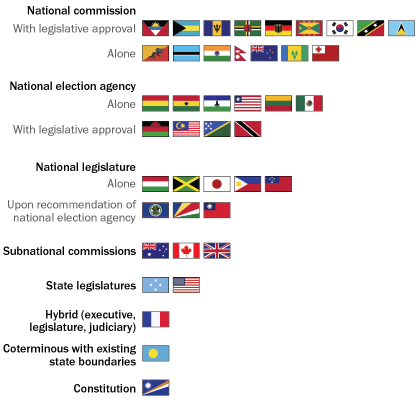
| Country* | Primary delimitation authority | Notes |
|---|---|---|
| Antigua and Barbuda | National commission (with legislative approval) | |
| Australia | Subnational commissions | |
| Bahamas | National commission (with legislative approval) | |
| Barbados | National commission (with legislative approval) | |
| Belize | National legislature (upon recommendation of national election agency) | |
| Bhutan | National commission (alone) | |
| Bolivia | National election agency (alone) | |
| Botswana | National commission (alone) | |
| Canada | Subnational commissions | |
| Dominica | National commission (with legislative approval) | |
| France | Hybrid (executive, legislature, judiciary) | |
| Germany | National commission (with legislative approval) | |
| Ghana | National election agency (alone) | |
| Grenada | National commission (with legislative approval) | |
| Hungary | National legislature (alone) | |
| India | National commission (alone) | No actual redistricting has occurred since early 2000s. |
| Jamaica | National legislature (alone) | |
| Japan | National legislature (alone) | |
| Lesotho | National election agency (alone) | |
| Liberia | National election agency (alone) | |
| Lithuania | National election agency (alone) | |
| Malawi | National election agency (with legislative approval) | |
| Malaysia | National election agency (with legislative approval) | |
| Marshall Islands | Constitution | |
| Mexico | National election agency (alone) | |
| Micronesia, Fed. States | State legislatures | |
| Nepal | National commission (alone) | |
| New Zealand | National commission (alone) | |
| Palau | Coterminous with existing state boundaries | |
| Philippines | National legislature (alone) | The Philippine Congress has not passed a general reapportionment law since 1987, though many individual districts have been created and redrawn ad hoc. |
| Samoa | National legislature (alone) | |
| Seychelles | National legislature (upon recommendation of national election agency) | |
| Solomon Islands | National election agency (with legislative approval) | |
| South Korea | National commission (with legislative approval) | |
| St. Kitts and Nevis | National commission (with legislative approval) | |
| St. Lucia | National commission (with legislative approval) | |
| St. Vincent and the Grenadines | National commission (alone) | |
| Taiwan | National legislature (upon recommendation of national election agency) | |
| Tonga | National commission (alone) | |
| Trinidad and Tobago | National election agency (with legislative approval) | |
| United Kingdom | Subnational commissions | |
| United States | State legislatures | In most U.S. states the legislature has ultimate authority over district boundaries. |
In the United Kingdom, for instance, the government appoints boundary commissions for England, Scotland, Wales and Northern Ireland. The four commissions, operating independently of the government, review the boundaries of the UK’s 650 parliamentary districts (called “constituencies”) every eight years. Their recommendations are implemented by government order; since 2020, Parliament itself hasn’t played any direct role.
Other countries use similar systems as the UK:
- In Canada, commissions in each of the country’s 10 provinces redraw the 343 election districts (called “ridings”) for the House of Commons.
- In New Zealand, where 71 of the 120 or so members of the House of Representatives are elected from single-member districts, an independent Representation Commission redraws boundaries for the entire nation.
- In Mexico, where 300 of the 500 members of the Chamber of Deputies are chosen from single-member districts, drawing those districts is one of the tasks of the National Electoral Institute, the country’s highest election authority.
In eight of the 42 countries that make substantial use of single-member districts, the national legislature sets district boundaries by law. Three do so upon the recommendation of the national election agency, while two – the U.S. and the Federated States of Micronesia – give the responsibility to states. (In addition to sharing 10 district seats, each of Micronesia’s four states elects one legislator at large.)
The other three countries in this group use different methods: Palau has each of its 16 states elect one lawmaker. The Marshall Islands sets district boundaries in its constitution. And France employs a hybrid system involving all three branches of the national government.
Having a commission in law, though, doesn’t always mean it operates in practice. For example, after every decennial census, India’s Delimitation Commission is supposed to reallocate seats in the lower house of Parliament among the states and redraw district boundaries. However, both procedures have been repeatedly delayed: Boundaries were last redrawn in the early 2000s, based on the 2001 census, and the current seat allocation is based on the 1971 census. Seats won’t be reallocated or districts redrawn until after the next Indian census, currently set for 2027.
How countries draw multimember districts
Nearly half – 24 – of the 52 multimember-centric democracies base their districts on existing states, provinces or administrative divisions. Two others have districts based on historic provinces (Finland) or counties (Norway), though the precise boundaries are set otherwise.
Twenty-one multimember countries specify their district divisions in their national electoral laws. In most of those (17), the legislature can act alone. In two (Panama and Kiribati), the legislature acts on the recommendation of the national election agency. And in two others (Mauritius and Ireland), it acts on the recommendation of an independent commission.
Among the remaining multimember countries:
- 3 specify district composition in their constitutions.
- 2 have their national election agencies set boundaries (alone in Vanuatu, with legislative approval in Malta).
- A different government agency draws the lines in Norway.
- Sri Lanka uses a boundary commission.
Allocating seats in multimember district countries
Since multimember countries can account for population changes by adjusting the number of legislators a district elects (rather than redrawing its boundaries), we also looked at how the 52 multimember democracies decide how many lawmakers each district gets to choose.
In 20 countries, seats are allocated via electoral laws. The national legislature can change those allocations on its own in 17 countries. In the other three, it acts on the recommendation of the national elections agency.
Three countries specify seat allocations in their constitutions, while 15 others include population-based allocation formulas in their constitutions or electoral law. (Some, but not all, also specify which agency or official actually makes the calculations.)
In 10 countries, the national elections agency allots the seats (also based on population, but without reference to a specific formula or method). In three countries, the executive branch allocates seats, and in Sao Tome and Principe, the job falls to the Constitutional Court.