
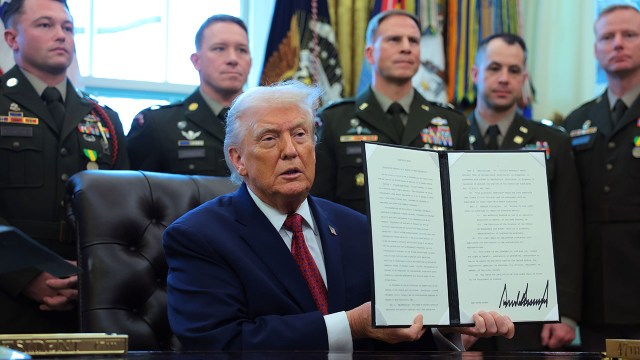
Less than a year into his second term, President Donald Trump has issued more executive orders than he did in his entire first term.
Note: Data as of Dec. 15, 2025. Executive orders before 1937 were often not clearly numbered or categorized and are thus excluded from this analysis.
| President | Executive order in current term | Total executive orders by term |
|---|---|---|
| Trump (2025-present) | 221 | |
| Biden (2021-2025) | 162 | |
| Trump (2017-2021) | 220 | |
| Obama (2013-2017) | 129 | |
| Obama (2009-2013) | 147 | |
| G.W. Bush (2005-2009) | 118 | |
| G.W. Bush (2001-2005) | 173 | |
| Clinton (1997-2001) | 164 | |
| Clinton (1993-1997) | 200 | |
| H.W. Bush (1989-1993) | 166 | |
| Reagan (1985-1989) | 168 | |
| Reagan (1981-1985) | 213 | |
| Carter (1977-1981) | 320 | |
| Ford (1974-1977)* | 169 | |
| Nixon (1973-1974) | 99 | |
| Nixon (1969-1973) | 247 | |
| Johnson (1965-1969) | 260 | |
| Johnson (1963-1965)* | 65 | |
| Kennedy (1961-1963) | 214 | |
| Eisenhower (1957-1961) | 218 | |
| Eisenhower (1953-1957) | 266 | |
| Truman (1949-1953) | 403 | |
| Truman (1945-1949)* | 504 | |
| F.D. Roosevelt (1945) | 22 | |
| F.D. Roosevelt (1941-1945) | 884 | |
| F.D. Roosevelt (1937-1941) | 1112 |
Note: Data as of Dec. 15, 2025. Executive orders before 1937 were often not clearly numbered or categorized and are thus excluded from this analysis.
As of Dec. 15, 2025, Trump has issued 221 executive orders since returning to the White House. That’s one more than he did during his first four years in office, according to the American Presidency Project, an online database of presidential documents.
So far, Trump’s second-term executive orders have often focused on topics including government operations, foreign relations and defense, energy, and immigration. Many orders have been challenged in the courts, raising questions about the legal bounds of presidential power. For example, the Supreme Court is weighing the legality of Trump’s use of executive orders to impose sweeping global tariffs.
Since George Washington’s time, presidents have used executive orders to set out policy goals and direct the activities of administration officials. These orders have the force of law as long as they align with the presidential powers spelled out in the Constitution or delegated by Congress. But executive orders can be modified or revoked at any time by a current or future president. In some cases, they can be altered or reversed by congressional action.
How Trump compares with other presidents in total executive orders
If he keeps up his current pace, Trump could issue far more executive orders in his second term than most recent presidents have in a four-year period.
From Franklin D. Roosevelt’s second term through Joe Biden’s administration, recent presidents have issued a median of 200 executive orders per term. (These calculations include presidential terms that lasted less than four years, such as Lyndon B. Johnson’s 14-month first term following John F. Kennedy’s assassination.) Trump surpassed that median in the first eight months of his second term.
Still, Trump has a long way to go to match the 1,112 executive orders that FDR issued in his second term (1937-1941).
How Trump compares with other presidents in early executive orders
Note: Data as of Dec. 15, 2025. Executive orders before 1937 were often not clearly numbered or categorized and are thus excluded from this analysis.
| President | Current term executive orders | Year 1 executive orders |
|---|---|---|
| Trump (2025) | 221 | |
| Biden (2021) | 77 | |
| Trump (2017) | 58 | |
| Obama (2013) | 21 | |
| Obama (2009) | 41 | |
| G.W. Bush (2005) | 25 | |
| G.W. Bush (2001) | 56 | |
| Clinton (1997) | 38 | |
| Clinton (1993) | 59 | |
| H.W. Bush (1989) | 33 | |
| Reagan (1985) | 46 | |
| Reagan (1981) | 53 | |
| Carter (1977) | 68 | |
| Ford (1974)* | 77 | |
| Nixon (1973) | 65 | |
| Nixon (1969) | 53 | |
| Johnson (1965) | 75 | |
| Johnson (1963)* | 61 | |
| Kennedy (1961) | 75 | |
| Eisenhower (1957) | 53 | |
| Eisenhower (1953) | 83 | |
| Truman (1949) | 66 | |
| Truman (1945)* | 178 | |
| F.D. Roosevelt (1945) | 22 | |
| F.D. Roosevelt (1941) | 387 | |
| F.D. Roosevelt (1937) | 258 |
Note: Data as of Dec. 15, 2025. Executive orders before 1937 were often not clearly numbered or categorized and are thus excluded from this analysis.
The 221 executive orders that Trump has issued so far in his second term are more than three times the 58 issued in the first year of his first term. He issued 26 on his first day back in office alone.
Before Trump, the last time a president surpassed 100 executive orders in the first year of a term was 1945, when Harry Truman took over the presidency after FDR’s death. (World War II was still underway in 1945, and many of Truman’s orders concerned the war effort.)
How Americans view Trump’s use of executive orders
| Too much | About the right amount | Too little | Not sure | |
|---|---|---|---|---|
| Total | 51 | 27 | 6 | 16 |
| Rep/Lean Rep | 23 | 54 | 7 | 17 |
| Dem/Lean Dem | 80 | 5 | 4 | 11 |
About half of U.S. adults (51%) think Trump is doing too much by executive order, according to a September Pew Research Center survey. Roughly a quarter (27%) say he is doing about the right amount, while 6% say he’s doing too little. Another 16% are not sure.
Democrats and Democratic-leaning independents were more than three times as likely as Republicans and Republican leaners to say Trump was doing too much by executive order (80% vs. 23%). Republicans were much more likely than Democrats to say he was doing the right amount (54% vs. 5%).
How Trump and other presidents have used memoranda and proclamations
Source: “The Document Archive,” American Presidency Project.
| President | Current term memoranda | Current term substantive proclamations | Total memoranda | Total substantive proclamations |
|---|---|---|---|---|
| Trump (2025-present) | 77 | 29 | — | — |
| Biden (2021-2025) | — | — | 258 | 85 |
| Trump (2017-2021) | — | — | 245 | 89 |
| Obama (2013-2017) | — | — | 226 | 65 |
| Obama (2009-2013) | — | — | 237 | 42 |
| G.W. Bush (2005-2009) | — | — | 239 | 57 |
| G.W. Bush (2001-2005) | — | — | 272 | 49 |
| Clinton (1997-2001) | — | — | 340 | 75 |
| Clinton (1993-1997) | — | — | 360 | 65 |
| H.W. Bush (1989-1993) | — | — | 260 | 60 |
| Reagan (1985-1989) | — | — | 151 | 65 |
| Reagan (1981-1985) | — | — | 78 | 48 |
| Carter (1977-1981) | — | — | 213 | 94 |
| Ford (1974-1977)* | — | — | 72 | 35 |
| Nixon (1973-1974) | — | — | 11 | 22 |
| Nixon (1969-1973) | — | — | 58 | 43 |
| Johnson (1965-1969) | — | — | 88 | 54 |
| Johnson (1963-1965)* | — | — | 10 | 17 |
| Kennedy (1961-1963) | — | — | 24 | 48 |
| Eisenhower (1957-1961) | — | — | 78 | 88 |
| Eisenhower (1953-1957) | — | — | 89 | 57 |
| Truman (1949-1953) | — | — | 28 | 93 |
| Truman (1945-1949)* | — | — | 27 | 102 |
| F.D. Roosevelt (1945) | — | — | 0 | 0 |
| F.D. Roosevelt (1941-1945) | — | — | 8 | 43 |
| F.D. Roosevelt (1937-1941) | — | — | 2 | 100 |
Source: “The Document Archive,” American Presidency Project.
Executive orders are just one kind of unilateral presidential action. Presidents also regularly use memoranda or proclamations to make policy changes.
Memoranda are functionally similar to executive orders, but they do not face as many filing requirements. Proclamations are often ceremonial in nature but sometimes are more substantive. In January, for example, Trump issued a proclamation pardoning around 1,500 people charged or convicted in connection with the riot at the U.S. Capitol on Jan. 6, 2021.
Since George H.W. Bush, presidents have regularly issued 200 or more memoranda per term, and an average of about 65 substantive proclamations per term, according to our analysis of American Presidency Project data. (Refer to the “How we did this” box for more on how we defined substantive versus ceremonial proclamations.)
So far this term, Trump has issued 221 executive orders, 77 memoranda and 29 substantive proclamations. In his first term, he issued 220 executive orders, 245 memoranda and 89 substantive proclamations.
