
☀️ Happy Thursday! The Briefing is your guide to the world of news and information. Sign up here!
In today’s email:
- Featured story: News coverage of cruise ship hantavirus outbreak
- New from Pew Research Center: What Americans think it takes to be a good news consumer
- In other news: ABC accuses U.S. government of violating its free speech rights
- Looking ahead: Former BBC chief delivers warning, advice for legacy media
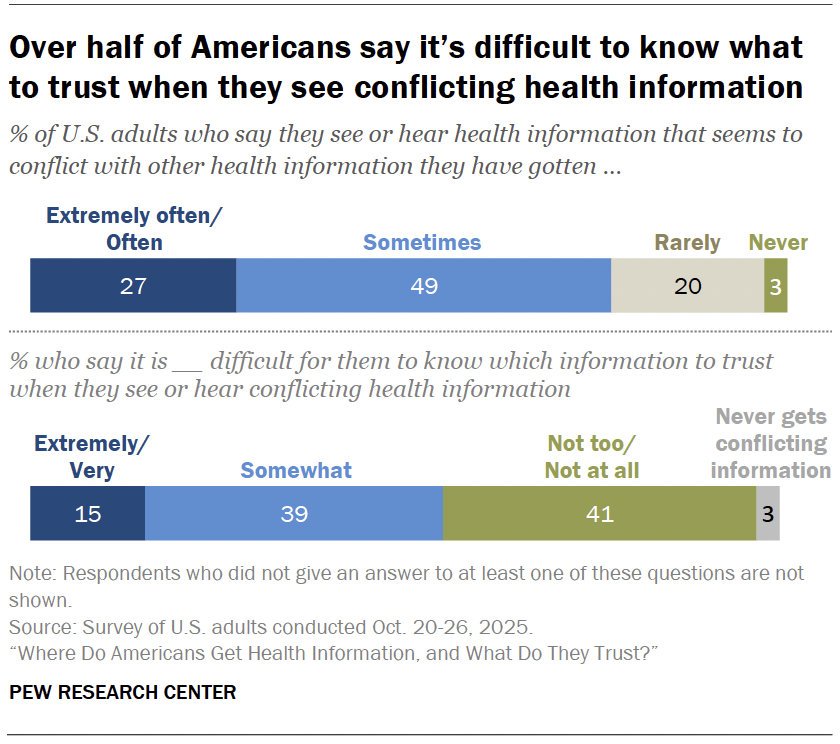
- Chart of the week: Over half of Americans say it’s difficult to know what to trust when they see conflicting health information
🔥 Featured story
A hantavirus outbreak that recently caused multiple deaths on a cruise ship has captured widespread media attention, even as public health officials say it’s extremely unlikely the virus will spread broadly. This discrepancy has prompted some criticism of the news coverage.
While the hantavirus and COVID-19 are very different, the outbreak has evoked memories of the pandemic in 2020. Back in 2024, 54% of Americans said the news media exaggerated the risks of COVID-19, including 38% who said news organizations greatly exaggerated the risks.
Republicans were much more likely than Democrats to say the media exaggerated the risks of COVID-19. They were also much less confident than Democrats that they’d be able to find accurate information in the event of a new health emergency.
Related: Where do Americans get health information, and what do they trust?
🚨 New from Pew Research Center
We asked Americans to describe in their own words what they think it means to be a “good news consumer.” Some of the key themes in the responses include:
- Being discerning or skeptical, including checking the facts on their own
- Following the news regularly and staying informed
- Getting news from only high-quality news sources
- Getting news from multiple sources or different perspectives
Read more in today’s new Pew Research Center analysis from the Pew-Knight Initiative.
📌 In other news
- ABC accuses U.S. government of violating its free speech rights
- Trump seeks subpoenas for reporters to identify leaks related to Iran war
- Israel says it will sue New York Times over column on sexual abuse in prisons
- To keep audiences, news outlets seek sense of ‘belonging’
- CBS News’ Tony Dokoupil fails to get visa to report from China for Trump trip; the number of U.S. journalists in China is falling
- ProPublica launching reporting hub in California
- The Daily Wire faces challenges after layoffs
- After stint at U.S. Agency for Global Media, Kari Lake nominated to be ambassador to Jamaica
- NBC to create game show based on New York Times’ Wordle
📅 Looking ahead
Earlier this week, former BBC chief Deborah Turness delivered a speech on what she called an existential threat faced by traditional news organizations as audiences shift toward personality-driven sources and mediums for news, including podcasts and social media.
Turness argued that traditional media need to regain viewers’ trust with transparency and clarity in the news they report, reconnect with audiences by developing new ways for viewers to get to know journalists, and reinvent how news is produced and delivered to audiences across platforms.
In the U.S., we have witnessed substantial growth in recent years in the share of Americans who say they regularly get news on YouTube, Instagram and TikTok. Young adults are much more likely than their elders to get news from social media and news influencers specifically, and much less likely to turn to a preferred news organization to get more information about breaking news.
📊 Chart of the week
This week’s chart comes from a recent Pew Research Center report about where Americans get their health information. About three-quarters of U.S. adults (76%) say they see conflicting health information at least sometimes, including 27% who see it often or extremely often. And just over half (54%) say they have at least some difficulty knowing which information to trust when this happens.
👋 That’s all for this week.
The Briefing is compiled by Pew Research Center staff, including Naomi Forman-Katz, Christopher St. Aubin, Joanne Haner, and Sawyer Reed. It is edited by Michael Lipka and copy edited by David Kent.
Do you like this newsletter? Email us at info@pewresearch.org or fill out this two-question survey to tell us what you think.
