
☀️ Happy Thursday! The Briefing is your guide to the world of news and information. Sign up here!
In today’s email:
- Featured story: Fake AI images and videos blur the reality of Iran war
- In other news: Federal judge rules Kari Lake violated law in actions toward Voice of America
- Looking ahead: New production company offers support to creator journalists
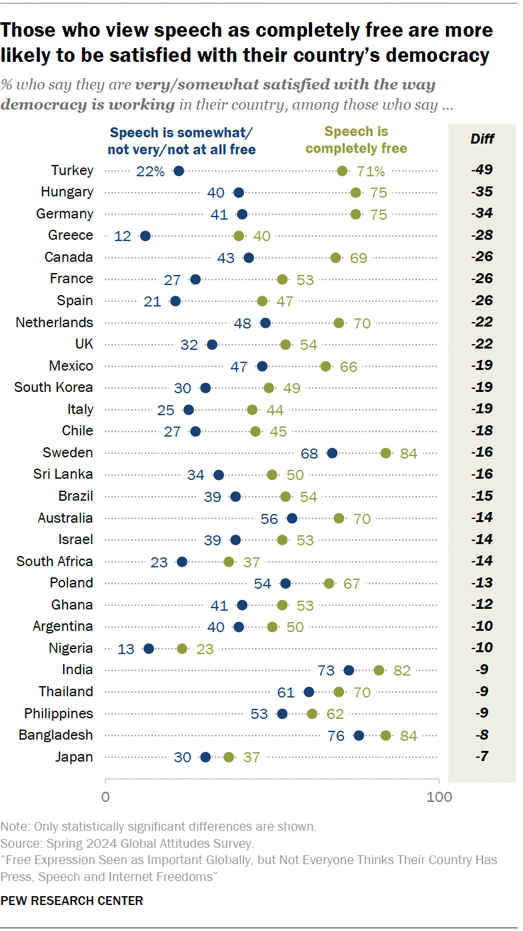
- Chart of the week: The link between freedom of speech and satisfaction with how democracy is working in many countries
🔥 Featured story
The Iran war is taking place amid rapidly advancing artificial intelligence (AI) technology, which has led to AI-generated fake images and videos spreading on social media. This has added another challenge for news consumers as they try to understand what is happening in Iran, Israel and elsewhere in the Middle East.
As we mentioned in last week’s Briefing, relatively few Americans have a high degree of confidence that they can tell if pictures, videos and text were made by AI. And a 2024 survey found that 66% of Americans were extremely or very concerned about people getting inaccurate information from AI.
More broadly, a majority of U.S. adults (60%) said in 2025 that technology companies should take steps to restrict false information online, even if it limits freedom of information.
📌 In other news
- Federal judge rules Kari Lake acted unlawfully in overseeing Voice of America, nullifies mass layoffs
- Nashville reporter who covered ICE actions detained by ICE
- Pentagon bars photographers from press briefings on the Iran war
- Pentagon officials view Washington Post appeal for news tips about the military as “solicitation” under new media policy
- Federal judge rules that Washington state lawmakers were within their rights to withhold press passes from three conservative media figures
- YouTube expands technology that identifies AI deepfakes to pilot group of government officials, political candidates and journalists
- U.S. Navy violated First Amendment and must provide public access to records of criminal trials, judge rules
- USA Today names new top editor
📅 Looking ahead
Many news influencers and creator journalists tend to operate independently. But a new production company known as Newpress recently launched with the goal of connecting creators and supporting their journalism.
News influencers have become a popular alternative to traditional journalists for many Americans. About one-in-five U.S. adults (21%) say they regularly get news from news influencers on social media, according to a 2025 Center survey, including 38% of those ages 18 to 29.
In a separate study, we asked Americans what it means to be a journalist. About a quarter (26%) say they consider people who make their own videos or posts about news on social media to be journalists, while half of Americans don’t consider these creators to be journalists. Nearly a quarter (23%) say they aren’t sure.
📊 Chart of the week
This week’s chart looks at the link between people’s satisfaction with democracy and feelings about free speech in many countries around the world. Those who say speech is completely free in their country tend to be much more likely than others to say they are very or somewhat satisfied with the way democracy is working in their country.
👋 That’s all for this week.
The Briefing is compiled by Pew Research Center staff, including Naomi Forman-Katz, Christopher St. Aubin, Joanne Haner and Sawyer Reed. It is edited by Michael Lipka and copy edited by Mia Hennen.
Do you like this newsletter? Email us at info@pewresearch.org or fill out this two-question survey to tell us what you think.
